

Philosopher · Age of revolutions and empire · Germany
Karl Marx
1818–1883
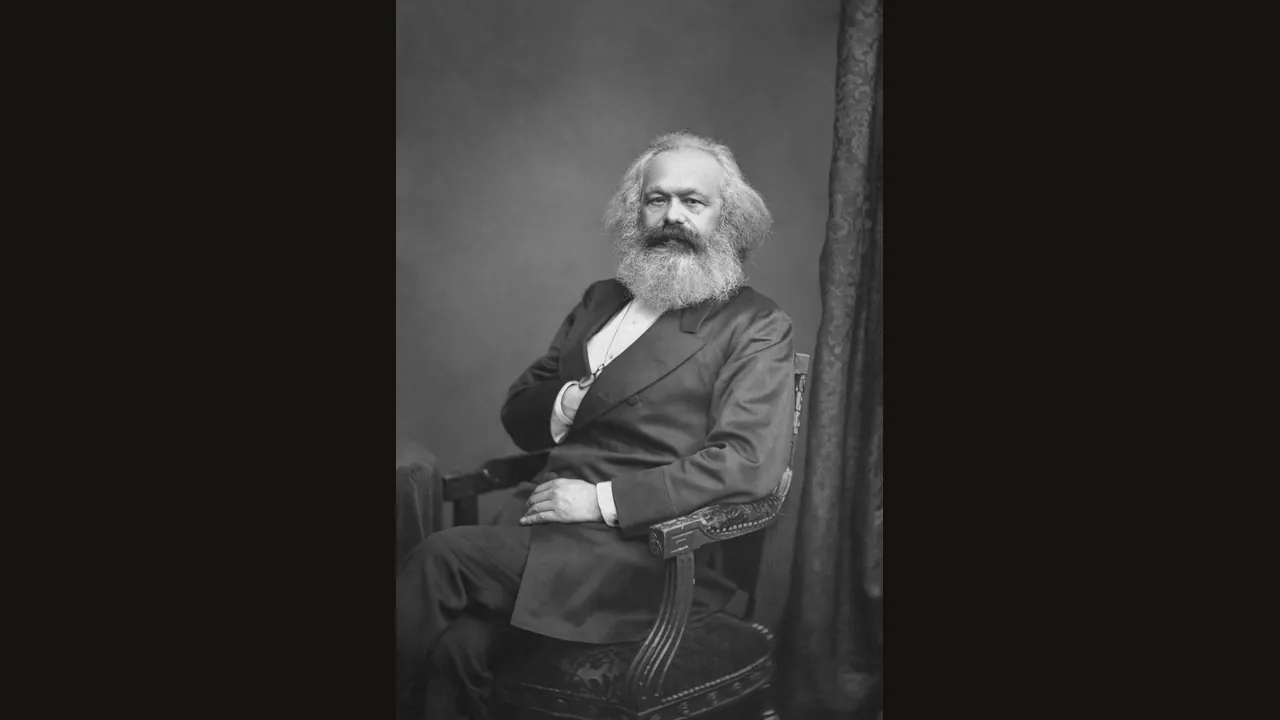
German thinker who turned Hegel's dialectic into historical materialism: class struggle drives history, and capitalism digs its own grave. The Communist Manifesto of 1848 and Capital of 1867 made him the most politically consequential philosopher of modern times. He lived 1818 to 1883, mostly in London exile.
Karl Marx was born in Trier in the Prussian Rhineland in 1818, the son of a lawyer who had converted from Judaism to Lutheranism because Prussian law barred Jews from his profession. Marx studied law at Bonn and then philosophy at Berlin, took his doctorate from Jena in 1841, and joined the circle of the Young Hegelians. He turned to journalism, became editor of the Rheinische Zeitung, and watched the Prussian censors close the paper in 1843. That year he married Jenny von Westphalen, the daughter of a Prussian official, and moved to Paris. There in 1844 he met Friedrich Engels, the son of a cotton manufacturer, who became his collaborator and for forty years the man whose money kept the Marx household alive.
Expelled from Paris and then from Brussels, Marx helped write, with Engels, the Manifesto of the Communist Party, published in London in February 1848, weeks before revolutions broke across Europe. In 1849 he settled in London. The family lived in poverty in Soho on Engels's money and his fees from the New York Tribune, and several of his children died young. He worked for decades in the reading room of the British Museum, and in 1864 he helped found the International Workingmen's Association, whose internal battles, above all with the anarchist Bakunin, consumed his remaining energies. He died in 1883 and was buried in Highgate Cemetery. Engels spoke at the grave and said that mankind was shorter by a head.
The German Ideology, written with Engels in 1845 and 1846 and left unpublished until 1932, states the premise: the production of material life conditions law, politics, and thought, and the ruling ideas of an age are the ideas of its ruling class. In the preface of 1859 he gave the formula its compact form: a society's relations of production form its economic base, on which rises a legal and political superstructure, and when growing productive forces are fettered by existing property relations, an era of social revolution begins. The Manuscripts of 1844, also published only in 1932, analyze alienation: under capitalism the worker is estranged from the product he makes, from his own activity, from other men, and from his distinctively human capacities.
Capital, whose first volume appeared in 1867, attempts to prove the theory in the most advanced economy on earth. Marx took the labor theory of value from Smith and Ricardo: a commodity's value is set by the labor time socially necessary to produce it. The worker sells his labor power, his capacity to work, and works longer than the time needed to produce his wage; the unpaid surplus is surplus value, the source of profit. Capital accumulates and centralizes, mechanization swells the reserve army of the unemployed and presses on wages, and Marx argued the rate of profit tends to fall as machinery displaces the living labor that alone creates value. Eugen von Böhm Bawerk argued in 1896 that the third volume, where commodities exchange at prices of production, contradicts the first volume's values, the difficulty known as the transformation problem, which economists still dispute. The marginal revolution of Jevons, Menger, and Walras displaced the labor theory in academic economics, and Karl Popper attacked the whole as prophecy dressed as science, since its defenders could explain away every failed prediction.
His political expectations were as definite as his economics, and events treated them roughly. He expected revolution to begin where capitalism was most developed, in England, Germany, or America. Revolution in his name came instead to Russia in 1917 and China in 1949, agrarian empires with small industrial classes, and it came through disciplined parties that seized the state. The regimes that ruled by his doctrine collectivized agriculture and abolished private productive property across a third of the world. The documented record of those regimes includes the Ukrainian famine of 1932 and 1933, the Great Terror, the Gulag camp system, the Chinese famine of 1959 to 1961, and the Cambodian killing fields. Historians dispute exact totals; the dead from famine, execution, and the camps number in the tens of millions by any mainstream reckoning. Marx's defenders reply that he prescribed none of this and imagined socialism arising from advanced nations; the record of the parties stands on its own. Eduard Bernstein broke with the orthodoxy in 1899 on the wage statistics: real wages were rising, the middle classes were not vanishing, and capitalism was not collapsing.
His influence survives his political failures. Class analysis, the study of ideology, and the insistence that ideas serve material interests entered the ordinary equipment of history and sociology. Western social democracy built welfare states that answered charges against the capitalism of 1848. The twentieth century ran his experiment at full scale, and the results stand in the archives of the states that tried it.
Watch
Roots and Branches of the Radical Left
Events · 2026-10-15
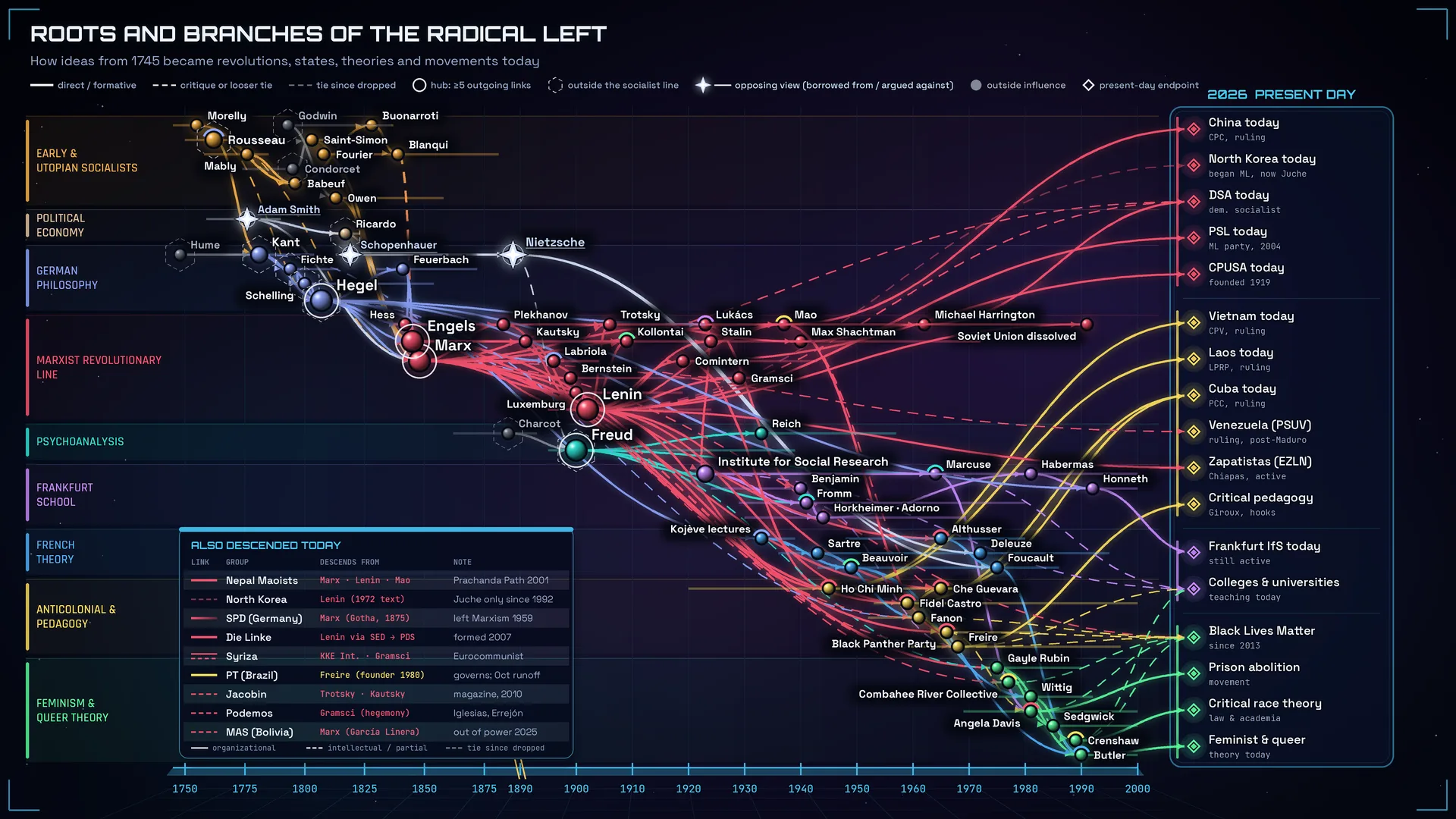
Socialism is presented as an economic theory. In reality, woven through every part of the theory are two things that must be adopted before socialism can "work properly": a pseudo-history of mankind, and a massive shift of worldview. Both rest on a fundamental lie about human nature: they blame man's conditions for what belongs to the man himself.
That ideology did not appear from nowhere. It grew out of long-standing ideas, taken up across a chain of events and twisted over time into a promise of a better way for human beings to live, which is why the whole runs far deeper and is far more complex than the economic label suggests. Along the way it was woven in and out of great thinkers, at different points and for different reasons. Some were used for it and some against it, and through all of it the idea kept building.
This map lays that out where it can be seen: the evolution of the ideas, the effects they had, and the chain of cause and effect that followed from thinker to thinker.
Facts
- Born
- 1818, Trier, Germany.
- Source: Encyclopaedia Britannica, Karl Marx
- Died
- 1883, London, England.
- Source: Encyclopaedia Britannica, Karl Marx
- School
- Marxism, historical materialism.
- Source: Encyclopaedia Britannica, Karl Marx
- Known for
- The Communist Manifesto, written with Engels, and Capital, on surplus value and the laws of capitalist crisis.
- Source: Encyclopaedia Britannica, Karl Marx
Sources
- Encyclopaedia Britannica, Karl Marx Source
Source links accessed 22 November 2026.
Images
Related
- Georg Wilhelm Friedrich HegelConnected
- Antonio GramsciConnected
- VictoriaSame era
- Otto von BismarckSame era
- Søren KierkegaardSame era
- Abraham LincolnSame era
What happened elsewhere
Pairings are by recorded year, not exact simultaneity.
- ChileWhile Karl Marx (1818)
- VictoriaWhile Karl Marx (1819)
- ColombiaWhile Karl Marx (1819)
- ArgentinaWhile Karl Marx (1816)
- Saint Pierre and MiquelonWhile Karl Marx (1816)
Meanwhile
Meanwhile, around the world — drag to spin, click a pulsing marker.
Keep reading
Test yourself
When was Karl Marx born?
- 1818, Trier, Germany
- 1762, Rammenau, Saxony, Germany
- 1775, Leonberg, Germany
- 1770, Stuttgart, Germany
Answer
1818, Trier, Germany — Born: 1818, Trier, Germany.
When did Karl Marx die?
- 1883, London, England
- 1857, Paris
- 1855, Copenhagen
- 1831, Berlin, of cholera
Answer
1883, London, England — Died: 1883, London, England.
What is Karl Marx known for?
- The Communist Manifesto, written with Engels, and Capital, on surplus value and the laws of capitalist crisis
- The leap of faith, the three stages of life, aesthetic, ethical, religious, and the attack on comfortable Christendom
- The Wissenschaftslehre, the science of knowledge, and the Addresses to the German Nation of 1808
- God is dead, the will to power, the Übermensch, master and slave morality, and the eternal recurrence
Answer
The Communist Manifesto, written with Engels, and Capital, on surplus value and the laws of capitalist crisis — Known for: The Communist Manifesto, written with Engels, and Capital, on surplus value and the laws of capitalist crisis.
Which school of thought was Karl Marx part of?
- Marxism, historical materialism
- Post Kantian pessimism, drawing on Indian thought
- Phenomenology, its founder
- None; the critic of all schools
Answer
Marxism, historical materialism — School: Marxism, historical materialism.
True or false: German thinker who turned Hegel's dialectic into historical materialism: class struggle drives history, and capitalism digs its own grave.
- True
- False
Answer
True — True. German thinker who turned Hegel's dialectic into historical materialism: class struggle drives history, and capitalism digs its own grave.
Articles
My notes
Highlights on this page
None yet.
Spotted an error on this page? Email [email protected] and it will be checked against the sources.