

Philosopher · Age of revolutions and empire · Germany
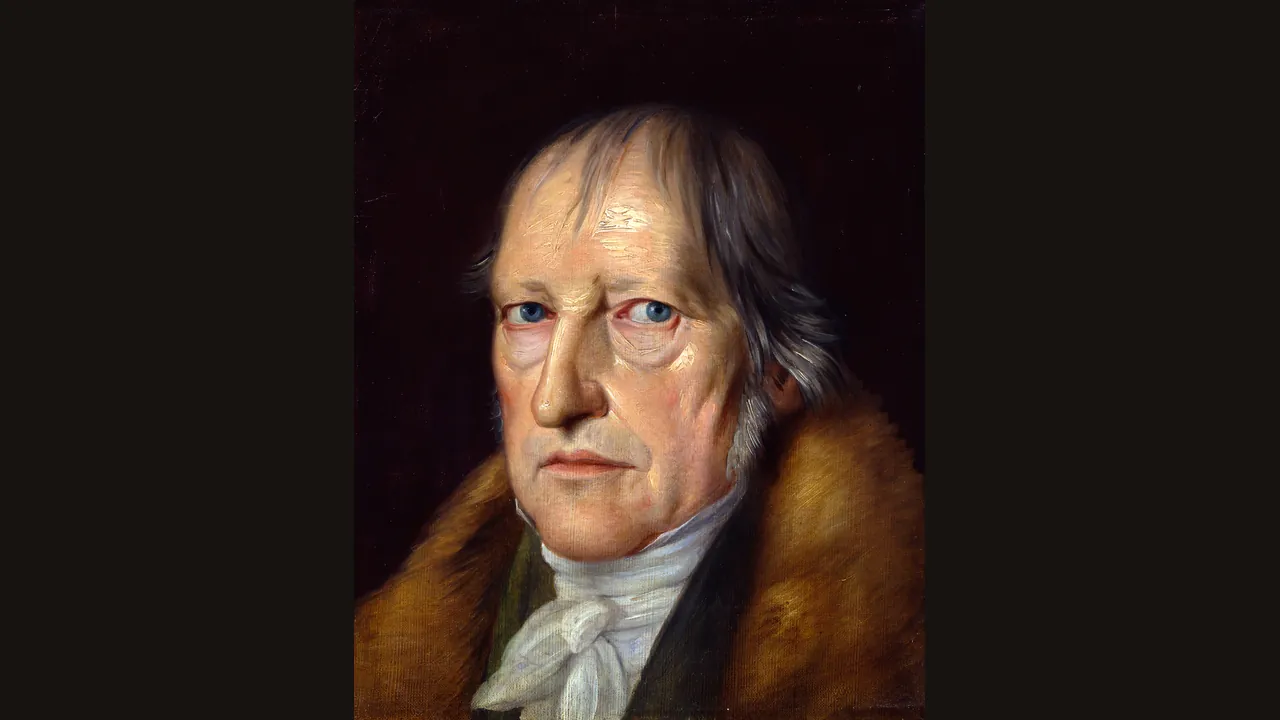
Georg Wilhelm Friedrich Hegel
1770–1831
German thinker whose system made history the unfolding of reason itself. The Phenomenology of Spirit of 1807 follows consciousness to absolute knowing. He lived 1770 to 1831 and died of cholera at the height of his Berlin fame.
Hegel was born in 1770 at Stuttgart, the son of a revenue official, and studied theology at Tübingen, where he shared a room with Schelling and Hölderlin. He worked as a tutor at Bern and Frankfurt, lectured at Jena, edited a newspaper at Bamberg, and directed a school at Nuremberg. He held the chair at Heidelberg from 1816 and at Berlin from 1818 until his death in the cholera epidemic of 1831.
His system takes Geist, spirit or mind, as its subject: reality is spirit coming to know itself. The method he called dialectic follows a concept or a form of life until its contradictions show its limits. The resolution preserves what held true in the earlier stage and lifts it into a fuller form, in a movement he called Aufhebung. The Phenomenology of Spirit of 1807 traces consciousness from sense certainty through self consciousness to absolute knowing. Its best known passage sets a master, who risks his life and wins recognition, against a bondsman, who serves in fear and, through work, reaches a mind of his own. The Encyclopaedia arranges the system as logic, philosophy of nature, and philosophy of spirit. In his lectures on the philosophy of history, world history is the progress of the consciousness of freedom, and the Philosophy of Right presents the family, civil society, and the state as the shapes freedom takes in institutions.
Watch
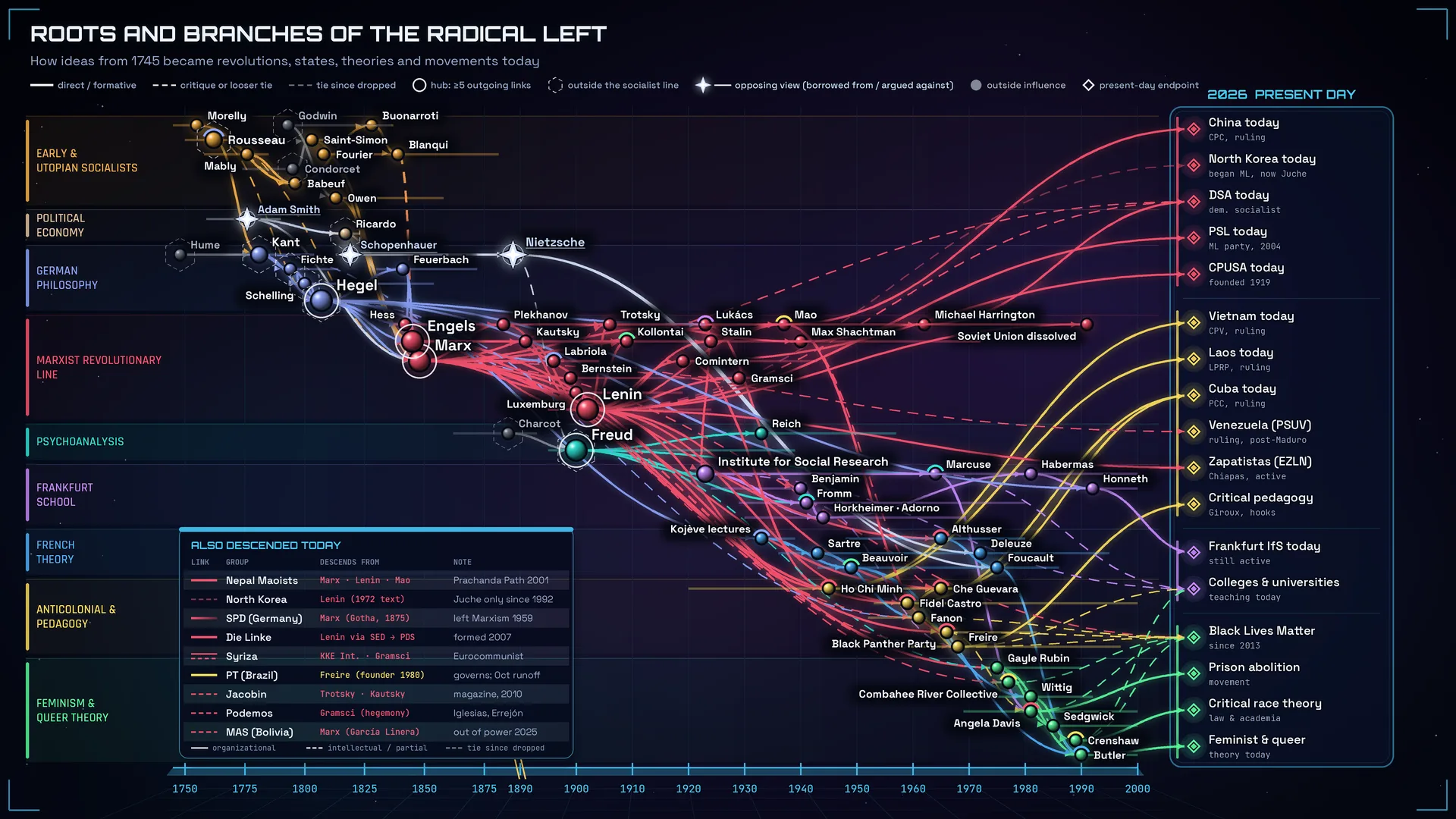
Roots and Branches of the Radical Left
Events · 2026-10-15
Socialism is presented as an economic theory. In reality, woven through every part of the theory are two things that must be adopted before socialism can "work properly": a pseudo-history of mankind, and a massive shift of worldview. Both rest on a fundamental lie about human nature: they blame man's conditions for what belongs to the man himself.
That ideology did not appear from nowhere. It grew out of long-standing ideas, taken up across a chain of events and twisted over time into a promise of a better way for human beings to live, which is why the whole runs far deeper and is far more complex than the economic label suggests. Along the way it was woven in and out of great thinkers, at different points and for different reasons. Some were used for it and some against it, and through all of it the idea kept building.
This map lays that out where it can be seen: the evolution of the ideas, the effects they had, and the chain of cause and effect that followed from thinker to thinker.
Facts
- Born
- 1770, Stuttgart, Germany.
- Source: Encyclopaedia Britannica, Georg Wilhelm Friedrich Hegel
- Died
- 1831, Berlin, of cholera.
- Source: Encyclopaedia Britannica, Georg Wilhelm Friedrich Hegel
- School
- German idealism, its completion.
- Source: Encyclopaedia Britannica, Georg Wilhelm Friedrich Hegel
- Known for
- The dialectic of the Logic and the Phenomenology, the master and slave struggle, and the claim that the real is the rational. The formula 'thesis, antithesis, synthesis' attached to his name comes from Fichte and later textbooks, not from Hegel.
- Source: Encyclopaedia Britannica, Georg Wilhelm Friedrich Hegel
Sources
- Encyclopaedia Britannica, Georg Wilhelm Friedrich Hegel Source
Source links accessed 22 November 2026.
Images
Related
- Immanuel KantConnected
- Johann Gottlieb FichteConnected
- Karl MarxConnected
- Søren KierkegaardConnected
- Friedrich SchellingConnected
- Napoleon BonaparteSame era
What happened elsewhere
Pairings are by recorded year, not exact simultaneity.
- Napoleon BonaparteWhile Georg Wilhelm Friedrich Hegel (1769)
- NepalWhile Georg Wilhelm Friedrich Hegel (1768)
- Isle of ManWhile Georg Wilhelm Friedrich Hegel (1765)
- United StatesWhile Georg Wilhelm Friedrich Hegel (1776)
Meanwhile
Meanwhile, around the world — drag to spin, click a pulsing marker.
Keep reading
Test yourself
When was Georg Wilhelm Friedrich Hegel born?
- 1770, Stuttgart, Germany
- 1806, London, England
- 1813, Copenhagen, Denmark
- 1818, Trier, Germany
Answer
1770, Stuttgart, Germany — Born: 1770, Stuttgart, Germany.
When did Georg Wilhelm Friedrich Hegel die?
- 1831, Berlin, of cholera
- 1814, Berlin, of typhus
- 1854, Ragaz, Switzerland
- 1860, Frankfurt, Germany
Answer
1831, Berlin, of cholera — Died: 1831, Berlin, of cholera.
Which school of thought was Georg Wilhelm Friedrich Hegel part of?
- German idealism, its completion
- Post Kantian pessimism, drawing on Indian thought
- Marxism, historical materialism
- Existentialism, its Christian founder
Answer
German idealism, its completion — School: German idealism, its completion.
True or false: German thinker whose system made history the unfolding of reason itself.
- True
- False
Answer
True — True. German thinker whose system made history the unfolding of reason itself.
Articles
My notes
Highlights on this page
None yet.
Spotted an error on this page? Email [email protected] and it will be checked against the sources.