

Philosopher · Age of revolutions and empire · Germany
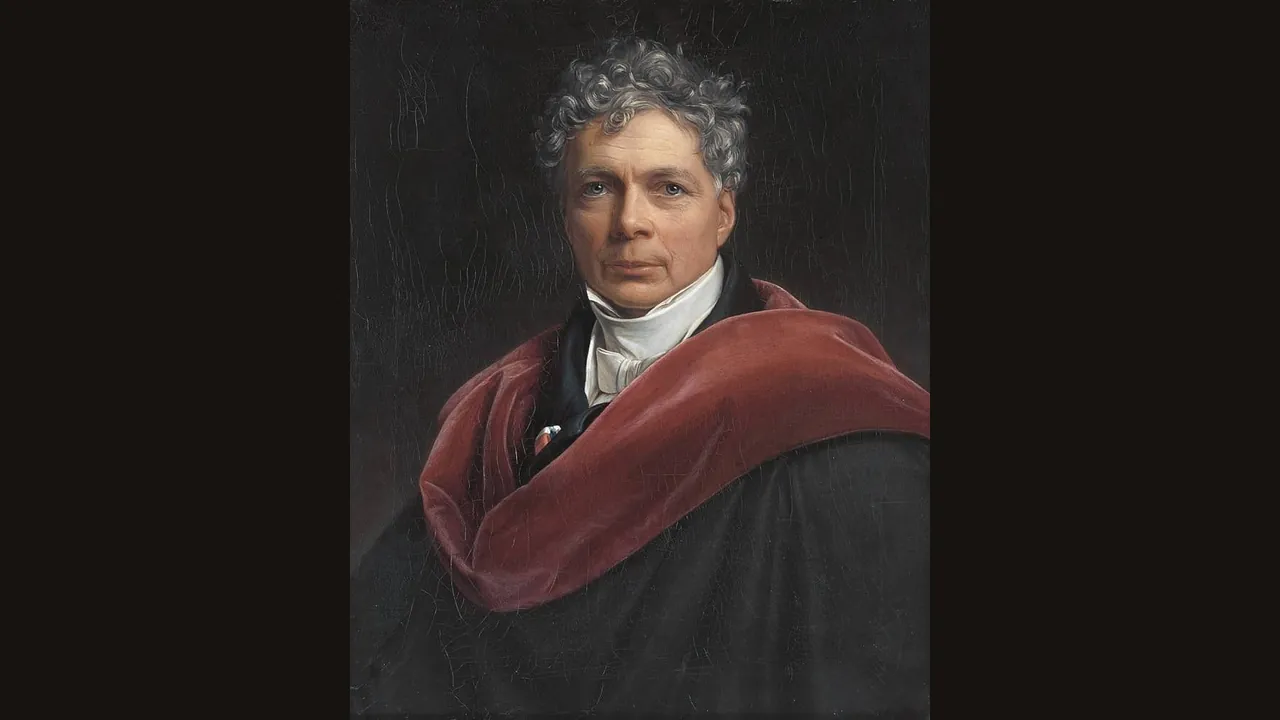
Friedrich Schelling
1775–1854
German thinker of nature and art who stood between Fichte and Hegel in German idealism. His philosophy of nature treated the natural world as visible spirit. He lived 1775 to 1854, outliving his fame.
Friedrich Schelling was born in 1775 at Leonberg in Württemberg, the son of a Lutheran pastor. He entered the theological seminary at Tübingen at fifteen and shared a room there with Hegel and the poet Hölderlin. At Jena from 1798 he lectured beside Fichte and moved in the circle of the early Romantics, and he later held chairs at Würzburg and Munich. In 1841 the Prussian king called him to Berlin to lecture against the school of Hegel. He died at Bad Ragaz in Switzerland in 1854.
His early writings extended idealism from the self to nature. In the Ideas for a Philosophy of Nature of 1797 he treated nature as a productive process rather than a finished machine, an unconscious activity rising through stages toward mind. The System of Transcendental Idealism of 1800 traced consciousness from sensation to self awareness and closed with art, which he named the true organ of philosophy, where conscious making and unconscious production meet in one product. His 1809 inquiry into human freedom treated evil as a positive power and grounded it in a ground of existence within God himself. In his last decades he divided philosophy into a negative part, which unfolds what things are, and a positive part, which starts from the fact that things are, and he lectured on mythology and revelation.
Watch
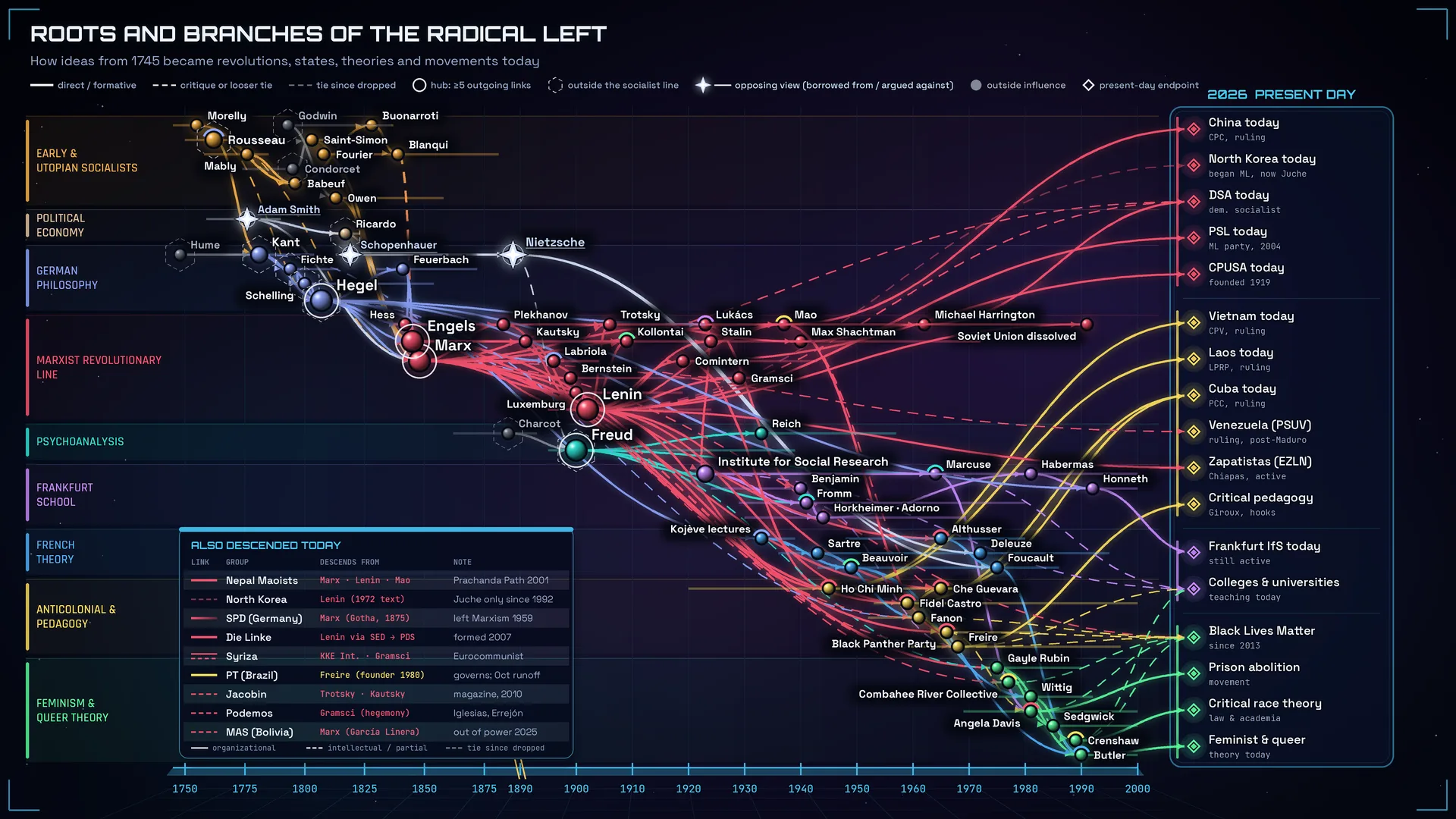
Roots and Branches of the Radical Left
Events · 2026-10-15
Socialism is presented as an economic theory. In reality, woven through every part of the theory are two things that must be adopted before socialism can "work properly": a pseudo-history of mankind, and a massive shift of worldview. Both rest on a fundamental lie about human nature: they blame man's conditions for what belongs to the man himself.
That ideology did not appear from nowhere. It grew out of long-standing ideas, taken up across a chain of events and twisted over time into a promise of a better way for human beings to live, which is why the whole runs far deeper and is far more complex than the economic label suggests. Along the way it was woven in and out of great thinkers, at different points and for different reasons. Some were used for it and some against it, and through all of it the idea kept building.
This map lays that out where it can be seen: the evolution of the ideas, the effects they had, and the chain of cause and effect that followed from thinker to thinker.
Facts
- Born
- 1775, Leonberg, Germany.
- Source: Encyclopaedia Britannica, Friedrich Schelling
- Died
- 1854, Ragaz, Switzerland.
- Source: Encyclopaedia Britannica, Friedrich Schelling
- School
- German idealism.
- Source: Encyclopaedia Britannica, Friedrich Schelling
- Known for
- The System of Transcendental Idealism of 1800 and the philosophy of nature, Naturphilosophie.
- Source: Encyclopaedia Britannica, Friedrich Schelling
Sources
- Encyclopaedia Britannica, Friedrich Schelling Source
Source links accessed 22 November 2026.
Images
Related
- Johann Gottlieb FichteConnected
- Georg Wilhelm Friedrich HegelConnected
- Napoleon BonaparteSame era
- Simon BolivarSame era
- ShakaSame era
- Arthur SchopenhauerSame era
What happened elsewhere
Pairings are by recorded year, not exact simultaneity.
- United StatesWhile Friedrich Schelling (1776)
- Napoleon BonaparteWhile Friedrich Schelling (1769)
- NepalWhile Friedrich Schelling (1768)
- Simon BolivarWhile Friedrich Schelling (1783)
- Isle of ManWhile Friedrich Schelling (1765)
Meanwhile
Meanwhile, around the world — drag to spin, click a pulsing marker.
Keep reading
Test yourself
When was Friedrich Schelling born?
- 1775, Leonberg, Germany
- 1788, Danzig, in what is now Poland
- 1818, Trier, Germany
- 1859, Prossnitz, Moravia, in what is now Czechia
Answer
1775, Leonberg, Germany — Born: 1775, Leonberg, Germany.
When did Friedrich Schelling die?
- 1854, Ragaz, Switzerland
- 1883, London, England
- 1938, Freiburg, Germany
- 1900, Weimar, Germany, after eleven years of mental collapse
Answer
1854, Ragaz, Switzerland — Died: 1854, Ragaz, Switzerland.
What is Friedrich Schelling known for?
- The System of Transcendental Idealism of 1800 and the philosophy of nature, Naturphilosophie
- The Course of Positive Philosophy, the law of three stages, and the founding of sociology as a science
- The leap of faith, the three stages of life, aesthetic, ethical, religious, and the attack on comfortable Christendom
- The Wissenschaftslehre, the science of knowledge, and the Addresses to the German Nation of 1808
Answer
The System of Transcendental Idealism of 1800 and the philosophy of nature, Naturphilosophie — Known for: The System of Transcendental Idealism of 1800 and the philosophy of nature, Naturphilosophie.
Which school of thought was Friedrich Schelling part of?
- German idealism
- Marxism, historical materialism
- German idealism, its completion
- Analytic philosophy, its founder; logicism
Answer
German idealism — School: German idealism.
True or false: German thinker of nature and art who stood between Fichte and Hegel in German idealism.
- True
- False
Answer
True — True. German thinker of nature and art who stood between Fichte and Hegel in German idealism.
Articles
My notes
Highlights on this page
None yet.
Spotted an error on this page? Email [email protected] and it will be checked against the sources.