

Philosopher · Twentieth century · Austria
Karl Popper
1902–1994
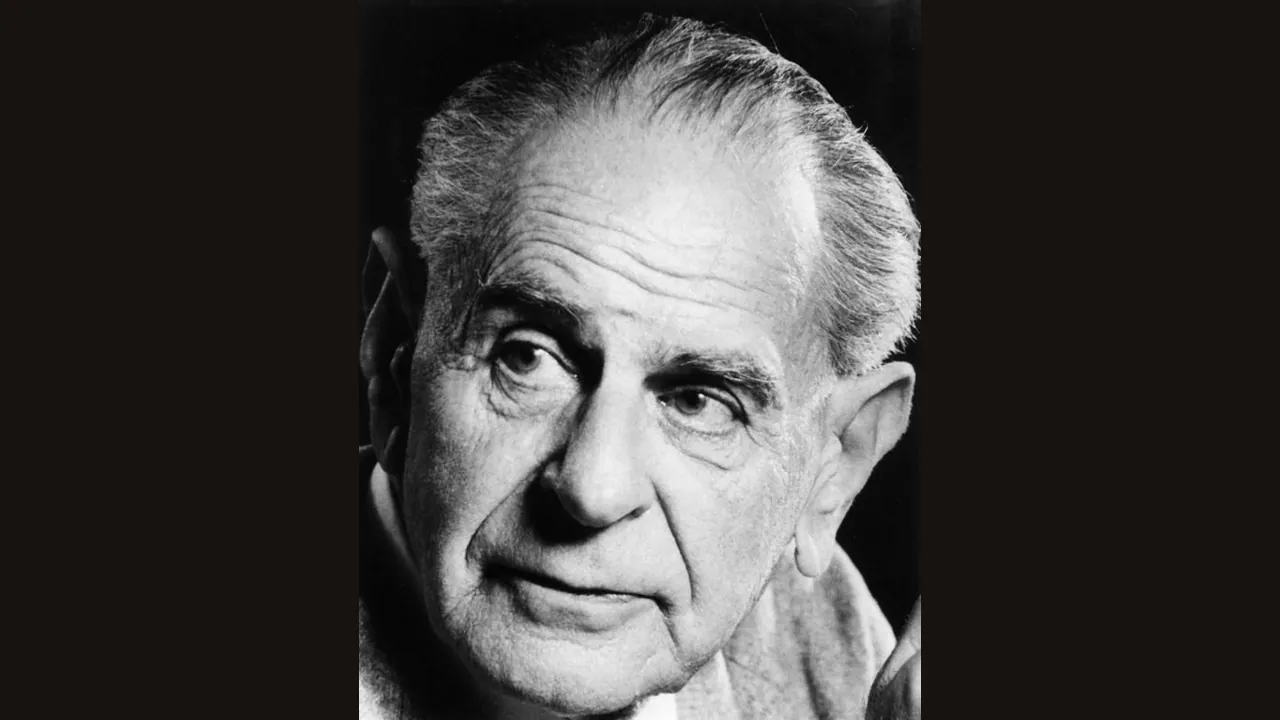
Austrian born British thinker who redrew the line between science and nonsense: a theory is scientific only if it can be proven wrong. His Open Society attacked historicism and totalitarian thought. He lived 1902 to 1994.
Popper was born in Vienna in 1902 and worked as a schoolteacher before taking his doctorate at the University of Vienna. He published The Logic of Scientific Discovery in German in 1934. In 1937 he left Austria for a lectureship at Canterbury University College in New Zealand. He moved to the London School of Economics in 1946 and held a professorship there until his retirement. He died in London in 1994.
His rule of demarcation holds that a theory counts as scientific only where it forbids some observable outcome and can in principle be falsified. Science, on his account, grows by conjectures and refutations: bold hypotheses are stated sharply and tested hard, and they survive as corroborated, never as proven. He argued that psychoanalysis and the Marxism of his day fail the test, since their followers can explain every outcome within the theory. The Open Society and Its Enemies (1945) argues against historicism, the doctrine that history moves by discoverable laws toward a fixed end, and it defends societies whose rulers can be criticized and removed without bloodshed. Against plans for remaking society whole, he proposed piecemeal social engineering, changes made in small steps and corrected by their results.
Facts
- Born
- 1902, Vienna, Austria.
- Source: Encyclopaedia Britannica, Karl Popper
- Died
- 1994, London, England.
- Source: Encyclopaedia Britannica, Karl Popper
- School
- Critical rationalism; philosophy of science.
- Source: Encyclopaedia Britannica, Karl Popper
- Known for
- Falsifiability as the mark of science, and The Open Society and Its Enemies of 1945.
- Source: Encyclopaedia Britannica, Karl Popper
Sources
- Encyclopaedia Britannica, Karl Popper Source
Source links accessed 22 November 2026.
Images
Related
- Bertrand RussellConnected
- Friedrich August von HayekConnected
- Twentieth centurySame era
- HirohitoSame era
- Jean-Paul SartreSame era
- Hannah ArendtSame era
What happened elsewhere
Pairings are by recorded year, not exact simultaneity.
- CubaWhile Karl Popper (1902)
- Twentieth centuryWhile Karl Popper (1901)
- HirohitoWhile Karl Popper (1901)
- PanamaWhile Karl Popper (1903)
- AustraliaWhile Karl Popper (1901)
Meanwhile
Meanwhile, around the world — drag to spin, click a pulsing marker.
Keep reading
Test yourself
When was Karl Popper born?
- 1902, Vienna, Austria
- 1913, Mondovi, Algeria
- 1929, Düsseldorf, Germany
- 1928, Philadelphia, Pennsylvania, United States
Answer
1902, Vienna, Austria — Born: 1902, Vienna, Austria.
When did Karl Popper die?
- 1994, London, England
- 2004, Paris, France
- 1960, near Sens, France, in a car crash
- 1975, New York, United States
Answer
1994, London, England — Died: 1994, London, England.
What is Karl Popper known for?
- Falsifiability as the mark of science, and The Open Society and Its Enemies of 1945
- Bad faith, the look of the other, and the slogan that man is condemned to be free
- Being and Time, Dasein, being toward death, and the later critique of technology
- The Stranger, The Myth of Sisyphus, The Rebel, and the Nobel Prize in Literature 1957
Answer
Falsifiability as the mark of science, and The Open Society and Its Enemies of 1945 — Known for: Falsifiability as the mark of science, and The Open Society and Its Enemies of 1945.
Which school of thought was Karl Popper part of?
- Critical rationalism; philosophy of science
- Analytic philosophy; naturalism
- Deconstruction; post structuralism
- Political theory, in the classical tradition
Answer
Critical rationalism; philosophy of science — School: Critical rationalism; philosophy of science.
True or false: Austrian born British thinker who redrew the line between science and nonsense: a theory is scientific only if it can be proven wrong.
- True
- False
Answer
True — True. Austrian born British thinker who redrew the line between science and nonsense: a theory is scientific only if it can be proven wrong.
My notes
Highlights on this page
None yet.
Spotted an error on this page? Email [email protected] and it will be checked against the sources.