

Philosopher · Twentieth century · Austria
Ludwig Wittgenstein
1889–1951
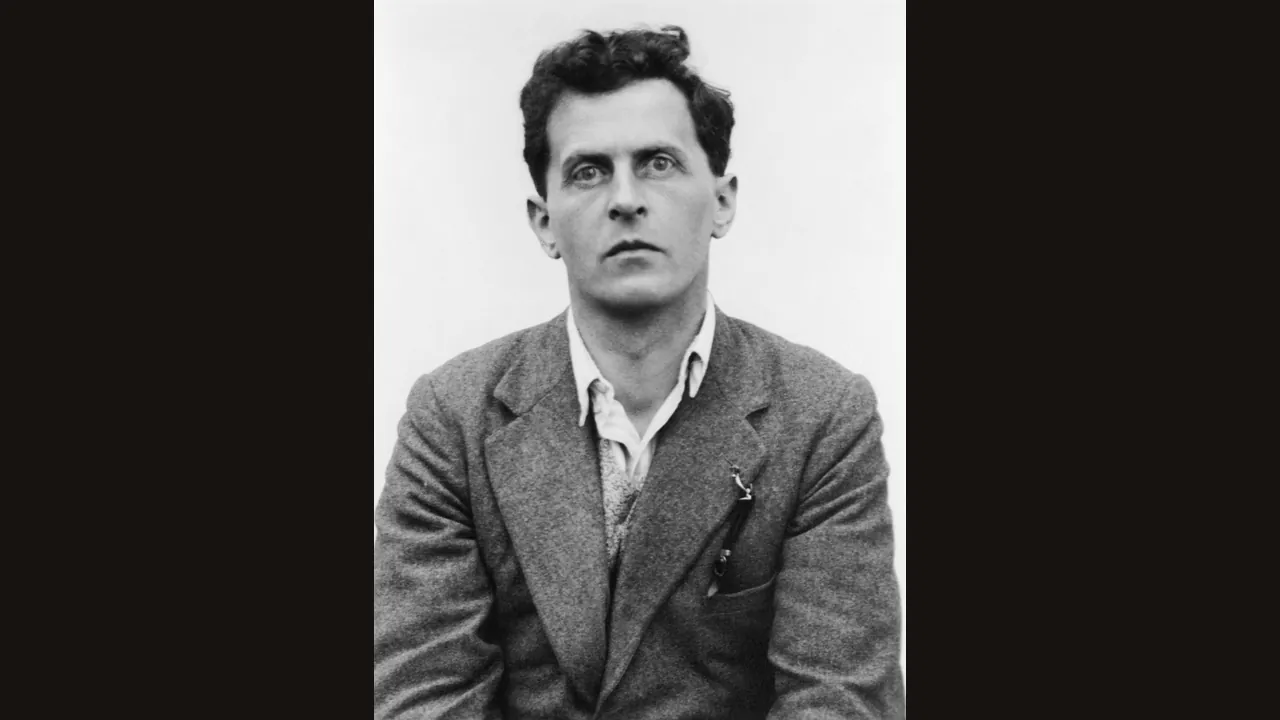
Austrian born thinker, heir to a steel fortune he gave away, who wrote two philosophies: the Tractatus of 1921, then the Investigations, published after his death, which undid it. He lived 1889 to 1951, teaching at Cambridge between wars.
Ludwig Wittgenstein was born in 1889 at Vienna, the youngest of eight children of the steel magnate Karl Wittgenstein. He studied engineering at Berlin and Manchester, moved from aeronautics to mathematics, and came to Cambridge in 1911 to work under Russell. He served in the Austrian army through the First World War and finished his book as an Italian prisoner, and after the war he gave away his share of the family fortune. He taught in village schools and returned to Cambridge in 1929, where he was professor from 1939. He died at Cambridge in 1951.
The Tractatus Logico Philosophicus, published in 1921, holds that the world is the totality of facts and that a proposition pictures a possible fact by sharing its logical form. Ethics, aesthetics, and meaning lie outside what can be said and can only be shown, and it closes by telling the reader to throw away its propositions like a ladder and keep silence on the rest. The Philosophical Investigations, published in 1953, sets the picture theory aside. Meaning, it argues, is use: words function within language games, the activities into which speaking is woven, and concepts such as game hold together by family resemblance, overlapping similarities, no essence common to all. Its private language argument holds that sensation words cannot take their meaning from a private inward pointing, since correct use needs a public standard.
Facts
- Born
- 1889, Vienna, Austria.
- Source: Encyclopaedia Britannica, Ludwig Wittgenstein
- Died
- 1951, Cambridge, England.
- Source: Encyclopaedia Britannica, Ludwig Wittgenstein
- School
- Analytic philosophy, in two acts.
- Source: Encyclopaedia Britannica, Ludwig Wittgenstein
- Known for
- The picture theory of meaning, language games, family resemblance, and private language arguments.
- Source: Encyclopaedia Britannica, Ludwig Wittgenstein
Sources
- Encyclopaedia Britannica, Ludwig Wittgenstein Source
Source links accessed 22 November 2026.
Images
Related
- Bertrand RussellConnected
- Gottlob FregeConnected
- Willard Van Orman QuineConnected
- Martin HeideggerSame era
- Adolf HitlerSame era
- Chiang Kai-shekSame era
What happened elsewhere
Pairings are by recorded year, not exact simultaneity.
- Martin HeideggerWhile Ludwig Wittgenstein (1889)
- Adolf HitlerWhile Ludwig Wittgenstein (1889)
- Wallis and FutunaWhile Ludwig Wittgenstein (1888)
- Chiang Kai-shekWhile Ludwig Wittgenstein (1887)
- Antonio GramsciWhile Ludwig Wittgenstein (1891)
Meanwhile
Meanwhile, around the world — drag to spin, click a pulsing marker.
Keep reading
Test yourself
When was Ludwig Wittgenstein born?
- 1889, Vienna, Austria
- 1908, Akron, Ohio, United States
- 1908, Paris, France
- 1889, Messkirch, Germany
Answer
1889, Vienna, Austria — Born: 1889, Vienna, Austria.
When did Ludwig Wittgenstein die?
- 1951, Cambridge, England
- 2000, Boston, United States
- 1994, London, England
- 1986, Paris
Answer
1951, Cambridge, England — Died: 1951, Cambridge, England.
What is Ludwig Wittgenstein known for?
- The picture theory of meaning, language games, family resemblance, and private language arguments
- The Origins of Totalitarianism, Eichmann in Jerusalem, and the phrase the banality of evil
- Being and Time, Dasein, being toward death, and the later critique of technology
- The Stranger, The Myth of Sisyphus, The Rebel, and the Nobel Prize in Literature 1957
Answer
The picture theory of meaning, language games, family resemblance, and private language arguments — Known for: The picture theory of meaning, language games, family resemblance, and private language arguments.
Which school of thought was Ludwig Wittgenstein part of?
- Analytic philosophy, in two acts
- Political theory, in the classical tradition
- Critical rationalism; philosophy of science
- Analytic philosophy; logical atomism
Answer
Analytic philosophy, in two acts — School: Analytic philosophy, in two acts.
True or false: Austrian born thinker, heir to a steel fortune he gave away, who wrote two philosophies: the Tractatus of 1921, then the Investigations, published after his death, which undid it.
- True
- False
Answer
True — True. Austrian born thinker, heir to a steel fortune he gave away, who wrote two philosophies: the Tractatus of 1921, then the Investigations, published after his death, which undid it.
My notes
Highlights on this page
None yet.
Spotted an error on this page? Email [email protected] and it will be checked against the sources.