

Philosopher · Twentieth century · United States
Noam Chomsky
1928–
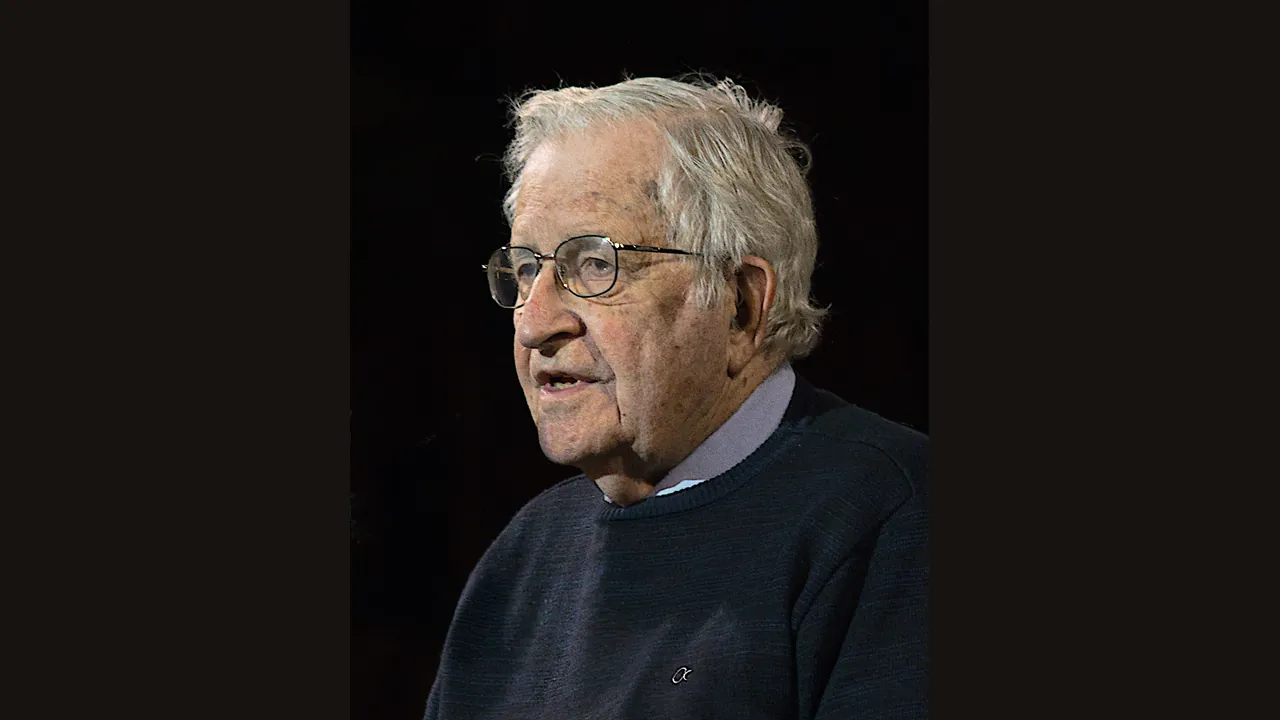
American linguist and thinker whose Syntactic Structures of 1957 argued that the human mind is born with a universal grammar. He became equally known as a critic of American foreign policy. Born 1928, living.
Chomsky was born in Philadelphia in 1928 and studied linguistics at the University of Pennsylvania under Zellig Harris, taking his doctorate in 1955. He joined the MIT faculty the same year and taught there for more than five decades. In 2017 he took a post at the University of Arizona as well.
Syntactic Structures (1957) and his 1959 review of B. F. Skinner's Verbal Behavior set out his claim that language rests on an innate faculty. Universal grammar names the principles he holds to be built into the human mind and shared by all languages. His poverty of the stimulus argument states that the speech children hear is too limited and too fragmentary to account for the grammar every child commands, so much of that grammar must be inborn. His early theory distinguishes deep structure from surface structure in the sentences a grammar generates.
With Edward S. Herman he published Manufacturing Consent (1988), which sets out a propaganda model of the mass media. Five filters, in their model, shape the news: the size and ownership of media companies, advertising as their revenue, reliance on official and business sources, flak against unwelcome reporting, and anticommunism as a ruling ideology. Working through the filters, they argue, coverage serves state and corporate interests without direct orders.
Facts
- Born
- 1928, Philadelphia, Pennsylvania, United States.
- Source: Encyclopaedia Britannica, Noam Chomsky
- School
- Generative linguistics; analytic philosophy of language.
- Source: Encyclopaedia Britannica, Noam Chomsky
- Known for
- Universal grammar, the poverty of the stimulus argument, and the manufacturing consent critique of media.
- Source: Encyclopaedia Britannica, Noam Chomsky
- Career
- Taught at MIT from 1955; among the most cited scholars alive.
- Source: Encyclopaedia Britannica, Noam Chomsky
Sources
- Encyclopaedia Britannica, Noam Chomsky Source
Source links accessed 22 November 2026.
Images
Related
- Willard Van Orman QuineConnected
- René DescartesConnected
- Chinese Civil WarSame era
- Jürgen HabermasSame era
- Michel FoucaultSame era
- Jacques DerridaSame era
What happened elsewhere
Pairings are by recorded year, not exact simultaneity.
- Chinese Civil WarWhile Noam Chomsky (1927)
- Jürgen HabermasWhile Noam Chomsky (1929)
- Vatican CityWhile Noam Chomsky (1929)
- Michel FoucaultWhile Noam Chomsky (1926)
- Jacques DerridaWhile Noam Chomsky (1930)
Meanwhile
Meanwhile, around the world — drag to spin, click a pulsing marker.
Keep reading
Test yourself
When was Noam Chomsky born?
- 1928, Philadelphia, Pennsylvania, United States
- 1921, Baltimore, Maryland, United States
- 1930, El Biar, Algeria
- 1908, Paris, France
Answer
1928, Philadelphia, Pennsylvania, United States — Born: 1928, Philadelphia, Pennsylvania, United States.
What is Noam Chomsky known for?
- Universal grammar, the poverty of the stimulus argument, and the manufacturing consent critique of media
- The picture theory of meaning, language games, family resemblance, and private language arguments
- Being and Time, Dasein, being toward death, and the later critique of technology
- Falsifiability as the mark of science, and The Open Society and Its Enemies of 1945
Answer
Universal grammar, the poverty of the stimulus argument, and the manufacturing consent critique of media — Known for: Universal grammar, the poverty of the stimulus argument, and the manufacturing consent critique of media.
Which school of thought was Noam Chomsky part of?
- Generative linguistics; analytic philosophy of language
- Critical theory; discourse ethics
- Critical rationalism; philosophy of science
- Political theory, in the classical tradition
Answer
Generative linguistics; analytic philosophy of language — School: Generative linguistics; analytic philosophy of language.
True or false: American linguist and thinker whose Syntactic Structures of 1957 argued that the human mind is born with a universal grammar.
- True
- False
Answer
True — True. American linguist and thinker whose Syntactic Structures of 1957 argued that the human mind is born with a universal grammar.
My notes
Highlights on this page
None yet.
Spotted an error on this page? Email [email protected] and it will be checked against the sources.