
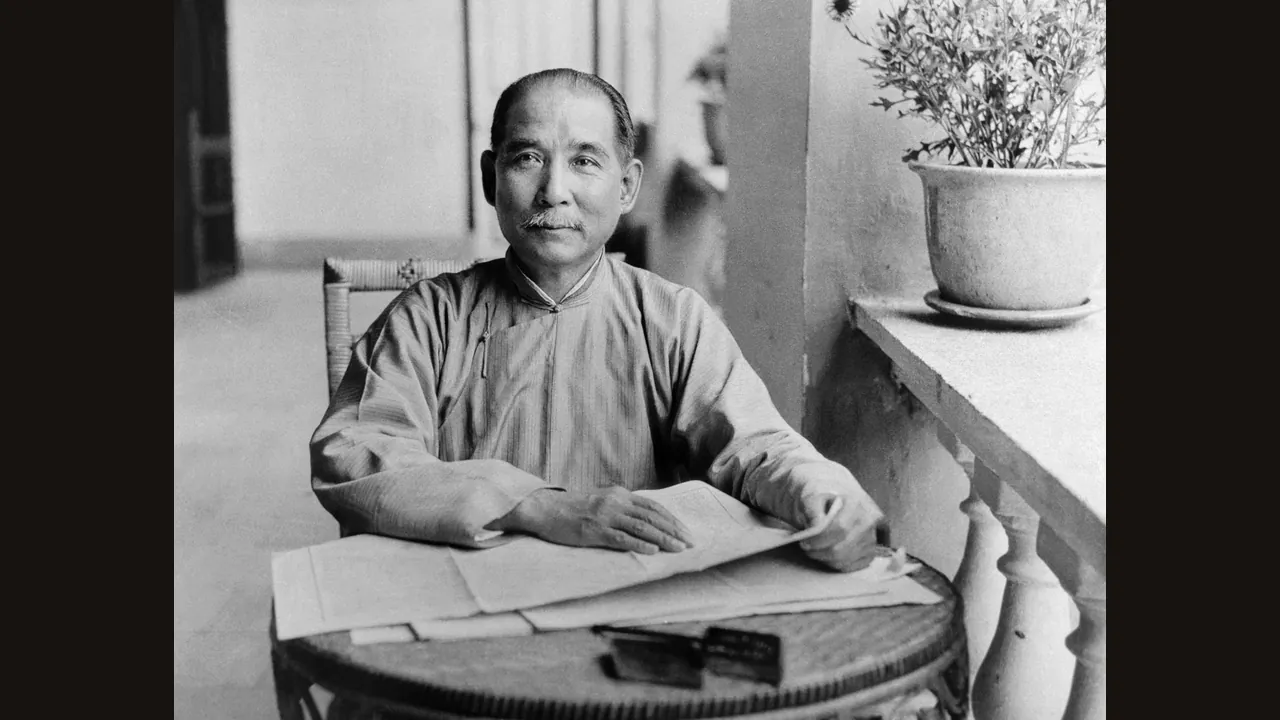
Ruler · Twentieth century · China
Sun Yat-sen
1866–1925
Founder of the Republic of China, 1866 to 1925, called the father of modern China in both Taiwan and the mainland. His Revolutionary Alliance overthrew the Qing dynasty in the Xinhai Revolution of 1911, and he served briefly as provisional president in 1912. He founded the Kuomintang and allied it with the Soviet Union before his death.
Sun Yat-sen trained as a doctor in Hong Kong and spent years abroad organizing against the Qing dynasty. He founded the Revive China Society in 1894 and the Revolutionary Alliance in Tokyo in 1905. His program rested on the Three Principles of the People: nationalism, the people's rights, meaning democratic government, and the people's livelihood. A series of uprisings he backed failed before the Wuchang uprising of 10 October 1911 set off the Xinhai Revolution. Sun returned from abroad, and the new republic's assembly elected him provisional president at Nanjing on 1 January 1912. The Qing emperor abdicated in February 1912. Sun then handed the presidency to Yuan Shikai, the commander of the strongest army, under the agreement that had ended the dynasty.
Yuan dissolved parliament and the Kuomintang, the party Sun had formed, and Sun went back into exile and opposition. From 1917 he headed a rival government at Guangzhou without holding power over a united China. In 1923 and 1924 he reorganized the Kuomintang with Soviet advisers, admitted Chinese Communist Party members into it, and founded the Whampoa military academy to train an army for his party. He traveled north to negotiate national unification with the Beijing government and died of cancer in Beijing on 12 March 1925, before any settlement was reached.
Facts
- Born
- 1866, Guangdong.
- Source: Encyclopaedia Britannica, Sun Yat-sen
- Died
- 1925, Beijing.
- Source: Encyclopaedia Britannica, Sun Yat-sen
- Office
- Provisional president of the Republic of China, January to March 1912.
- Source: Encyclopaedia Britannica, Sun Yat-sen
- Known for
- The Xinhai Revolution (1911) and the founding of the Kuomintang.
- Source: Encyclopaedia Britannica, Sun Yat-sen
Sources
- Encyclopaedia Britannica, Sun Yat-sen Source
Source links accessed 22 November 2026.
Images
Related
- Chiang Kai-shekConnected
- ChinaConnected
- Vladimir LeninSame era
- Bertrand RussellSame era
- Winston ChurchillSame era
- Joseph StalinSame era
What happened elsewhere
Pairings are by recorded year, not exact simultaneity.
- CanadaWhile Sun Yat-sen (1867)
- Vladimir LeninWhile Sun Yat-sen (1870)
- ItalyWhile Sun Yat-sen (1861)
- Bertrand RussellWhile Sun Yat-sen (1872)
- Edmund HusserlWhile Sun Yat-sen (1859)
Meanwhile
Meanwhile, around the world — drag to spin, click a pulsing marker.
Keep reading
Test yourself
When was Sun Yat-sen born?
- 1866, Guangdong
- 1925, Kampong Thom
- 1874, Blenheim Palace
- 1901, Tokyo
Answer
1866, Guangdong — Born: 1866, Guangdong.
When did Sun Yat-sen die?
- 1925, Beijing
- 2016, Havana
- 1938, Istanbul
- 1989, Tokyo
Answer
1925, Beijing — Died: 1925, Beijing.
What is Sun Yat-sen known for?
- The Xinhai Revolution (1911) and the founding of the Kuomintang
- The Nazi dictatorship, World War II, and the Holocaust
- The New Deal and American leadership in World War II
- The Cuban Revolution (1959) and the Cuban Missile Crisis (1962)
Answer
The Xinhai Revolution (1911) and the founding of the Kuomintang — Known for: The Xinhai Revolution (1911) and the founding of the Kuomintang.
True or false: Founder of the Republic of China, 1866 to 1925, called the father of modern China in both Taiwan and the mainland.
- True
- False
Answer
True — True. Founder of the Republic of China, 1866 to 1925, called the father of modern China in both Taiwan and the mainland.
My notes
Highlights on this page
None yet.
Spotted an error on this page? Email [email protected] and it will be checked against the sources.