
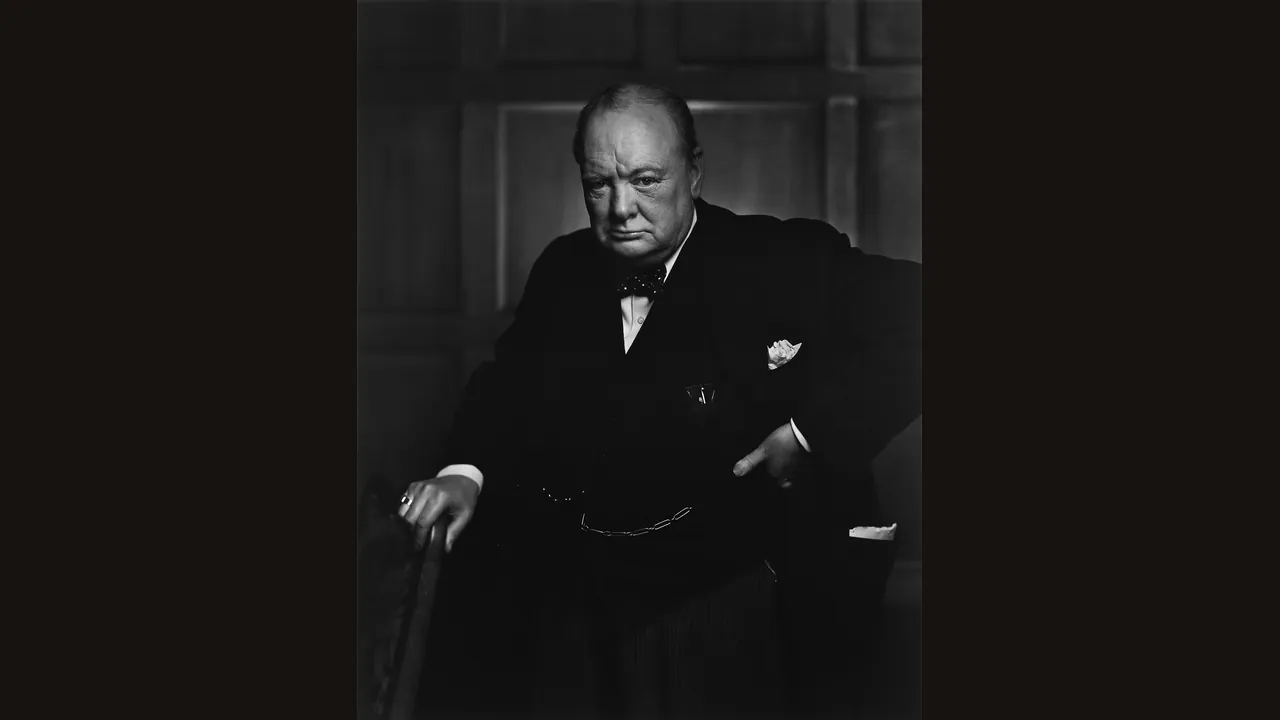
Ruler · Twentieth century · United Kingdom
Winston Churchill
1874–1965
British prime minister for most of World War II, 1874 to 1965, who led Britain through its darkest years. His speeches in 1940 rallied the country after the fall of France. Voted out in 1945, he returned as prime minister from 1951 to 1955 and won the Nobel Prize in Literature in 1953.
Winston Churchill was born in 1874 at Blenheim Palace, the son of Lord Randolph Churchill and an American mother, Jennie Jerome. He made his name as a soldier and a war writer. He rode in the cavalry charge at Omdurman in 1898, and in the Boer War the Boers captured him and he escaped, which made him famous at home. He entered Parliament in 1900 and crossed from the Conservatives to the Liberals in 1904, rising fast through offices that ran colonies, trade, and the home department.
As First Lord of the Admiralty from 1911, he pushed the navy to oil fuel and bigger guns, and the fleet was ready when war came in 1914. The Dardanelles campaign of 1915, meant to knock the Ottoman Empire out of the war and open a supply route to Russia, failed at Gallipoli with heavy loss of life. Churchill took the blame in public and lost his office, though the plan had many authors and historians still dispute how much of the failure was his. He served in the trenches in France, then returned to office as minister of munitions and later as colonial secretary. Back with the Conservatives, he became Chancellor of the Exchequer in 1924 and returned Britain to the gold standard in 1925. The economist John Maynard Keynes attacked the move at once, and economists still argue over how much damage it did to British industry and wages.
Churchill lost office in 1929 and stayed out of government for ten years. Through the 1930s he warned Parliament, year after year, that Germany was rearming and that British air strength was falling behind. Governments of his own party treated him as an alarmist and past his time, and policy ran on appeasement. He also spent the decade writing the history and biography that kept his name before the public. When war came in September 1939 he returned to the Admiralty, and the fleet signaled that Winston was back.
In May 1940, as Germany invaded France and the Low Countries, Churchill became prime minister at the age of sixty five. The war cabinet weighed an approach to terms through Italy, and he beat it down. Britain would fight on. His speeches that summer set the words the country still remembers: blood, toil, tears and sweat, and we shall fight on the beaches. The Royal Air Force won the Battle of Britain that autumn, the Royal Navy kept the seas, and Britain survived the year alone. American aid under Lend Lease from 1941 kept the country supplied. When Germany invaded the Soviet Union, Churchill allied with Stalin, a man whose system he had opposed all his life, because Hitler was the enemy in front of him.
The alliance he built with Franklin Roosevelt ran the western war, from the Atlantic Charter of 1941 through the landings in North Africa, Italy, and Normandy. Churchill pressed for action in the Mediterranean and argued with American commanders over how soon to cross the Channel, and the argument went against him as American power grew. At Yalta in February 1945 he met Roosevelt and Stalin with the Red Army standing across eastern Europe, and the settlement there left Poland and its neighbors under Soviet control. The war years also carry the Bengal famine of 1943, in which two to three million people died in British India. Historians dispute how far Churchill and his cabinet were to blame, setting wartime shipping shortages and their own decisions beside harvest failure, hoarding, and the failures of the Bengal government. What is clear is that relief from London was small and slow to arrive.
Victory did not keep him in office. In the election of July 1945 the voters dismissed his government and chose Labour and its program of state welfare, and Churchill led the opposition. At Fulton, Missouri, in 1946 he warned that an iron curtain had descended across Europe and called for the English speaking peoples to stand together against Soviet expansion, words that named the conflict the Cold War became. He returned as prime minister in 1951 and governed until ill health forced his retirement in 1955. His war memoirs and his history of the English speaking peoples won the Nobel Prize in Literature in 1953. He died in London in 1965 and was given a state funeral. He left Britain victorious but exhausted, deep in debt to the United States, and already losing the empire he had spent his life defending. He also left it a working parliamentary state that had beaten the tyrannies of the century, in part because in 1940 he refused to treat surrender as an option.
Facts
- Born
- 1874, Blenheim Palace.
- Source: Encyclopaedia Britannica, Winston Churchill
- Died
- 1965, London.
- Source: Encyclopaedia Britannica, Winston Churchill
- Office
- Prime minister 1940 to 1945 and 1951 to 1955.
- Source: Encyclopaedia Britannica, Winston Churchill
- Known for
- The wartime speeches of 1940 and the Nobel Prize in Literature (1953).
- Source: Encyclopaedia Britannica, Winston Churchill
Sources
- Encyclopaedia Britannica, Winston Churchill Source
Source links accessed 22 November 2026.
Images
Related
- Bertrand RussellSame era
- Joseph StalinSame era
- Vladimir LeninSame era
- Mustafa Kemal AtaturkSame era
- Franklin D. RooseveltSame era
- Sun Yat-senSame era
What happened elsewhere
Pairings are by recorded year, not exact simultaneity.
- Bertrand RussellWhile Winston Churchill (1872)
- Joseph StalinWhile Winston Churchill (1878)
- Vladimir LeninWhile Winston Churchill (1870)
- RomaniaWhile Winston Churchill (1878)
- Mustafa Kemal AtaturkWhile Winston Churchill (1881)
Meanwhile
Meanwhile, around the world — drag to spin, click a pulsing marker.
Keep reading
Test yourself
When was Winston Churchill born?
- 1874, Blenheim Palace
- 1881, Salonica
- 1883, Predappio
- 1870, Simbirsk
Answer
1874, Blenheim Palace — Born: 1874, Blenheim Palace.
When did Winston Churchill die?
- 1965, London
- 1989, Tokyo
- 1924, Gorki, near Moscow
- 1938, Istanbul
Answer
1965, London — Died: 1965, London.
What is Winston Churchill known for?
- The wartime speeches of 1940 and the Nobel Prize in Literature (1953)
- The October Revolution (1917) and the founding of the Soviet Union (1922)
- The Cambodian genocide, 1975 to 1979
- The Nazi dictatorship, World War II, and the Holocaust
Answer
The wartime speeches of 1940 and the Nobel Prize in Literature (1953) — Known for: The wartime speeches of 1940 and the Nobel Prize in Literature (1953).
True or false: British prime minister for most of World War II, 1874 to 1965, who led Britain through its darkest years.
- True
- False
Answer
True — True. British prime minister for most of World War II, 1874 to 1965, who led Britain through its darkest years.
My notes
Highlights on this page
None yet.
Spotted an error on this page? Email [email protected] and it will be checked against the sources.