

Event · Twentieth century · Russia
The Cheka
1917–1922
All-Russian Extraordinary Commission, founded 20 December 1917 (7 December Old Style) under Felix Dzerzhinsky. Early Soviet secret police with power of summary execution.
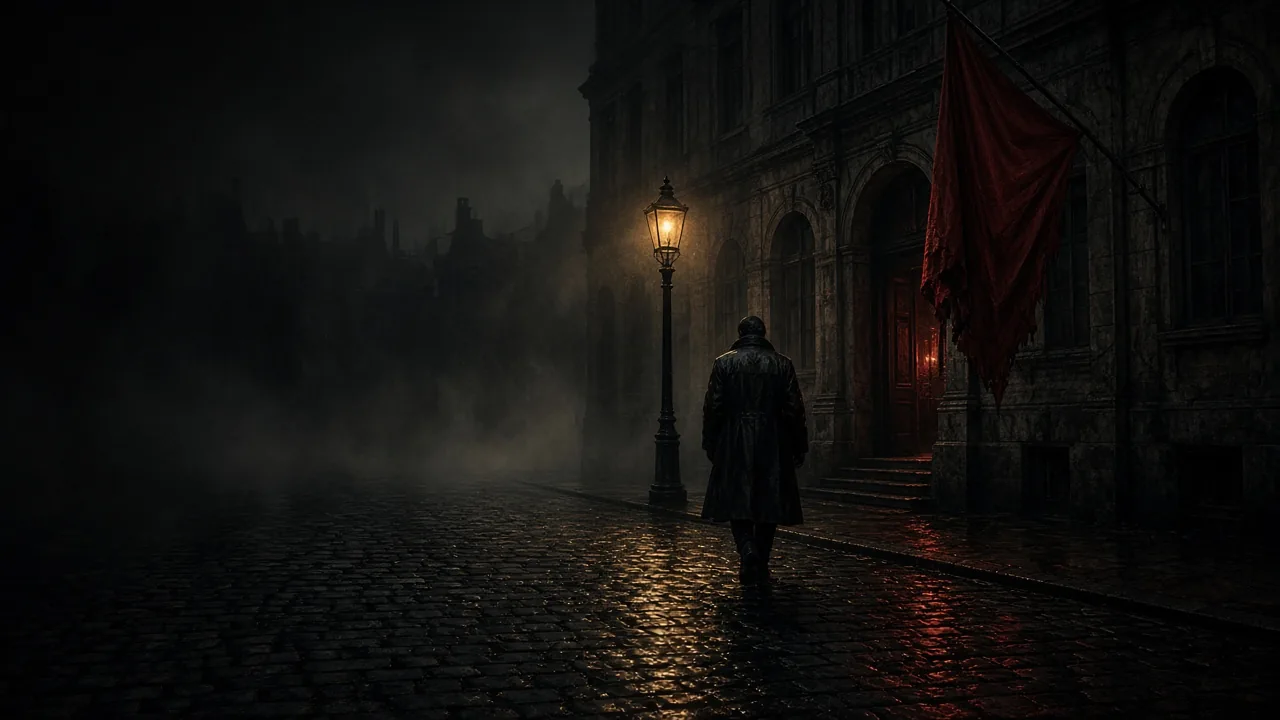
Karl Marx died on March 14, 1883, in London, decades before the establishment of the Soviet secret police. The All-Russian Extraordinary Commission, commonly known as the Cheka, was created thirty-four years later by official decree at the Smolny Institute. Understanding the distinction between nineteenth-century socialist theory and twentieth-century Soviet state apparatuses requires examining both the foundational texts and the institutions of the early Soviet government.
The theoretical groundwork began with Karl Marx and Friedrich Engels, who published The Communist Manifesto in 1848. Commissioned by the Communist League, the manifesto argued that all historical societal development has been driven by class struggle. Marx expanded his analysis in the first volume of Capital (1867), outlining what he termed the economic laws governing modern capitalist production. His framework introduced historical materialism, the abolition of private ownership over the means of production, and the concept of the dictatorship of the proletariat as a temporary transitional phase leading toward a classless society. In 1902, Vladimir Lenin modified this doctrine in What Is To Be Done?, introducing an organizational framework that required a disciplined vanguard party of professional revolutionaries. Lenin argued that the working class, left to its own devices, would develop only trade-union consciousness rather than true revolutionary awareness, necessitating political direction imposed from without.
The practical application of these principles began during the October Revolution of 1917, when the Bolsheviks seized power in Petrograd. In January 1918, the democratically elected Constituent Assembly convened for approximately thirteen hours before being permanently dissolved by the Bolshevik-controlled All-Russian Central Executive Committee. Prior to this, on December 7, 1917, the Council of People's Commissars (Sovnarkom) issued a decree establishing the Cheka1, chaired by Felix Dzerzhinsky, with an initial mandate to investigate and eliminate counterrevolutionary activity and sabotage.
The Cheka's operational authority expanded rapidly during its initial months. By early 1918, the agency asserted the right to perform summary executions, a measure reinforced by the February decree "The Socialist Homeland is in Danger!", which authorized the immediate liquidation of alleged state enemies2. In 1918, Dzerzhinsky publicly defended the use of systematic state coercion, stating that organized terror was an absolute necessity during revolutionary periods and that state security institutions were required to defend the regime even if innocent individuals were affected. Directives issued by senior leadership reinforced these measures. On August 11, 1918, during a peasant uprising in Penza, Lenin dispatched a telegraph instructing local party leaders to publicly execute no fewer than one hundred prominent landowning peasants3 (kulaks), confiscate their grain, take hostages, and ensure the actions served as a regional deterrent.
Between mid-1918 and early 1921, the regime instituted War Communism, a policy defined by forced agricultural requisitioning, widespread industrial nationalization, labor militarization, and the suppression of private trade. These policies generated severe economic disruption and widespread resistance, culminating in the Tambov Peasant Rebellion (1920–1921) and the Kronstadt Rebellion in March 1921, where naval forces demanded democratic reforms and free soviet elections. The Bolshevik leadership suppressed both revolts. At the Tenth Party Congress in March 1921, Lenin introduced two major adjustments: he replaced food requisitioning with a fixed tax in kind under the New Economic Policy to stabilize agricultural production, while simultaneously securing a confidential resolution that banned organized factions within the Communist Party. This resulted in partial economic liberalization alongside a tightened monopoly on political power.
While the Bolshevik leadership continued to utilize Marx's terminology regarding the dictatorship of the proletariat, the practical application evolved from a conceptual transitional state into an authoritarian party apparatus backed by an unrestricted secret police force.
Contemporary Marxist theorists recognized this structural shift. In her 1918 treatise The Russian Revolution, published posthumously, Polish-German Marxist Rosa Luxemburg argued that emergency wartime measures were being institutionalized4 into a permanent governance model. Luxemburg advocated for democratic participation rather than party dictatorship, stating that political freedom restricted exclusively to supporters of the ruling government did not constitute real freedom, and asserting that genuine liberty must always extend to those who hold differing views. The Cheka was created by decree in December 1917 to combat counterrevolution and sabotage; within months it claimed the right of summary execution, and the emergency commission became a permanent part of the Soviet state.
Sources
Primary sources
- Cheka established by Sovnarkom decree December 7, 1917 Council of People's Commissars, Decree establishing the Cheka (1917).
- February 1918 decree authorized liquidation of state enemies Soviet government, The Socialist Homeland is in Danger! (1918).
- Lenin ordered execution of 100 kulaks in Penza, August 11, 1918 Vladimir Lenin, Telegraph to Penza party leaders (1918).
Secondary sources
- Luxemburg warned emergency measures were becoming permanent Rosa Luxemburg, The Russian Revolution (1918).
Facts
- Founded
- Decree of Sovnarkom, 20 December 1917 (N.S.), chaired by Felix Dzerzhinsky.
- Source: Encyclopaedia Britannica, Cheka
- Mandate
- Combat counter-revolution and sabotage; authority expanded to summary execution in 1918.
- Source: Encyclopaedia Britannica, Cheka
Sources
- Encyclopaedia Britannica, Cheka Source
Source links accessed 22 November 2026.
Images
Related
- Joseph StalinConnected
- RussiaConnected
- Twentieth centuryConnected
- Stalin's TerrorConnected
- Soviet UnionSame civilization
- HolodomorSame civilization
What happened elsewhere
Pairings are by recorded year, not exact simultaneity.
- FinlandWhile The Cheka (1917)
- U.S. Virgin IslandsWhile The Cheka (1917)
- Nicolae CeaușescuWhile The Cheka (1918)
- AustriaWhile The Cheka (1918)
- PolandWhile The Cheka (1918)
Meanwhile
Meanwhile, around the world — drag to spin, click a pulsing marker.
Keep reading
Articles
My notes
Highlights on this page
None yet.
Spotted an error on this page? Email [email protected] and it will be checked against the sources.