
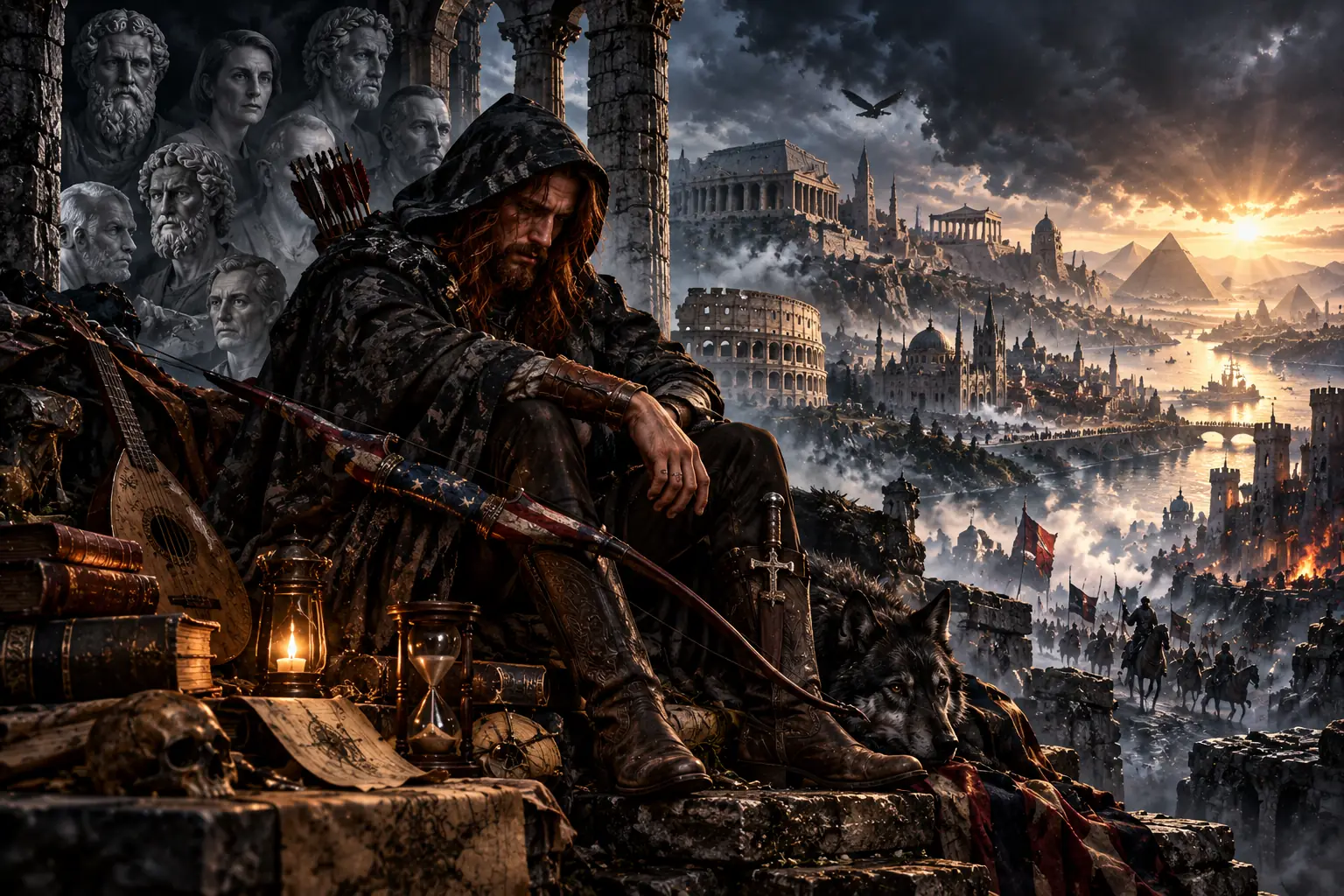
Civilization · Classical antiquity · Roman Empire
Roman Empire
27 BCE–476 CE
The Roman Empire ruled the Mediterranean world for five centuries. At its height under Trajan it stretched from Britain to Egypt. The western half fell in 476 CE; the eastern half lived on as Byzantium.
The Roman Empire began in 27 BCE, when the Senate granted Octavian the name Augustus and left him in command of the frontier armies while the republic's offices continued. Under Trajan in 117 CE the empire reached its widest extent, from Britain and Spain to Mesopotamia and the Persian Gulf. Modern estimates put its population between 50 and 70 million people. Latin was the language of government in the west and Greek in the east.
The emperor governed through appointed provincial governors, a central staff drawn from his household and the equestrian order, and city councils that collected taxes and ran local affairs. Censuses registered provincial households for the land tax and the poll tax. In 212 CE the emperor Caracalla extended Roman citizenship to all free inhabitants of the empire. Armies and engineers built about 80,000 kilometres of paved road, and aqueducts carried water to the cities.
Constantine moved the chief imperial capital to Constantinople in 330 CE, and from 395 CE two emperors ruled the eastern and western halves separately. Germanic peoples set up kingdoms inside the western provinces during the fifth century. In 476 CE the commander Odoacer deposed Romulus Augustulus, the last western emperor, and sent the imperial insignia to Constantinople. The eastern empire continued under its own emperors.
Facts
- Founded
- 27 BCE, Augustus became the first emperor.
- Source: Encyclopaedia Britannica, Roman Empire
- Ended
- 476 CE, the last western emperor deposed; the east survived to 1453.
- Source: Encyclopaedia Britannica, Roman Empire
- Heartland
- The Mediterranean, capital Rome, later Constantinople in the east.
- Source: Encyclopaedia Britannica, Roman Empire
- Major rulers
- Augustus, the founder; Trajan, at the greatest extent; Constantine, who made Christianity legal; Justinian, who reconquered the west.
- Source: Encyclopaedia Britannica, Roman Empire
Sources
- Encyclopaedia Britannica, Roman Empire Source
Source links accessed 22 November 2026.
Images
Related
- SenecaSame civilization
- AugustusSame civilization
- EpictetusSame civilization
- Marcus AureliusSame civilization
- Sextus EmpiricusSame civilization
- PlotinusSame civilization
What happened elsewhere
Pairings are by recorded year, not exact simultaneity.
- Julius CaesarWhile Roman Empire (100 BC)
Meanwhile
Meanwhile, around the world — drag to spin, click a pulsing marker.
Keep reading
Test yourself
When was Roman Empire founded?
- 27 BCE, Augustus became the first emperor
- 221 BCE, Qin Shi Huang proclaimed the first emperor
- 206 BCE, Liu Bang founded the dynasty after Qin's fall
- 224 CE, Ardashir I overthrew the Parthians
Answer
27 BCE, Augustus became the first emperor — Founded: 27 BCE, Augustus became the first emperor.
When did Roman Empire end?
- 476 CE, the last western emperor deposed; the east survived to 1453
- c. 550 CE, broken by Hun invasions
- 651 CE, the last king killed; Persia became Muslim
- 220 CE, the last emperor deposed; China split into Three Kingdoms
Answer
476 CE, the last western emperor deposed; the east survived to 1453 — Ended: 476 CE, the last western emperor deposed; the east survived to 1453.
Where was the heartland of Roman Empire?
- The Mediterranean, capital Rome, later Constantinople in the east
- Persia and Mesopotamia, capital Ctesiphon, in present day Iran and Iraq
- Italy, capital Rome
- Northern India, capital Pataliputra
Answer
The Mediterranean, capital Rome, later Constantinople in the east — Heartland: The Mediterranean, capital Rome, later Constantinople in the east.
True or false: The Roman Empire ruled the Mediterranean world for five centuries.
- True
- False
Answer
True — True. The Roman Empire ruled the Mediterranean world for five centuries.
My notes
Highlights on this page
None yet.
Myth vs. evidence
The myth
In the arena, a thumbs down from the crowd meant death for a beaten gladiator.
The evidence
The Latin in the sources is pollice verso, a turned thumb, and no surviving text or picture settles which direction meant death and which meant mercy. The confident modern code comes from an 1872 painting by Gerome and the films that copied it.
Sources: Juvenal, Satires 3; Anthony Corbeill, Nature Embodied, on the Roman gesture
Spotted an error on this page? Email [email protected] and it will be checked against the sources.