

Ruler · Classical antiquity · Roman Empire · Italy
Augustus
63 BC–14 AD
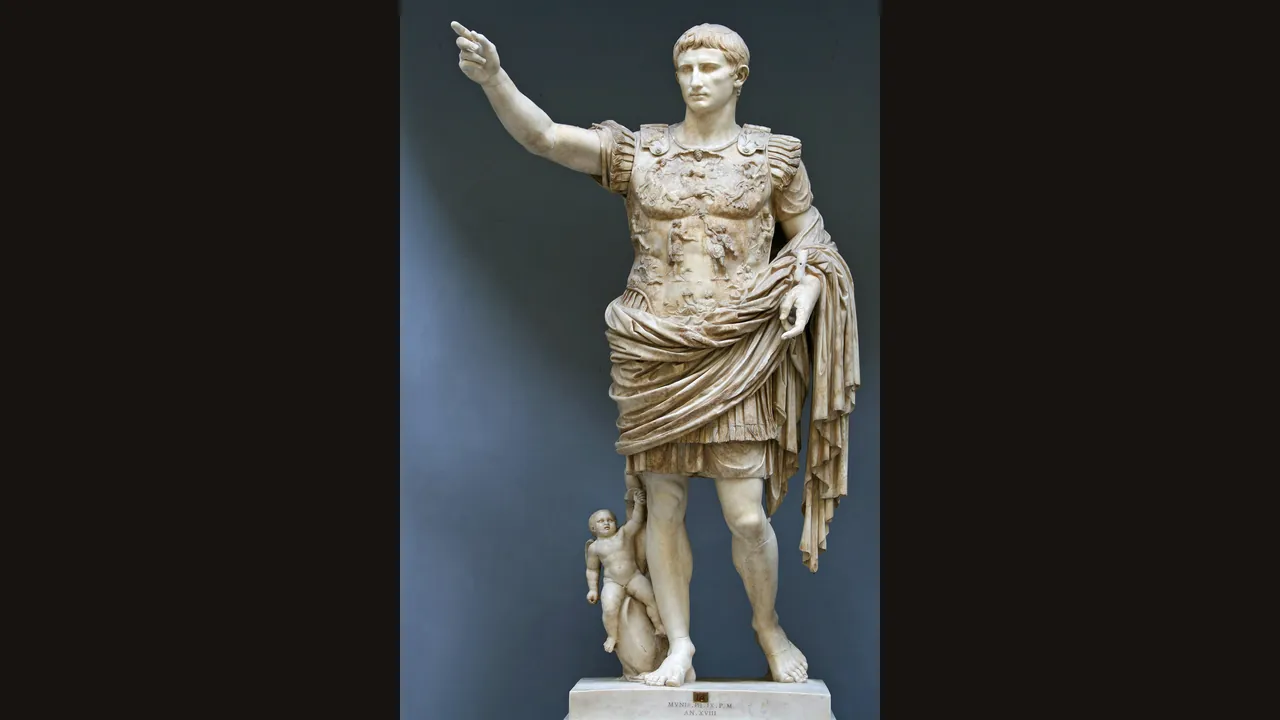
First emperor of Rome, ruling from 27 BC to 14 AD, born Gaius Octavius in 63 BC. He defeated Mark Antony and Cleopatra at Actium in 31 BC and then rebuilt the Roman state around himself while keeping republican names. His reign began the Pax Romana, two centuries of relative peace.
Augustus was born Gaius Octavius in Rome in 63 BC. His father died when he was four, and his upbringing fell to his mother Atia, who was Julius Caesar's niece. Caesar took an interest in the boy, named him in his will as his adopted son and heir, and left him three quarters of his estate. Octavian, as historians call him in these years, was studying in Apollonia in Illyria when news of Caesar's murder reached him in 44 BC. He was nineteen. He accepted the inheritance and the name Gaius Julius Caesar, raised a private army from Caesar's veterans, and marched on Rome. In 43 BC the Senate, under force, made him consul.
That same year Octavian formed the Second Triumvirate with Mark Antony and Marcus Lepidus, a legal board of three men given power to remake the state for five years, and later renewed. The triumvirs published lists of proscribed enemies whose property was seized and whose lives were forfeit. About 300 senators and 2,000 equestrians appeared on the lists, and Cicero was among the first killed. In 42 BC the armies of Octavian and Antony defeated Brutus and Cassius at Philippi in Macedonia. The victors divided the Roman world. Antony took the east and Octavian took the west, and Lepidus, the weakest of the three, was pushed aside in 36 BC after Octavian defeated Sextus Pompeius, the son of Pompey, who had held Sicily and blockaded Italy.
War between Octavian and Antony followed. Antony had married Octavian's sister Octavia and then lived in Egypt with Cleopatra, and Octavian used the scandal, and Antony's will, to win public opinion in Italy. In 31 BC Octavian's fleet under Agrippa defeated Antony and Cleopatra at Actium off the coast of Greece. The pair fled to Egypt and killed themselves in 30 BC as Octavian took Alexandria. Egypt became a Roman province, and Octavian stood alone as master of the Roman world.
His problem was to keep that power without provoking the fate of Caesar. In January 27 BC he announced that he was handing the state back to the Senate and people of Rome. The Senate responded by granting him the name Augustus and a command over the provinces that held most of the legions, for ten years at first and renewed after that. In 23 BC a second arrangement gave him the power of a tribune, renewed every year for life, and a greater military command that outranked other governors. He stopped holding the consulship every year. The exact legal shape of his position is still argued over by historians. Ronald Syme called the whole process a Roman revolution carried out by a party leader. Augustus himself, in the Res Gestae, the account of his deeds he left to be carved in bronze, claimed he had restored the republic and excelled everyone only in authority, holding no more power than his colleagues in any office.
He built a standing professional army of 28 legions stationed on the frontiers, with fixed terms of service and retirement grants paid from a new military treasury. The Praetorian Guard stood in Italy. He reformed taxation in the provinces, ordered censuses, built roads, created a police force and a fire brigade for Rome, and secured the grain supply of the capital. His armies pushed the frontier to the Danube and annexed Galatia, Judaea, and parts of the Alpine region. In Germany the work failed. In AD 9 the Cheruscan leader Arminius destroyed three legions under Quinctilius Varus in the Teutoburg Forest, and Rome never conquered the lands east of the Rhine. Augustus dealt with Parthia by diplomacy, recovering in 20 BC the standards Crassus had lost at Carrhae.
Augustus married Livia Drusilla and had no son. His daughter Julia was exiled for adultery in 2 BC. His grandsons Gaius and Lucius, adopted as heirs, died young. In AD 4 Augustus adopted his stepson Tiberius and required Tiberius to adopt Germanicus, fixing the succession. He died at Nola in AD 14, aged seventy five, and the Senate declared him a god. The settlement he built, an empire wrapped in republican forms, lasted for centuries. The main sources are his own Res Gestae, the biographies of Suetonius, the history of Cassius Dio, and the Annals of Tacitus.
Facts
- Born
- 63 BC, Rome.
- Source: Encyclopaedia Britannica, Augustus
- Died
- 14 AD, Nola.
- Source: Encyclopaedia Britannica, Augustus
- Reign
- 27 BC to 14 AD as Augustus.
- Source: Encyclopaedia Britannica, Augustus
- Realm
- The Roman Empire.
- Source: Encyclopaedia Britannica, Augustus
- Known for
- Actium (31 BC) and the founding of the Principate.
- Source: Encyclopaedia Britannica, Augustus
Sources
- Encyclopaedia Britannica, Augustus Source
Source links accessed 22 November 2026.
Images
Related
- ItalyConnected
- Roman EmpireSame civilization
- SenecaSame civilization
- EpictetusSame civilization
- Marcus AureliusSame civilization
- Sextus EmpiricusSame civilization
Meanwhile
Meanwhile, around the world — drag to spin, click a pulsing marker.
Keep reading
Test yourself
When was Augustus born?
- 63 BC, Rome
- About 272, Naissus (now Nis in Serbia)
- 356 BC, Pella, Macedon
- About 495 BC, Athens
Answer
63 BC, Rome — Born: 63 BC, Rome.
When did Augustus die?
- 14 AD, Nola
- 429 BC, of plague, Athens
- 323 BC, Babylon
- 210 BC, on tour in eastern China
Answer
14 AD, Nola — Died: 14 AD, Nola.
When did Augustus reign?
- 27 BC to 14 AD as Augustus
- 141 to 87 BC
- As king of Qin 246 to 221 BC; as emperor 221 to 210 BC
- About 268 to 232 BC
Answer
27 BC to 14 AD as Augustus — Reign: 27 BC to 14 AD as Augustus.
What realm did Augustus rule?
- The Roman Empire
- An empire from Greece to India, divided after his death among his generals
- The Maurya Empire, covering most of the Indian subcontinent
- The Roman Empire, reunited under one ruler
Answer
The Roman Empire — Realm: The Roman Empire.
True or false: First emperor of Rome, ruling from 27 BC to 14 AD, born Gaius Octavius in 63 BC.
- True
- False
Answer
True — True. First emperor of Rome, ruling from 27 BC to 14 AD, born Gaius Octavius in 63 BC.
My notes
Highlights on this page
None yet.
Myth vs. evidence
The myth
Augustus became emperor in 27 BCE when the Senate handed him supreme power in a single settlement.
The evidence
His supremacy was assembled in stages and kept republican dress. The settlement of 27 BCE formally returned the state to the Senate while leaving him its strongest man, and the settlement of 23 BCE reshaped his position again around tribune power and a greater command over the armies.
Sources: Augustus, Res Gestae; Cassius Dio, Roman History 53
Spotted an error on this page? Email [email protected] and it will be checked against the sources.