

Philosopher · Classical antiquity · Roman Empire · Italy
Marcus Aurelius
121–180
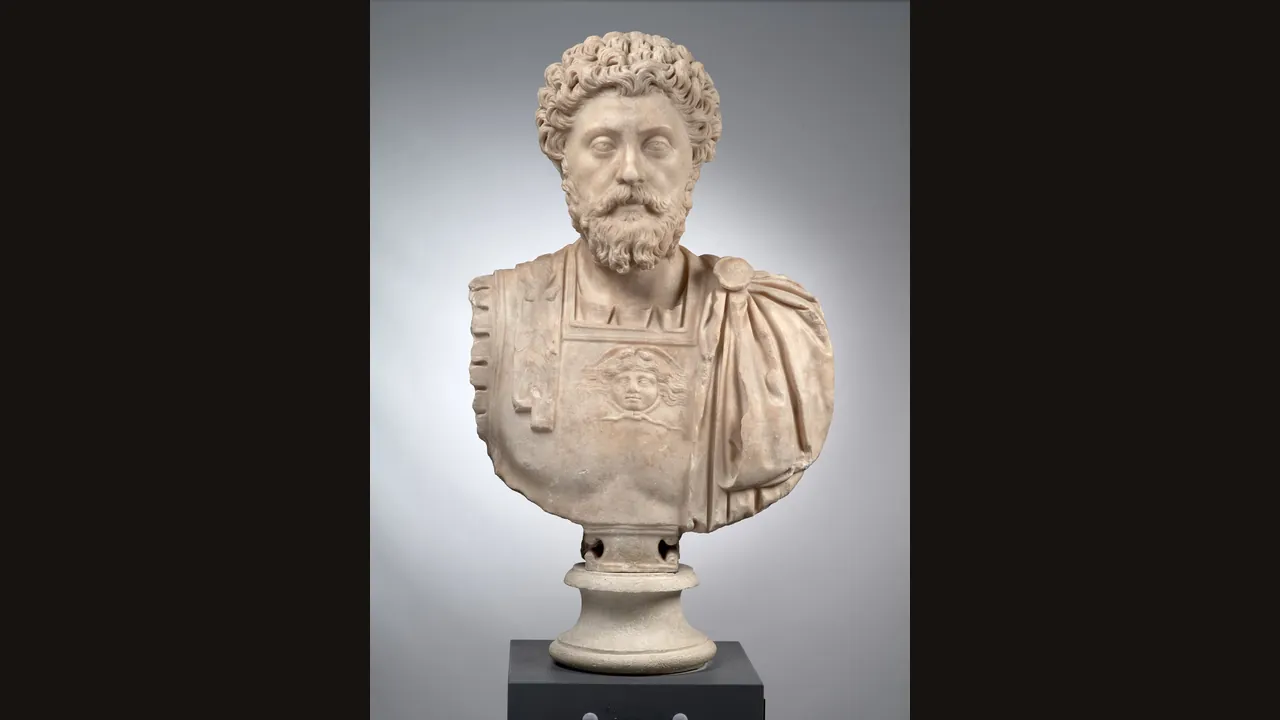
Roman emperor from 161 to 180 who wrote the Meditations, a private notebook of Stoic exercises, in Greek on campaign along the Danube. He lived 121 to 180. The book was never meant for publication.
Marcus Aurelius was born in Rome in 121, into a rich family that had come from Spain generations earlier. His father died when he was young, and the emperor Hadrian noticed the boy and arranged his future. Hadrian adopted Antoninus Pius as his heir on the condition that Antoninus adopt Marcus and a younger boy, Lucius Verus. Marcus thus stood in the direct line of succession from the age of seventeen, and Antoninus, who reigned from 138 to 161, trained him by giving him office and work. Marcus married Antoninus's daughter Faustina, and the marriage produced at least thirteen children, most of whom died young.
He became emperor in 161 and at once made Lucius Verus joint emperor with him, the first formal sharing of the imperial office between equals. The reign that followed was spent mostly in war and disease. Rome fought Parthia in the east from 161 to 166, a war fought under Verus and generals such as Avidius Cassius, and the returning armies brought plague with them. The Antonine Plague, probably smallpox, moved through the empire for years and killed on a scale no source measures reliably; modern estimates of the toll are guesses built on scattered reports. Verus died in 169, perhaps of the plague. From 166 onward Germanic peoples pressed across the Danube, and invaders at one point crossed the Alps into Italy itself. Marcus spent most of the 170s on the Danube frontier fighting the Marcomanni, the Quadi, and the Sarmatians, raised money by auctioning palace treasures, and enrolled even slaves and gladiators when recruits ran short. In 175 Avidius Cassius, acting on a false report that Marcus had died, had himself proclaimed emperor in the east. His own soldiers killed him before Marcus reached Syria, and Marcus treated the rebel provinces with a restraint the sources note as deliberate policy.
In 177 Marcus raised his son Commodus, then fifteen, to be joint emperor with him. The act broke the practice of the previous century, in which each emperor had adopted a capable adult as his heir, and it put the succession back on birth. Marcus died on campaign in 180, at Vindobona on the Danube or at Sirmium; the ancient sources differ on the place, and the cause was probably the plague. Commodus made peace with the Danube tribes and returned to Rome. His reign ended in his murder in 192, followed by civil war. Edward Gibbon, and many historians since, have treated the choice of Commodus as the great failure of the reign, the point at which Marcus put fatherhood above the empire. That judgment is an interpretation. The fact under it is not disputed: the succession by adoption had given Rome a run of able rulers, and Marcus ended it.
The Meditations was not written for readers. Marcus composed it in Greek, the language of philosophy, in twelve books, much of it in camp on the Danube; a heading in the manuscripts places one book among the Quadi on the river Gran. The Greek title tradition gives it means, roughly, the things addressed to himself. The notes apply Stoic teaching to the business of ruling: that fame after death is nothing, that the universe runs by reason, that a man should do the work in front of him without complaint, and that anger at wrongdoing misunderstands what wrongdoers are. The first book is a list of debts, naming what he learned from each member of his family and each teacher. From Junius Rusticus, his Stoic teacher, he records receiving a copy of the Discourses of Epictetus, the former slave whose teaching stands behind the whole work. The text survived through a handful of manuscripts, and its survival was never guaranteed; the complete work reached print only in 1559.
Christians suffered under his government in places, most famously at Lyon and Vienne in Gaul in 177, where prisoners were tortured and killed. Justin Martyr had been executed at Rome around 165 after a trial before the city prefect, who was that same Junius Rusticus. No general edict of Marcus against the Christians survives, and historians dispute how far the persecution under him was his own policy rather than the work of local governors and crowds pressing local charges. What is certain is that the emperor did not stop it.
He remains the single case in Roman history of a serious philosopher holding supreme power, and the Meditations is read because the power was real. Machiavelli counted him last of the five good emperors, the rulers who gained the throne by adoption and merit rather than by birth. Readers since have measured him by the distance between the notebook and the reign: the wars and the plague he could not master, and the son he would not pass over.
Facts
- Born
- 121, Rome, Italy.
- Source: Encyclopaedia Britannica, Marcus Aurelius
- Died
- 180, on the Danube frontier, likely of plague.
- Source: Encyclopaedia Britannica, Marcus Aurelius
- School
- Stoicism, practiced from the throne.
- Source: Encyclopaedia Britannica, Marcus Aurelius
- Known for
- The Meditations, twelve books of self examination, and the last of the Five Good Emperors.
- Source: Encyclopaedia Britannica, Marcus Aurelius
Sources
- Encyclopaedia Britannica, Marcus Aurelius Source
Source links accessed 22 November 2026.
Images
Related
- ItalyConnected
- Zeno of CitiumConnected
- SenecaConnected
- EpictetusConnected
- Sextus EmpiricusSame civilization
- PlotinusSame civilization
Meanwhile
Meanwhile, around the world — drag to spin, click a pulsing marker.
Keep reading
Test yourself
When was Marcus Aurelius born?
- 121, Rome, Italy
- 341 BC, Samos, Greece
- About 280 BC, of the royal house of the Han state, China
- About 360 BC, Elis, Greece
Answer
121, Rome, Italy — Born: 121, Rome, Italy.
When did Marcus Aurelius die?
- 180, on the Danube frontier, likely of plague
- 270 BC, Athens
- About 262 BC, Athens
- About 135, Nicopolis, Greece
Answer
180, on the Danube frontier, likely of plague — Died: 180, on the Danube frontier, likely of plague.
What is Marcus Aurelius known for?
- The Meditations, twelve books of self examination, and the last of the Five Good Emperors
- Living in a tub, carrying a lantern in daylight looking for an honest man, and telling Alexander to stand out of his sunlight. The stories are later, not records
- Atoms and the void as the explanation of all change, and an ethics of cheerfulness
- Founding Stoicism: live according to nature, want only what is in your control, treat virtue as the sole good
Answer
The Meditations, twelve books of self examination, and the last of the Five Good Emperors — Known for: The Meditations, twelve books of self examination, and the last of the Five Good Emperors.
Which school of thought was Marcus Aurelius part of?
- Stoicism, practiced from the throne
- Stoicism, named for the Stoa Poikile where he taught
- Academic skepticism, with Stoic leanings in ethics
- Eleatic school, the strict logic of being
Answer
Stoicism, practiced from the throne — School: Stoicism, practiced from the throne.
True or false: Roman emperor from 161 to 180 who wrote the Meditations, a private notebook of Stoic exercises, in Greek on campaign along the Danube.
- True
- False
Answer
True — True. Roman emperor from 161 to 180 who wrote the Meditations, a private notebook of Stoic exercises, in Greek on campaign along the Danube.
My notes
Highlights on this page
None yet.
Spotted an error on this page? Email [email protected] and it will be checked against the sources.