

Philosopher · Classical antiquity · Roman Empire · Egypt
Plotinus
c. 204–270
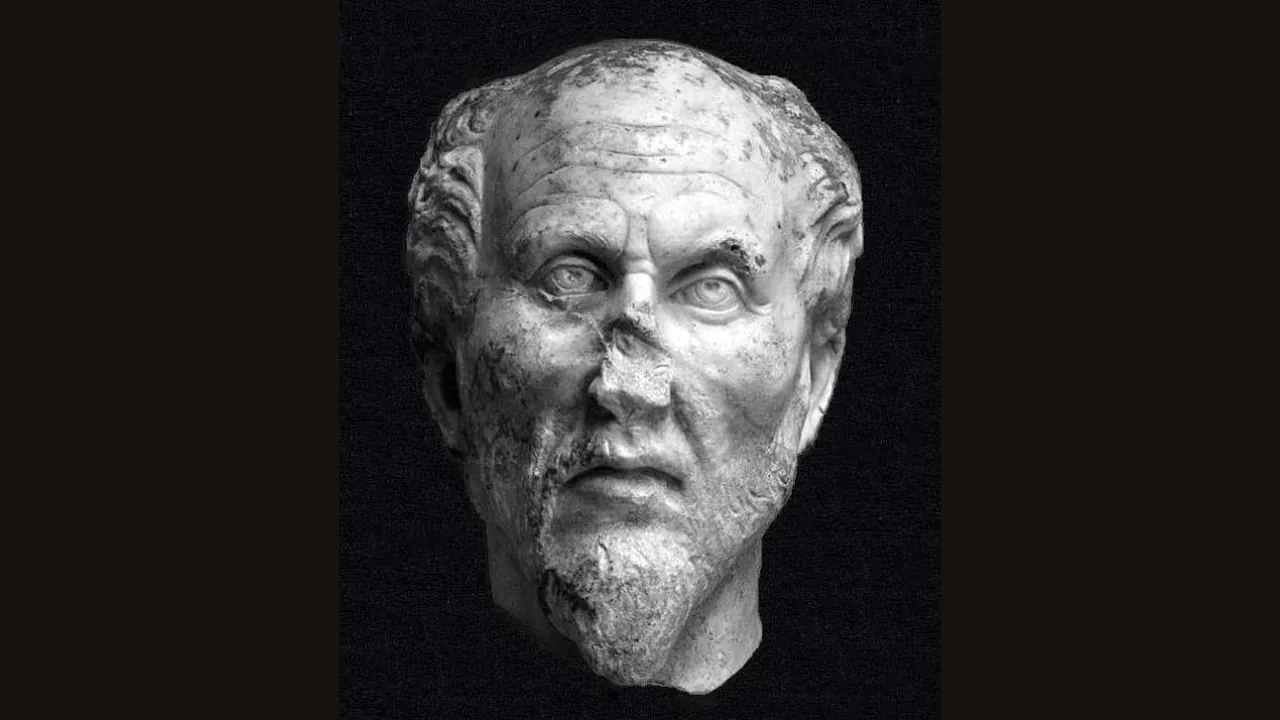
Founder of Neoplatonism, born probably at Lycopolis in Egypt, who taught at Rome from 244 until his death. His pupil Porphyry edited his writings as the Enneads. He lived about 204 to 270.
Plotinus was born in Egypt in about 204, probably at Lycopolis. At twenty-eight he began to study philosophy at Alexandria under Ammonius Saccas and stayed with him eleven years. In 243 he joined the emperor Gordian's expedition against Persia, hoping to study Persian and Indian thought at first hand. Gordian was murdered in Mesopotamia, and Plotinus escaped to Antioch and then settled at Rome in 244. He taught there for the rest of his life, lecturing to a circle of senators and students and writing nothing until his fiftieth year. He died in Campania in 270.
His pupil Porphyry collected his fifty-four treatises and arranged them in six sets of nine, the Enneads. Plotinus taught that all things proceed from the One, a first principle beyond being and beyond description. From the One flows Intellect, which thinks itself and holds the Platonic forms. From Intellect flows Soul, which orders the sensible world and descends in part into bodies. The procession needs no act of will and takes nothing from the source, as light leaves a lamp undiminished. Matter stands at the last remove and counts as privation and evil. The human soul, he taught, is not wholly fallen, and it returns upward by virtue and contemplation, stripping away images until, in rare moments, it rests in union with the One.
Facts
- Born
- About 204, probably Lycopolis, Egypt.
- Source: Encyclopaedia Britannica, Plotinus
- Died
- 270, in Campania, Italy.
- Source: Encyclopaedia Britannica, Plotinus
- School
- Neoplatonism, built from Plato with Stoic and Aristotelian parts.
- Source: Encyclopaedia Britannica, Plotinus
- Known for
- The doctrine of the One, from which Intellect and Soul overflow, and the soul's return by contemplation.
- Source: Encyclopaedia Britannica, Plotinus
Sources
- Encyclopaedia Britannica, Plotinus Source
Source links accessed 22 November 2026.
Images
Related
- ItalyConnected
- EgyptConnected
- PlatoConnected
- Augustine of HippoConnected
- Sextus EmpiricusSame civilization
- Marcus AureliusSame civilization
What happened elsewhere
Pairings are by recorded year, not exact simultaneity.
- Sassanian EmpireWhile Plotinus (around 224)
Meanwhile
Meanwhile, around the world — drag to spin, click a pulsing marker.
Keep reading
Test yourself
When was Plotinus born?
- About 204, probably Lycopolis, Egypt
- About 369 BC, in the state of Song, China
- About 334 BC, Citium, Cyprus
- 106 BC, Arpinum, Italy
Answer
About 204, probably Lycopolis, Egypt — Born: About 204, probably Lycopolis, Egypt.
When did Plotinus die?
- 270, in Campania, Italy
- 233 BC, in prison in the state of Qin
- 270 BC, Athens
- 180, on the Danube frontier, likely of plague
Answer
270, in Campania, Italy — Died: 270, in Campania, Italy.
What is Plotinus known for?
- The doctrine of the One, from which Intellect and Soul overflow, and the soul's return by contemplation
- Living in a tub, carrying a lantern in daylight looking for an honest man, and telling Alexander to stand out of his sunlight. The stories are later, not records
- Atoms and the void as the explanation of all change, and an ethics of cheerfulness
- Impartial care, the condemnation of aggressive war, frugality in ritual, and early work on logic and optics
Answer
The doctrine of the One, from which Intellect and Soul overflow, and the soul's return by contemplation — Known for: The doctrine of the One, from which Intellect and Soul overflow, and the soul's return by contemplation.
Which school of thought was Plotinus part of?
- Neoplatonism, built from Plato with Stoic and Aristotelian parts
- Pyrrhonist skepticism
- Pyrrhonism, the first skeptical school
- Sophist, a traveling teacher of rhetoric and argument
Answer
Neoplatonism, built from Plato with Stoic and Aristotelian parts — School: Neoplatonism, built from Plato with Stoic and Aristotelian parts.
True or false: Founder of Neoplatonism, born probably at Lycopolis in Egypt, who taught at Rome from 244 until his death.
- True
- False
Answer
True — True. Founder of Neoplatonism, born probably at Lycopolis in Egypt, who taught at Rome from 244 until his death.
My notes
Highlights on this page
None yet.
Spotted an error on this page? Email [email protected] and it will be checked against the sources.