

Philosopher · Classical antiquity · Roman Empire · Turkey
Epictetus
c. 50–c. 135
Stoic teacher born a slave at Hierapolis, in modern Turkey, who won his freedom and taught at Nicopolis in Greece. His pupil Arrian wrote down his talks as the Discourses and the handbook Enchiridion. He lived about 50 to 135.
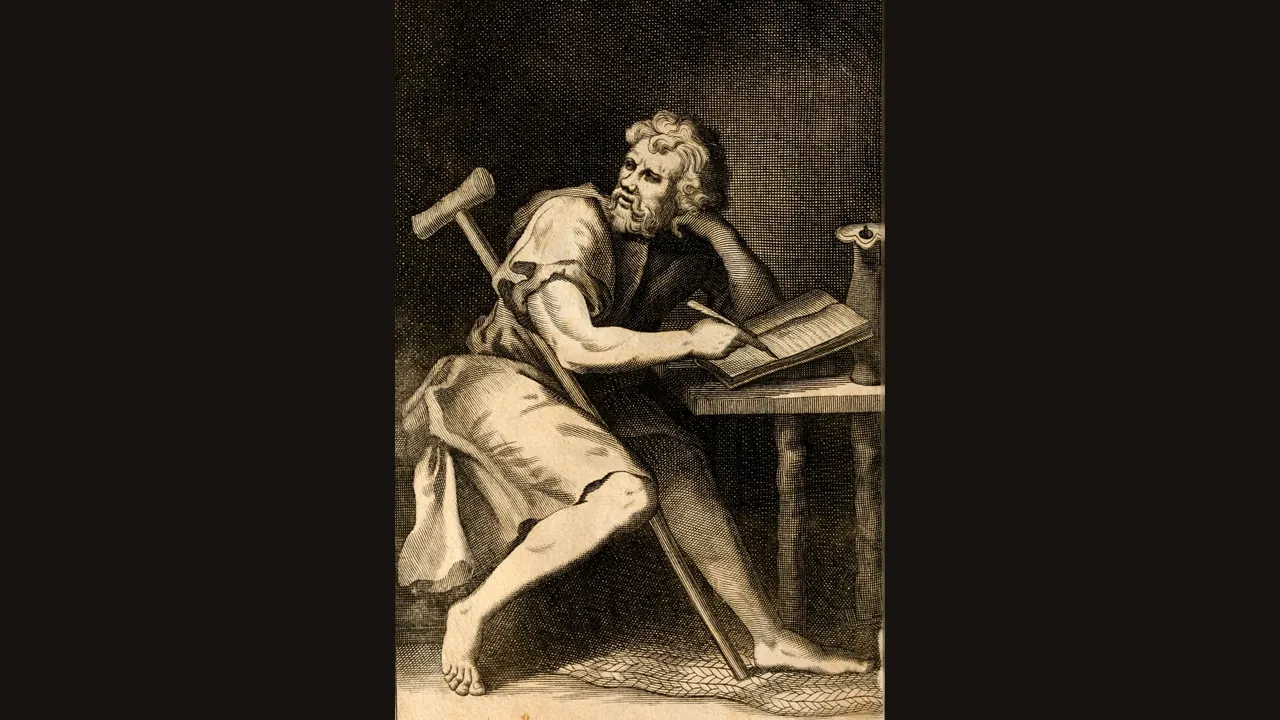
Epictetus was born in about 50 at Hierapolis in Phrygia, in what is now Turkey, and came to Rome as a slave. His owner was Epaphroditus, a rich freedman who served as a secretary to the emperor Nero. Epictetus walked lame all his life. One late account says Epaphroditus twisted the leg and broke it while Epictetus bore the pain without crying out. Another tradition attributes the lameness to disease. The sources do not agree, and the dramatic version has the shape of a story improved in the telling. While still a slave he attended the lectures of Musonius Rufus, the leading Roman Stoic teacher of the day, and studied logic and ethics under him.
He gained his freedom sometime after Nero's fall in 68 and began teaching at Rome. In about 93 the emperor Domitian banished philosophers from the city, and then from Italy. Epictetus moved to Nicopolis, a Roman colony on the west coast of Greece, and opened a school there. The school drew the sons of Roman senators, and Hadrian, who later became emperor, visited it in his youth if the late imperial biographies can be trusted. Students came to be trained, not merely to hear lectures. Epictetus ran his classroom as a hospital, in the image his recorder preserved, and told his students that they arrived sick and should leave having been treated.
He wrote nothing himself. What we have comes from his student Arrian, a young man from Nicomedia who went on to govern Cappadocia and to write a history of Alexander. Arrian took notes on the lectures. In the letter that opens the Discourses he says he set down what Epictetus said in order to preserve it, not as a book composed for the public, and that the notes passed into circulation beyond his intention. Of the eight books of Discourses he recorded, four survive. He also distilled the teaching into the Enchiridion, a handbook of fifty three short chapters whose Greek title means a thing held in the hand. Scholars dispute how faithfully the record reproduces the spoken lectures. The voice is consistent and distinctive, but Arrian was a skilled writer who shaped his material elsewhere, and certainty on this point is not available.
The teaching turns on one distinction. Some things are up to us: our judgments, our impulses, our desires and aversions, the use we make of impressions. Other things are not up to us: the body, property, reputation, office, and in general whatever is not our own doing. Freedom, for Epictetus, is not getting what we want but wanting what happens, as the eighth chapter of the Enchiridion puts it. A man is enslaved not by a master but by needing things that other men control. He pressed his students to test every impression before assenting to it, and to remember the part each of them was playing in life. A person is a son, a brother, a father, a citizen, and each relation carries duties that do not wait on reward. His manner in the Discourses is blunt, and comic by turns. He mocks students who want to lecture on books they have not practiced, and he tells them the school exists to correct their desires and aversions, not to drill them in reciting Chrysippus.
Epictetus never married. The commentator Simplicius, writing centuries later, reports that in old age he took in a child of a friend who would otherwise have been exposed to die, and brought in a woman to nurse it. He died at Nicopolis in about 135. Lucian, the satirist of the next generation, records that after his death a collector paid three thousand drachmae for the clay lamp Epictetus had used, which is some measure of the fame attached to a man who owned almost nothing.
The Enchiridion has never been out of circulation for long. Monks copied it, Christian writers adapted it into a manual of their own, and modern readers still meet Stoicism first through it. The emperor Marcus Aurelius read the Discourses with care, took their author as a model of the free mind, and thanked his teacher in his own notebook for the loan of the book. Epictetus's standing rests on the position from which he taught. He preached freedom as a man whom the law had owned, and the teaching grants no exemption for circumstance. The division he drew, between what a person controls and what he does not, stands in the first lines of the handbook and remains the most quoted sentence in Stoic ethics.
Facts
- Born
- About 50, Hierapolis, in what is now Turkey, enslaved in Rome.
- Source: Encyclopaedia Britannica, Epictetus
- Died
- About 135, Nicopolis, Greece.
- Source: Encyclopaedia Britannica, Epictetus
- School
- Stoicism, freed from theory into practice.
- Source: Encyclopaedia Britannica, Epictetus
- Known for
- The division of things into what is up to us and what is not, the core of his handbook Enchiridion.
- Source: Encyclopaedia Britannica, Epictetus
Sources
- Encyclopaedia Britannica, Epictetus Source
Source links accessed 22 November 2026.
Images
Related
- Zeno of CitiumConnected
- SenecaConnected
- Marcus AureliusConnected
- Roman EmpireSame civilization
- Sextus EmpiricusSame civilization
- AugustusSame civilization
Meanwhile
Meanwhile, around the world — drag to spin, click a pulsing marker.
Keep reading
Test yourself
When was Epictetus born?
- About 50, Hierapolis, in what is now Turkey, enslaved in Rome
- 106 BC, Arpinum, Italy
- About 334 BC, Citium, Cyprus
- About 360 BC, Elis, Greece
Answer
About 50, Hierapolis, in what is now Turkey, enslaved in Rome — Born: About 50, Hierapolis, in what is now Turkey, enslaved in Rome.
When did Epictetus die?
- About 135, Nicopolis, Greece
- 270 BC, Athens
- 270, in Campania, Italy
- 233 BC, in prison in the state of Qin
Answer
About 135, Nicopolis, Greece — Died: About 135, Nicopolis, Greece.
What is Epictetus known for?
- The division of things into what is up to us and what is not, the core of his handbook Enchiridion
- The poem On Nature, which reasons that what is cannot come from what is not, so change and plurality are illusion
- The doctrine that human nature tends to good as water tends downhill, and that a ruler who starves his people loses the mandate to rule
- The measure doctrine: man is the measure of all things. Plato made him the target of the dialogue Theaetetus
Answer
The division of things into what is up to us and what is not, the core of his handbook Enchiridion — Known for: The division of things into what is up to us and what is not, the core of his handbook Enchiridion.
Which school of thought was Epictetus part of?
- Stoicism, freed from theory into practice
- Atomism, developed from his teacher Leucippus
- Stoicism, practiced from the throne
- Epicureanism, taught in the Garden at Athens
Answer
Stoicism, freed from theory into practice — School: Stoicism, freed from theory into practice.
True or false: Stoic teacher born a slave at Hierapolis, in modern Turkey, who won his freedom and taught at Nicopolis in Greece.
- True
- False
Answer
True — True. Stoic teacher born a slave at Hierapolis, in modern Turkey, who won his freedom and taught at Nicopolis in Greece.
My notes
Highlights on this page
None yet.
Spotted an error on this page? Email [email protected] and it will be checked against the sources.