

Ruler · Classical antiquity · Roman Republic · Italy
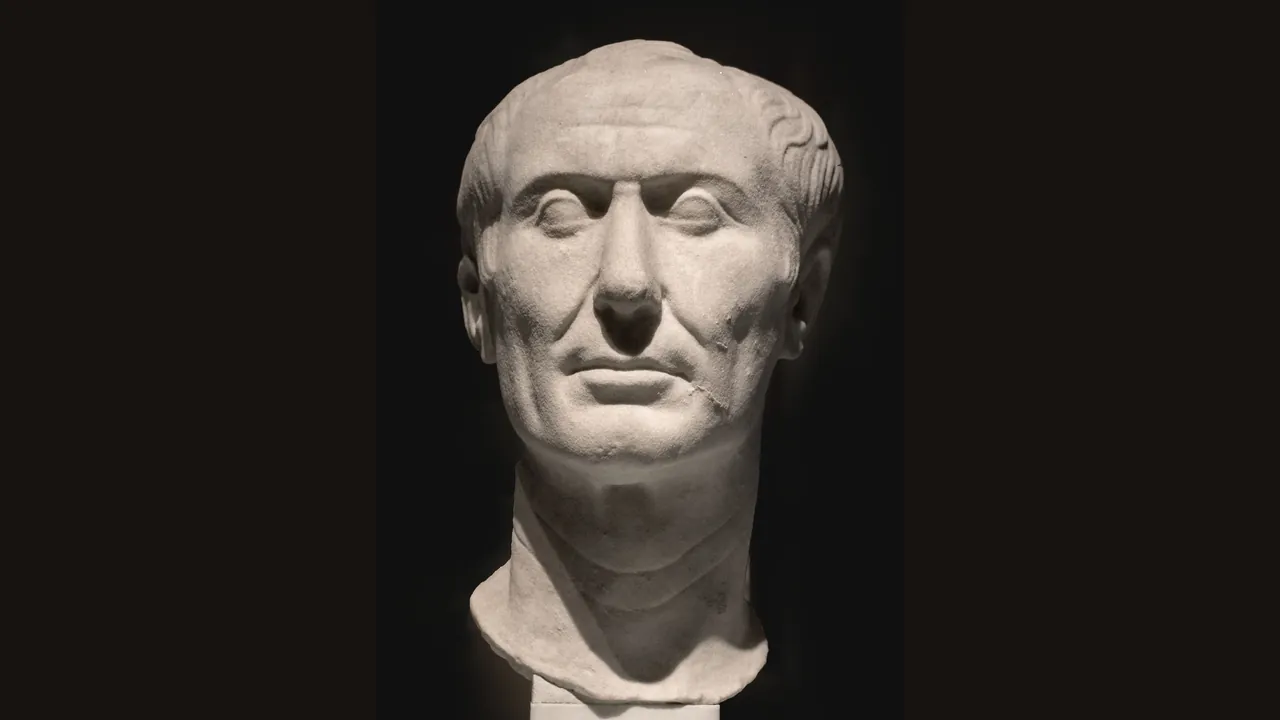
Julius Caesar
100–44 BC
Roman general and statesman, 100 to 44 BC, who ended the Roman Republic in practice. His conquest of Gaul made him rich and famous, and his crossing of the Rubicon in 49 BC began a civil war he won. Made dictator for life, he was stabbed to death by senators on the Ides of March, 44 BC.
Gaius Julius Caesar was born in Rome in 100 BC into the Julii, an old patrician family that had produced few famous men in recent generations. His aunt Julia was married to Gaius Marius, the great general and enemy of the dictator Sulla. When Sulla took power he ordered the young Caesar to divorce Cornelia, the daughter of one of Sulla's opponents. Caesar refused and went into hiding, and Sulla pardoned him only after friends intervened. Caesar served as a soldier in the east, and on a voyage in 75 BC pirates captured him near the island of Pharmacusa. Plutarch and Suetonius both tell the story that he raised his own ransom, and after his release he raised a force, captured the pirates, and had them crucified.
Caesar climbed the ladder of Roman offices by spending money he did not have. As aedile in 65 BC he staged lavish games and sank deep into debt. In 63 BC he won election as pontifex maximus, the chief priest of Rome. He governed Further Spain as praetor and returned rich enough to stand for the consulship. In 60 BC he formed the alliance modern historians call the First Triumvirate with Pompey and Crassus. As consul in 59 BC he pushed through land distributions and laws his partners wanted, and then took command in Gaul for five years, a command the Senate later extended.
The Gallic Wars ran from 58 to 50 BC. Caesar defeated the migrating Helvetii, drove the German king Ariovistus back across the Rhine, and fought the Belgae in the north. He crossed into Britain in 55 and 54 BC, the first Roman commander to do so, though he annexed nothing there. In 52 BC the Arvernian chief Vercingetorix united much of Gaul in revolt, and Caesar destroyed his army at Alesia by building walls around the town and holding off a relief force at the same time. Caesar wrote the Commentaries on the Gallic War himself, in the third person. The books were reports to Rome and advertisements for their author at once. His figures for enemy armies and enemy dead are large, and historians treat them with caution.
In January 49 BC Caesar crossed the Rubicon river, the boundary of his province, with one legion. Roman law counted that act as the start of a civil war. Pompey and most of the Senate fled to Greece. Caesar defeated Pompey's legates in Spain, then crossed to Greece and destroyed Pompey's larger army at Pharsalus in 48 BC. Pompey fled to Egypt, where the ministers of Ptolemy XIII murdered him. Caesar stayed in Egypt, took the side of Cleopatra in the royal succession struggle, and fought the Alexandrian War to hold the city. He then settled the east, defeating Pharnaces of Pontus at Zela in 47 BC. Victories at Thapsus in Africa in 46 BC and at Munda in Spain in 45 BC ended organized resistance.
Caesar ruled as dictator, first for ten years and then, early in 44 BC, as dictator for life. He reformed the calendar with the help of the Alexandrian astronomer Sosigenes, producing the Julian calendar of 365 days with a leap year every fourth year. He enlarged the Senate to about 900 members, planted colonies for his veterans and for poor citizens around the Mediterranean, granted citizenship to whole communities, and began public works in Rome that included the Forum Iulium. He pardoned most former enemies and restored many to office.
On 15 March 44 BC, the Ides of March, a group of about sixty senators attacked Caesar at a meeting in the Theatre of Pompey. The leaders included Marcus Brutus and Gaius Cassius. Suetonius records that Caesar received 23 wounds and fell dead at the base of Pompey's statue. The conspirators called themselves liberators and claimed they had saved the Republic. The killing brought no restored republic. It brought a new round of civil wars, and within twenty years Caesar's adopted heir Augustus held the power the assassins had killed Caesar to prevent. The main ancient sources for the life are Caesar's own Commentaries, the letters of Cicero, and the later biographies and histories by Suetonius, Plutarch, Appian, and Cassius Dio.
Facts
- Born
- 100 BC, Rome.
- Source: Encyclopaedia Britannica, Julius Caesar
- Died
- 15 March 44 BC, assassinated in Rome.
- Source: Encyclopaedia Britannica, Julius Caesar
- Office
- Dictator for life from 44 BC.
- Source: Encyclopaedia Britannica, Julius Caesar
- Known for
- The Gallic Wars, the crossing of the Rubicon, and the Julian calendar.
- Source: Encyclopaedia Britannica, Julius Caesar
Sources
- Encyclopaedia Britannica, Julius Caesar Source
Source links accessed 22 November 2026.
Images
Related
- ItalyConnected
- CiceroSame civilization
- Roman RepublicSame civilization
- AugustusSame era
- Han WudiSame era
- Roman EmpireSame era
What happened elsewhere
Pairings are by recorded year, not exact simultaneity.
- Han WudiWhile Julius Caesar (156 BC)
- Roman EmpireWhile Julius Caesar (27 BC)
Meanwhile
Meanwhile, around the world — drag to spin, click a pulsing marker.
Keep reading
Test yourself
When was Julius Caesar born?
- 100 BC, Rome
- 63 BC, Rome
- 356 BC, Pella, Macedon
- About 495 BC, Athens
Answer
100 BC, Rome — Born: 100 BC, Rome.
When did Julius Caesar die?
- 15 March 44 BC, assassinated in Rome
- 13–14 December 1931, Marnes-la-Coquette
- 9 September 1976, Beijing
- 5 May 1821, Saint Helena
Answer
15 March 44 BC, assassinated in Rome — Died: 15 March 44 BC, assassinated in Rome.
What is Julius Caesar known for?
- The Gallic Wars, the crossing of the Rubicon, and the Julian calendar
- The Age of Pericles, the Parthenon, and the Funeral Oration recorded by Thucydides
- Issus (333 BC), Gaugamela (331 BC), and the founding of Alexandria
- The Silk Road, the wars against the Xiongnu, and Confucian state orthodoxy
Answer
The Gallic Wars, the crossing of the Rubicon, and the Julian calendar — Known for: The Gallic Wars, the crossing of the Rubicon, and the Julian calendar.
True or false: Roman general and statesman, 100 to 44 BC, who ended the Roman Republic in practice.
- True
- False
Answer
True — True. Roman general and statesman, 100 to 44 BC, who ended the Roman Republic in practice.
My notes
Highlights on this page
None yet.
Myth vs. evidence
The myth
Caesar's last words were the line Shakespeare gave him, Et tu, Brute.
The evidence
No ancient source records those words. Suetonius reports that some claimed Caesar spoke in Greek to Brutus, saying You too, child, while others held that he said nothing and pulled his toga over his head. The famous Latin line comes from Shakespeare, writing more than sixteen centuries later.
Sources: Suetonius, Lives of the Caesars, Julius 82; Plutarch, Life of Caesar 66
Spotted an error on this page? Email [email protected] and it will be checked against the sources.