

Philosopher · Classical antiquity · Roman Republic · Italy
Cicero
106–43 BC
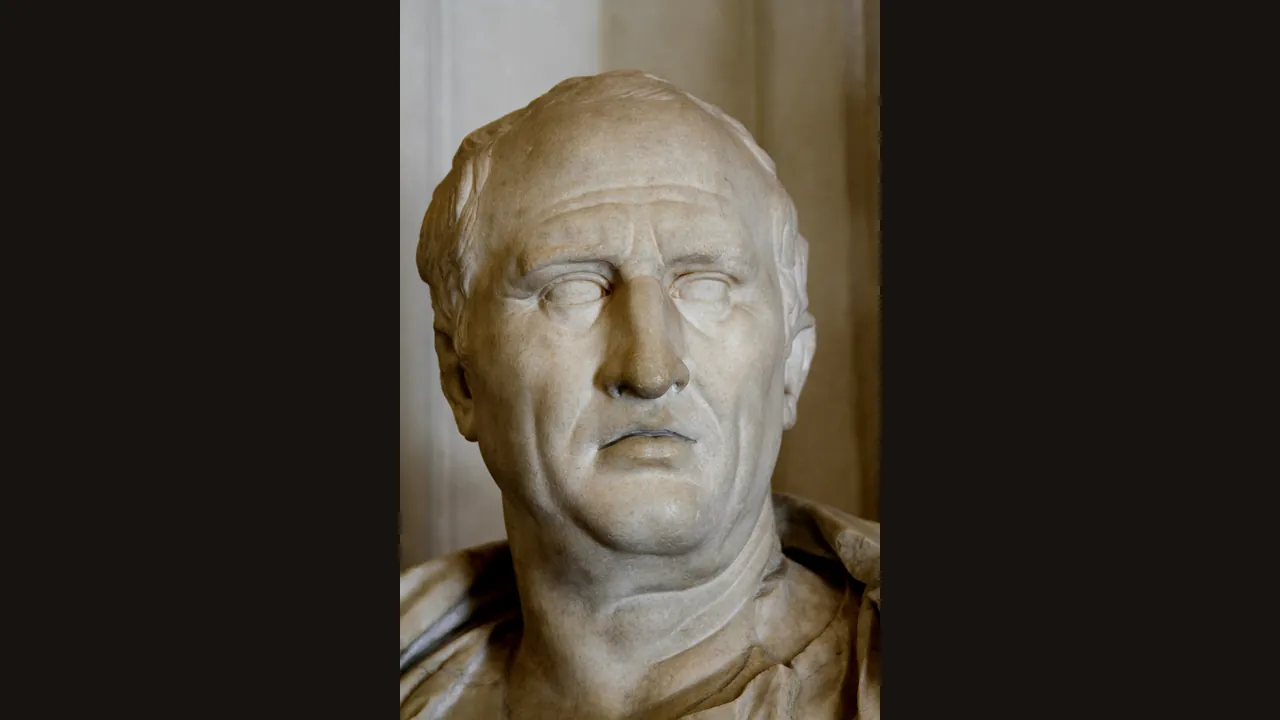
Roman statesman, orator, and writer from Arpinum who carried Greek philosophy into Latin. As consul in 63 BC he put down the conspiracy of Catiline. Proscribed by the Second Triumvirate, he was killed in 43 BC.
Cicero was born in 106 BC at Arpinum, a town south of Rome, and studied law, rhetoric, and philosophy at Rome, Athens, and Rhodes. He rose through the offices of state and held the consulship in 63 BC, when he exposed and suppressed the conspiracy of Catiline. His enemies drove him into exile in 58 BC, and the senate recalled him the next year. In the civil war he sided with Pompey, received Caesar's pardon, and after Caesar's murder attacked Mark Antony in the speeches called the Philippics. The triumvirs proscribed him, and soldiers killed him in December 43 BC.
Cicero wrote his philosophical works in the last years of his life. In De re publica and De legibus he set out a commonwealth ruled by law and grounded in natural law, which he defined as right reason in agreement with nature, one law for all peoples and all times. De officiis treated duties in public and private life. The Tusculan Disputations argued against the fear of death and pain, and De natura deorum and De finibus set out the teachings of the Stoic, Epicurean, and Academic schools in dialogue form. He followed the Academic practice of arguing both sides of a question and accepting the conclusion that seemed most probable. To give Latin a philosophical vocabulary he coined Latin equivalents for Greek terms, among them the word quality.
Facts
- Born
- 106 BC, Arpinum, Italy.
- Source: Encyclopaedia Britannica, Cicero
- Died
- 43 BC, murdered on the orders of Mark Antony after being proscribed.
- Source: Encyclopaedia Britannica, Cicero
- School
- Academic skepticism, with Stoic leanings in ethics.
- Source: Encyclopaedia Britannica, Cicero
- Known for
- The orations, the letters, and philosophical works like De re publica and De officiis that taught Rome to think in Greek categories.
- Source: Encyclopaedia Britannica, Cicero
Sources
- Encyclopaedia Britannica, Cicero Source
Source links accessed 22 November 2026.
Images
Related
- ItalyConnected
- PlatoConnected
- AristotleConnected
- Julius CaesarSame civilization
- Roman RepublicSame civilization
- AugustusSame era
What happened elsewhere
Pairings are by recorded year, not exact simultaneity.
- Han WudiWhile Cicero (156 BC)
Meanwhile
Meanwhile, around the world — drag to spin, click a pulsing marker.
Keep reading
Test yourself
When was Cicero born?
- 106 BC, Arpinum, Italy
- About 334 BC, Citium, Cyprus
- About 490 BC, Abdera, Greece
- About 360 BC, Elis, Greece
Answer
106 BC, Arpinum, Italy — Born: 106 BC, Arpinum, Italy.
When did Cicero die?
- 43 BC, murdered on the orders of Mark Antony after being proscribed
- About 270 BC
- About 420 BC
- About 286 BC
Answer
43 BC, murdered on the orders of Mark Antony after being proscribed — Died: 43 BC, murdered on the orders of Mark Antony after being proscribed.
What is Cicero known for?
- The orations, the letters, and philosophical works like De re publica and De officiis that taught Rome to think in Greek categories
- Atomist physics taken from Democritus, and an ethics of measured pleasure. Lucretius carried the doctrine to Rome in verse
- The claim that human nature is bad, that ritual reshapes it, and that Heaven is just nature running its course
- The division of things into what is up to us and what is not, the core of his handbook Enchiridion
Answer
The orations, the letters, and philosophical works like De re publica and De officiis that taught Rome to think in Greek categories — Known for: The orations, the letters, and philosophical works like De re publica and De officiis that taught Rome to think in Greek categories.
Which school of thought was Cicero part of?
- Academic skepticism, with Stoic leanings in ethics
- Legalism, the doctrine of the strong state
- Stoicism, named for the Stoa Poikile where he taught
- Stoicism, in its Roman practical form
Answer
Academic skepticism, with Stoic leanings in ethics — School: Academic skepticism, with Stoic leanings in ethics.
True or false: Roman statesman, orator, and writer from Arpinum who carried Greek philosophy into Latin.
- True
- False
Answer
True — True. Roman statesman, orator, and writer from Arpinum who carried Greek philosophy into Latin.
My notes
Highlights on this page
None yet.
Spotted an error on this page? Email [email protected] and it will be checked against the sources.