
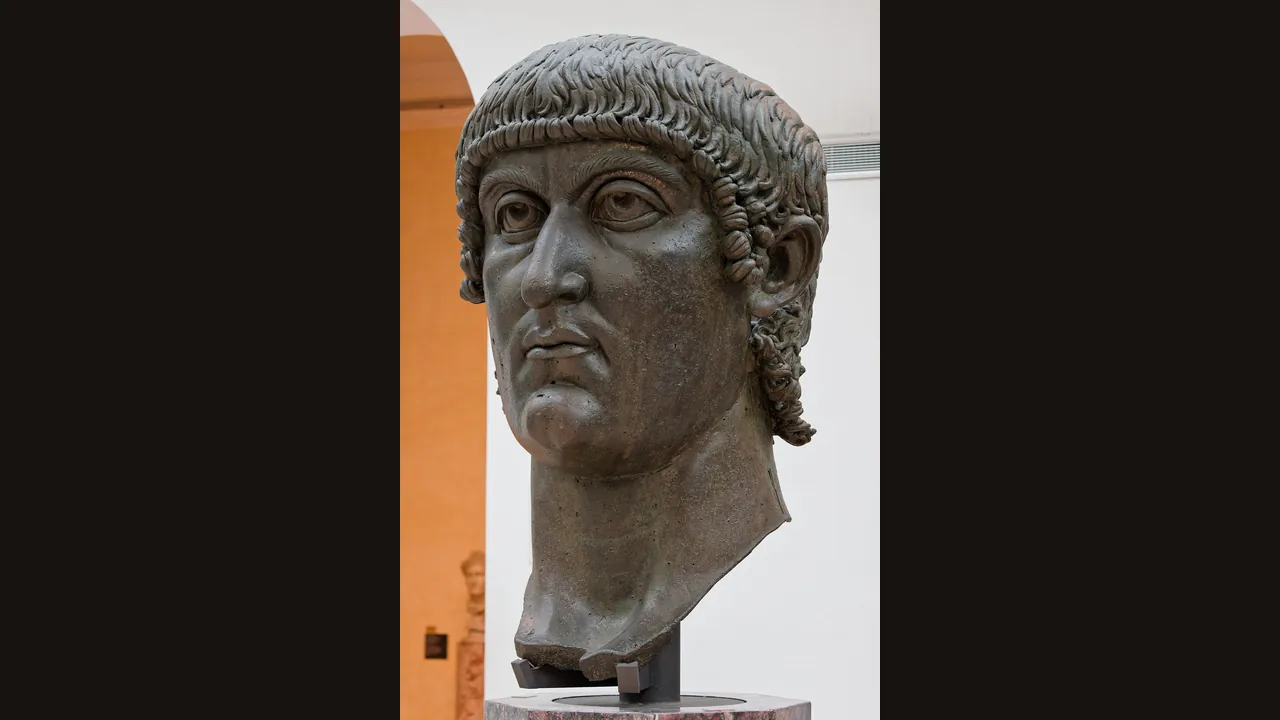
Ruler · Classical antiquity · Roman Empire · Turkey
Constantine the Great
r. 306–337
Roman emperor from 306 to 337, who reunited the empire and moved its center east. He legalized Christianity with the Edict of Milan in 313 and founded Constantinople as a new capital in 330. The Council of Nicaea in 325, called by him, defined Christian orthodoxy for centuries.
Constantine was born about 272 at Naissus in Moesia, the son of Constantius Chlorus, a soldier who rose to the rank of Caesar in the Tetrarchy, and Helena, a woman of humble origin in the sources. Constantine grew up at the eastern court of the emperor Diocletian and served as an officer under Galerius. In 305 his father became an Augustus in the west. In 306 Constantius died at York in Britain, and his troops proclaimed Constantine emperor on the spot. The Tetrarchy, the system of two senior and two junior emperors that Diocletian had built, broke down into a scramble of rivals, and Constantine spent the next eighteen years fighting his way to sole power.
In 312 he invaded Italy against Maxentius, who held Rome. At the Milvian Bridge north of the city, Constantine destroyed Maxentius's army and Maxentius drowned in the Tiber. The battle made Constantine master of the west, and it made his reputation as the emperor of the Christians. The sources disagree about what he saw before the battle. Lactantius, writing close to the events, says Constantine was told in a dream to mark his soldiers' shields with the sign of Christ. Eusebius, writing decades later, says Constantine told him he had seen a cross of light in the sky at midday with the words, in this sign, conquer. Both accounts exist, and historians still argue over when Constantine became a Christian and what his Christianity meant to him. Interpretations range from a genuine conversion in 312 to a slow political adoption of a useful god, with many scholars holding that belief and advantage ran together in his mind.
In 313 Constantine met the eastern emperor Licinius at Milan. The agreement known as the Edict of Milan ordered toleration for all religions and the return of confiscated property to the Christian churches. Relations between the two emperors collapsed into war, and in 324 Constantine defeated Licinius at Adrianople and again at Chrysopolis, executed him the next year, and ruled the whole Roman world alone.
Constantine poured money and legal privilege into the Christian church. He built the first Church of the Holy Sepulchre in Jerusalem on the site his mother Helena identified as the tomb of Christ, the first St Peter's in Rome, and churches across the empire. He gave bishops the right to hear cases, freed church property from some taxes, and in 321 made Sunday a day of rest in the cities. In 325 he summoned the bishops to Nicaea in Bithynia to settle the teaching of Arius, an Alexandrian priest who taught that Christ was created by God the Father rather than eternal with him. The Council of Nicaea produced a creed that called Christ of one substance with the Father, a formula meant to shut Arius out. Constantine exiled bishops who refused to sign. The quarrel over Arianism ran on for generations anyway.
His second great act was a new capital. In 330 he dedicated Constantinople on the site of Byzantium, at the point where Europe meets Asia and the land routes meet the sea. The city received a senate, a grain dole drawn from Egypt, palaces, forums, and churches, and men called it New Rome. Rome itself kept its prestige, but the center of imperial power had moved east, and Constantinople remained an imperial capital for more than a thousand years after his death.
Constantine also reformed the currency and the army. His gold solidus, struck at a weight the state held steady for centuries, became the standard coin of the Mediterranean world. He divided frontier troops from a mobile field army, expanded the role of German officers in high command, and kept the bureaucracy his predecessors had built. The home front had blood on it. In 326 his eldest son Crispus was executed on his orders at Pola, and his wife Fausta died soon after in an overheated bath. The surviving sources do not explain the killings clearly, and the affair remains one of the open questions of the reign.
Constantine was baptized only at the end, by Eusebius of Nicomedia, a bishop who had sided with the Arians. He died near Nicomedia in May 337, leaving the empire to his three sons and two nephews, an arrangement that produced a massacre of the nephews' branch of the family within months. The written record is unusually divided. Eusebius of Caesarea wrote a Life of Constantine that is part biography and part praise of a Christian hero. Lactantius wrote from inside the Christian camp as well. The pagan historian Zosimus, writing two centuries later, blamed Constantine for the ruin of Rome. Modern readers have all three traditions in front of them, and the dispute between them has never fully closed.
Facts
- Born
- About 272, Naissus (now Nis in Serbia).
- Source: Encyclopaedia Britannica, Constantine I
- Died
- 337, near Nicomedia.
- Source: Encyclopaedia Britannica, Constantine I
- Reign
- 306 to 337.
- Source: Encyclopaedia Britannica, Constantine I
- Realm
- The Roman Empire, reunited under one ruler.
- Source: Encyclopaedia Britannica, Constantine I
- Known for
- The Edict of Milan (313), Constantinople, and the Council of Nicaea (325).
- Source: Encyclopaedia Britannica, Constantine I
Sources
- Encyclopaedia Britannica, Constantine I Source
Source links accessed 22 November 2026.
Images
Related
- TurkeyConnected
- PlotinusSame civilization
- Sextus EmpiricusSame civilization
- Marcus AureliusSame civilization
- EpictetusSame civilization
- SenecaSame civilization
What happened elsewhere
Pairings are by recorded year, not exact simultaneity.
- San MarinoWhile Constantine the Great (301)
- Gupta EmpireWhile Constantine the Great (around 320)
- Byzantine EmpireWhile Constantine the Great (330)
Meanwhile
Meanwhile, around the world — drag to spin, click a pulsing marker.
Keep reading
Test yourself
When was Constantine the Great born?
- About 272, Naissus (now Nis in Serbia)
- 63 BC, Rome
- About 495 BC, Athens
- 356 BC, Pella, Macedon
Answer
About 272, Naissus (now Nis in Serbia) — Born: About 272, Naissus (now Nis in Serbia).
When did Constantine the Great die?
- 337, near Nicomedia
- 14 AD, Nola
- 323 BC, Babylon
- 429 BC, of plague, Athens
Answer
337, near Nicomedia — Died: 337, near Nicomedia.
When did Constantine the Great reign?
- 306 to 337
- 336 to 323 BC
- 141 to 87 BC
- About 268 to 232 BC
Answer
306 to 337 — Reign: 306 to 337.
What realm did Constantine the Great rule?
- The Roman Empire, reunited under one ruler
- Qin China, the first unified Chinese empire
- The Roman Empire
- Han dynasty China
Answer
The Roman Empire, reunited under one ruler — Realm: The Roman Empire, reunited under one ruler.
True or false: Roman emperor from 306 to 337, who reunited the empire and moved its center east.
- True
- False
Answer
True — True. Roman emperor from 306 to 337, who reunited the empire and moved its center east.
My notes
Highlights on this page
None yet.
Spotted an error on this page? Email [email protected] and it will be checked against the sources.