

Civilization · Early Middle Ages · Byzantine Empire
Byzantine Empire
330–1453
The Byzantine Empire was the eastern half of Rome, which survived a thousand years after the west fell. Its capital Constantinople was the richest city in Christendom. Ottoman Turks took it in 1453.
The name Byzantine is a label of later scholarship. Writers of the sixteenth century took it from Byzantium, the old name of the capital. The state itself was the Roman Empire. Its people called themselves Romans, spoke Greek, and practiced the Orthodox form of Christianity. The empire lasted from Constantine's dedication of Constantinople in 330 CE to the Ottoman conquest of the city in 1453.
The emperor ruled from Constantinople through a salaried bureaucracy paid from land tax revenues. Justinian I, emperor from 527 to 565, issued the Corpus Juris Civilis, a codification of Roman law, between 529 and 534. His generals retook North Africa from the Vandals and Italy from the Ostrogoths. Arab armies took Syria, Palestine, and Egypt in the 630s and 640s. Anatolia and the Balkans were organized into themes, districts where soldier farmers held land for military service. Greek replaced Latin in government during the seventh century.
The city withstood Avar and Persian attack in 626 and Arab sieges in 717 and 718. Crusaders of the Fourth Crusade took the city in 1204 and held it until Michael VIII retook it in 1261. The restored state held the capital and parts of Greece. On 29 May 1453 the Ottoman sultan Mehmed II captured the city after a siege of about seven weeks, his heavy cannon battering the land walls. Constantine XI died in the fighting.
Facts
- Founded
- 330 CE, Constantine founded Constantinople; the east separated fully in 395.
- Source: Encyclopaedia Britannica, Byzantine Empire
- Ended
- 1453, Constantinople fell to Mehmed II.
- Source: Encyclopaedia Britannica, Byzantine Empire
- Heartland
- The eastern Mediterranean, capital Constantinople.
- Source: Encyclopaedia Britannica, Byzantine Empire
- Major rulers
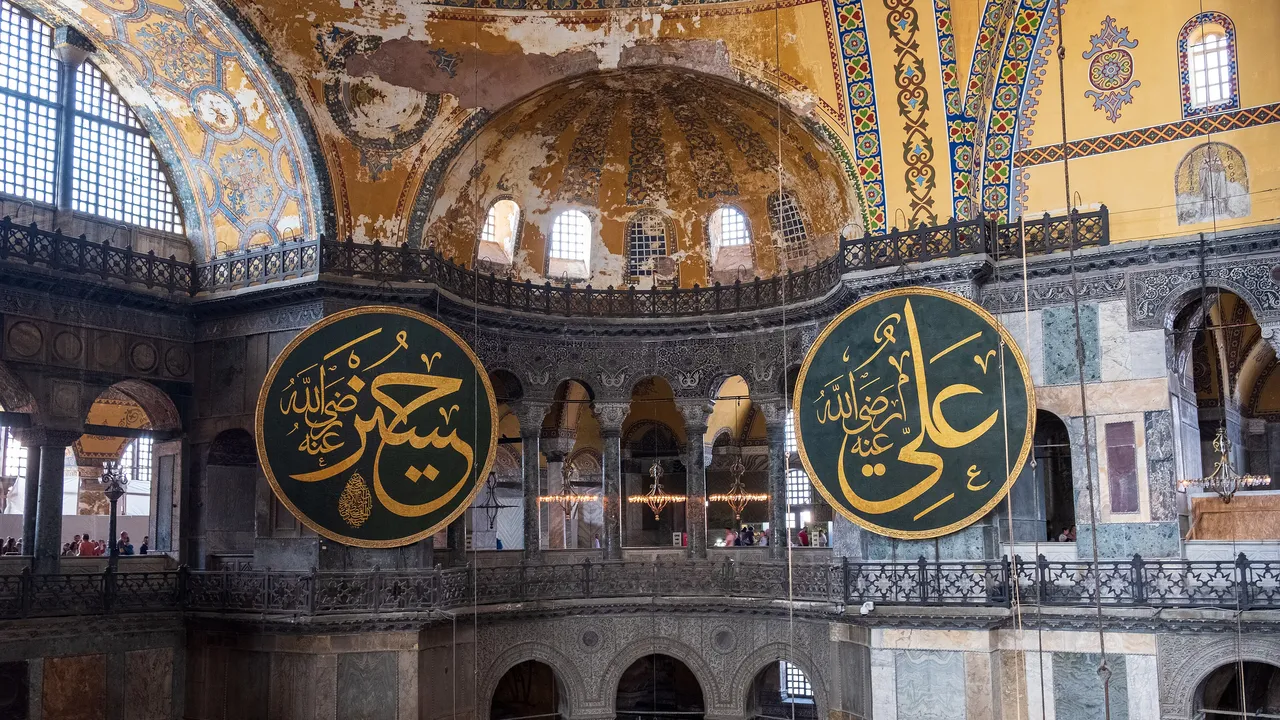
- Justinian I, lawgiver and builder of Hagia Sophia; Basil II, the Bulgar slayer; Constantine XI, who died on the walls in 1453.
- Source: Encyclopaedia Britannica, Byzantine Empire
Sources
- Encyclopaedia Britannica, Byzantine Empire Source
Source links accessed 22 November 2026.
Images
Related
- Justinian ISame civilization
- BoethiusSame era
- Tang TaizongSame era
- Tang dynastySame era
- Umar ibn al-KhattabSame era
- Abd al-MalikSame era
What happened elsewhere
Pairings are by recorded year, not exact simultaneity.
- Gupta EmpireWhile Byzantine Empire (around 320)
- Augustine of HippoWhile Byzantine Empire (354)
- Constantine the GreatWhile Byzantine Empire (306)
Meanwhile
Meanwhile, around the world — drag to spin, click a pulsing marker.
Keep reading
Test yourself
When was Byzantine Empire founded?
- 330 CE, Constantine founded Constantinople; the east separated fully in 395
- 962, Otto I crowned emperor by the Pope
- 750 CE, the Abbasid revolution; Baghdad founded 762
- 618 CE, Li Yuan founded the dynasty
Answer
330 CE, Constantine founded Constantinople; the east separated fully in 395 — Founded: 330 CE, Constantine founded Constantinople; the east separated fully in 395.
When did Byzantine Empire end?
- 1453, Constantinople fell to Mehmed II
- 1258 CE, the Mongols sacked Baghdad
- 1806, Francis II dissolved it under Napoleon's pressure
- 907 CE, the last emperor deposed after rebellion and warlordism
Answer
1453, Constantinople fell to Mehmed II — Ended: 1453, Constantinople fell to Mehmed II.
Where was the heartland of Byzantine Empire?
- The eastern Mediterranean, capital Constantinople
- Central Europe, above all Germany and northern Italy
- China, capital Chang'an, the largest city on earth
- The Middle East, capital Damascus
Answer
The eastern Mediterranean, capital Constantinople — Heartland: The eastern Mediterranean, capital Constantinople.
True or false: The Byzantine Empire was the eastern half of Rome, which survived a thousand years after the west fell.
- True
- False
Answer
True — True. The Byzantine Empire was the eastern half of Rome, which survived a thousand years after the west fell.
My notes
Highlights on this page
None yet.
Myth vs. evidence
The myth
Byzantium was a thousand years of decadent decline, all ceremony and intrigue.
The evidence
The eastern Roman state outlasted the west by a thousand years because it kept recovering: it held rich tax provinces, rebuilt armies and finances after disasters, and stood as a great power into the twelfth century. The sneer carried by the word byzantine is a later western habit, spread above all by Gibbon.
Sources: Judith Herrin, Byzantium, The Surprising Life of a Medieval Empire
Spotted an error on this page? Email [email protected] and it will be checked against the sources.