

Philosopher · Early Middle Ages · Ostrogothic Italy · Italy
Boethius
c. 480–524
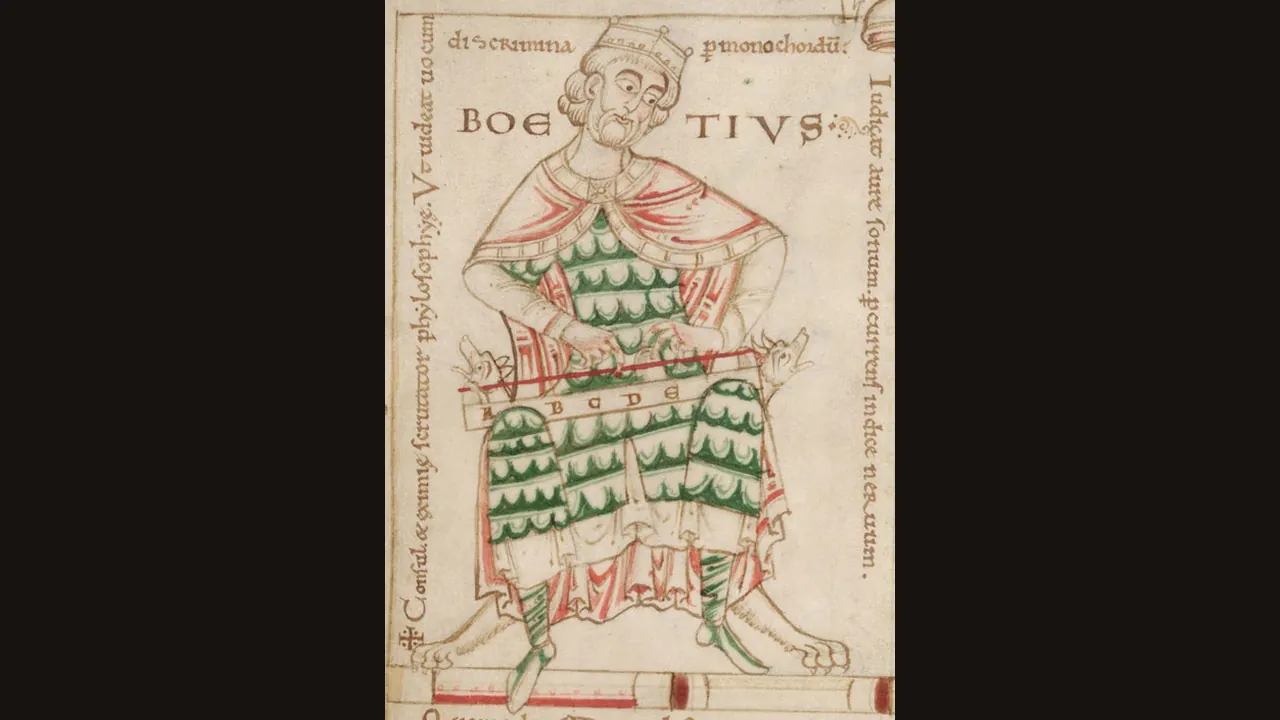
Roman statesman and thinker who served the Ostrogothic king Theodoric, then was imprisoned and executed on a treason charge. In prison he wrote the Consolation of Philosophy. He lived about 480 to 524, and his translations carried Aristotle's logic into the Middle Ages.
Boethius was born at Rome in about 480 into the Anicii, an old senatorial family, and received the full Roman education in grammar, rhetoric, and the Greek authors. He held the consulship in 510 and rose under Theodoric, king of the Ostrogoths, to the post of master of offices, the head of the civil service. In 523 he defended the senator Albinus against a treason charge and was himself arrested on the same charge. Theodoric's court condemned him without a hearing, and he spent about a year in prison at Pavia before his execution in 524.
In prison he wrote the Consolation of Philosophy, a dialogue in prose and verse between himself and Lady Philosophy. She argues that the goods of fortune, wealth, office, and fame, were never truly his and cannot secure happiness, that wicked men are punished by their own condition, and that providence orders all things while fate works out that order in time. Against the problem of divine foreknowledge he sets God's eternity: God sees all times in one present, and a present sight of an act does not compel the act. His earlier work began a plan to translate all of Aristotle and Plato into Latin. He translated Aristotle's logical books and Porphyry's introduction to them, wrote commentaries on both, and composed textbooks on arithmetic and music and short tracts on the Trinity.
Facts
- Born
- About 480, Rome, Italy, into an old senatorial family.
- Source: Encyclopaedia Britannica, Boethius
- Died
- 524, executed at Pavia after imprisonment on a treason charge under Theodoric.
- Source: Encyclopaedia Britannica, Boethius
- School
- Late ancient Platonism, transmitting Aristotle to the Latin West.
- Source: Encyclopaedia Britannica, Boethius
- Known for
- The Consolation of Philosophy, written in prison, and translations of Aristotle's logical works that the Middle Ages studied for centuries.
- Source: Encyclopaedia Britannica, Boethius
Sources
- Encyclopaedia Britannica, Boethius Source
Source links accessed 22 November 2026.
Images
Related
- AristotleConnected
- Augustine of HippoConnected
- ItalyConnected
- Justinian ISame era
- Tang TaizongSame era
- Tang dynastySame era
Meanwhile
Meanwhile, around the world — drag to spin, click a pulsing marker.
Keep reading
Test yourself
When was Boethius born?
- About 480, Rome, Italy, into an old senatorial family
- 980, near Bukhara, in what is now Uzbekistan
- About 872, Farab, in what is now Kazakhstan
- About 801, Kufa, Iraq
Answer
About 480, Rome, Italy, into an old senatorial family — Born: About 480, Rome, Italy, into an old senatorial family.
When did Boethius die?
- 524, executed at Pavia after imprisonment on a treason charge under Theodoric
- About 873, Baghdad
- About 950, Damascus, Syria
- 1037, Hamadan, Iran
Answer
524, executed at Pavia after imprisonment on a treason charge under Theodoric — Died: 524, executed at Pavia after imprisonment on a treason charge under Theodoric.
What is Boethius known for?
- The Consolation of Philosophy, written in prison, and translations of Aristotle's logical works that the Middle Ages studied for centuries
- The Canon of Medicine, the distinction between essence and existence, and the flying man thought experiment on self awareness
- The claim that atman is brahman, that plurality is illusion, and commentaries that made Vedanta the dominant Hindu philosophy
- Commentaries on Aristotle and Plato, and The Virtuous City, on the perfect state ruled by the philosopher
Answer
The Consolation of Philosophy, written in prison, and translations of Aristotle's logical works that the Middle Ages studied for centuries — Known for: The Consolation of Philosophy, written in prison, and translations of Aristotle's logical works that the Middle Ages studied for centuries.
Which school of thought was Boethius part of?
- Late ancient Platonism, transmitting Aristotle to the Latin West
- Islamic Peripatetic philosophy, from Aristotle and Neoplatonism
- Islamic Peripatetic philosophy, with Platonic political theory
- Advaita Vedanta, absolute nondualism
Answer
Late ancient Platonism, transmitting Aristotle to the Latin West — School: Late ancient Platonism, transmitting Aristotle to the Latin West.
True or false: Roman statesman and thinker who served the Ostrogothic king Theodoric, then was imprisoned and executed on a treason charge.
- True
- False
Answer
True — True. Roman statesman and thinker who served the Ostrogothic king Theodoric, then was imprisoned and executed on a treason charge.
My notes
Highlights on this page
None yet.
Spotted an error on this page? Email [email protected] and it will be checked against the sources.