

Philosopher · Early modern period · Florentine Republic · Italy
Niccolò Machiavelli
1469–1527
Florentine diplomat and author of The Prince and the Discourses on Livy. Effectual truth over imagined republics; republican institutions in the Discourses.
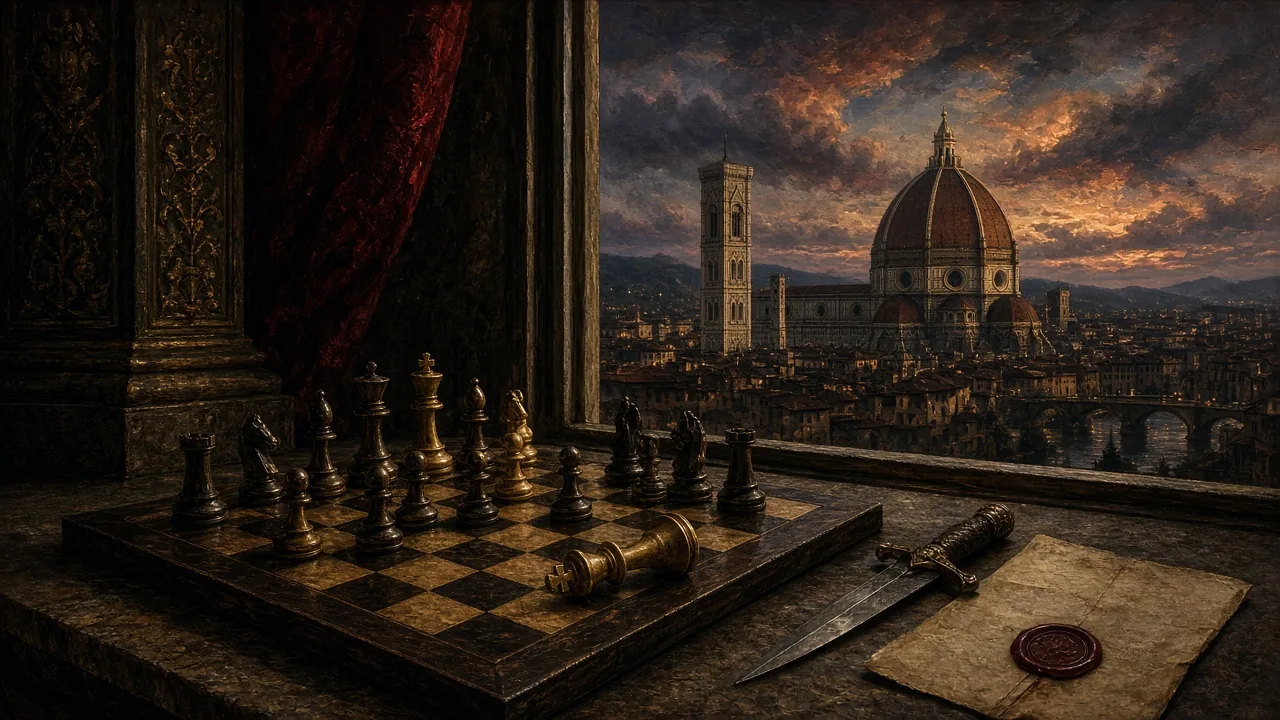
Niccolò Machiavelli confronts a fundamental political problem that theorists and idealists still attempt to avoid: what happens when the world refuses to behave according to our highest moral ideals?
He wrote The Prince in 1513, and the desperate circumstances of its composition are essential to understanding its contents. Following the return of the Medici to Florence, Machiavelli was stripped of his diplomatic post, falsely accused of conspiracy, and imprisoned. He was subjected to torture by the strappado, a painful procedure where the victim's wrists were bound behind their back and their body weight suspended until their shoulders dislocated. Denying all charges, he was released after three weeks and exiled to his small farm at Sant'Andrea in Percussina. Deprived of office, income, and political influence, Machiavelli spent his evenings in his study. In a famous December 1513 letter to his friend Francesco Vettori, he described shedding his muddy work clothes each night to put on courtly garments, figuratively entering the ancient courts of dead statesmen to converse with them about history and power. His method was not born from dry academic speculation, but from the reflections of a disgraced diplomat attempting to make sense of political survival.
The Prince grew directly from this experience. Published posthumously in 1532 with the permission of Pope Clement VII, it was later placed on the Catholic Church's Index of Prohibited Books in 1559. In Chapter 15, Machiavelli explicitly defines his political philosophy: he deemed it more practical to go directly to the verità effettuale, the effectual truth of the matter, rather than indulge in imaginative ideals. Scholars Bowd and Lee note that the term verità effettuale was unprecedented in Italian literature. Machiavelli argued that "many have imagined republics and principalities that have never been seen or known to exist in reality," warning that anyone who abandons how people actually live in favor of how they ought to live guarantees their own ruin rather than their preservation.
This empirical approach explains the uncompromising nature of his political advice. Machiavelli asserts that a ruler must learn how not to be good when necessity requires it. If a prince cannot be both loved and feared, choosing to be feared is the safer path, provided he avoids provoking hatred. While fortune may govern half of human affairs, he contends that the other half remains subject to human judgment, adaptability, courage, and virtù, the strategic capacity to master circumstances rather than surrender to them.
Sixteenth-century Italy gave him the setting for these conclusions. Fragmented into competing powers, Milan, Venice, Florence, Naples, and the Papal States, the peninsula became a primary battleground for French and Habsburg-Spanish armies during the Italian Wars following Charles VIII's invasion in 1494. Observing these conflicts firsthand, Machiavelli concluded that clean intentions do not eliminate political enemies or military threats.
Popular culture frequently attributes the phrase "the ends justify the means" to Machiavelli, though he never wrote those words. The passage typically misquoted appears at the conclusion of Chapter 18, where he observes that in the actions of men, and particularly princes who acknowledge no higher court of appeal, results are what ultimately get judged. This observation describes how political actions are evaluated in an international arena devoid of an overarching tribunal, rather than offering an unconditional moral license.
The Prince represents only one dimension of Machiavelli's political thought. In his Discourses on Livy, he argues in favor of republican governance, civic participation, liberty, constitutional institutions, and civic virtue. Yet even within his republican framework, realistic assessments of necessity prevail. In Book III, Chapter 41 of the Discourses, he writes that when the survival of the state is at stake, considerations of justice, cruelty, praise, or ignominy must be set aside in favor of whatever action preserves the nation's existence and liberty.
Machiavelli insists that stable institutions cannot be constructed on ideal assumptions about human nature. In Discourses I.3, he states that anyone founding a republic and drafting its laws must presuppose that all men are naturally inclined toward self-interest and will exercise their malice whenever given the opportunity. This realistic premise influenced later political thought. David Hume subsequently formulated the constitutional rule that every man ought to be supposed a knave, driven primarily by self-interest. James Madison embedded this concept into the framework of the United States Constitution in Federalist No. 51, arguing that ambition must be made to counteract ambition because "if men were angels, no government would be necessary".
Whereas classical theorists like Plato sought to engineer ideal societies by reshaping human desires through education, class structures, and civic myths, Machiavelli analyzed political power among self-interested, ambitious, and armed actors as they actually exist. By founding political analysis on the verità effettuale, he set out how republics and princes actually hold power, and that account continues to influence modern statecraft.
Sources
Primary sources
- The effectual truth (ch. 15), loved versus feared (ch. 17), judgment by results (ch. 18), fortune and virtù (ch. 25) Niccolò Machiavelli, The Prince (1532).
- Presupposing that men are bad (I.3); setting justice aside when the state's survival is at stake (III.41) Niccolò Machiavelli, Discourses on the First Decade of Titus Livius (1531).
- The letter of 10 December 1513 describing evenings spent in study with the ancient authors Niccolò Machiavelli, Letter to Francesco Vettori, in Machiavelli and His Friends: Their Personal Letters (trans. Atkinson and Sices) (1996).
- 'If men were angels, no government would be necessary'; ambition made to counteract ambition James Madison, The Federalist No. 51 (1788).

The Medici returned to Florence in 1512, and with their return Niccolò Machiavelli lost the political life that had defined him. For fourteen years he had served the Florentine Republic as secretary, diplomat, and political observer, carrying messages between courts, negotiating with rulers, watching armies move across Italy, and studying men like Cesare Borgia at close range. When the republic fell, the Medici removed him from office and pushed him out of public life. In early 1513 his name appeared in connection with a conspiracy against them. There is no solid evidence that Machiavelli was part of it, but he was arrested anyway.
He spent twenty two days in prison and was tortured with the strappado six times. His wrists were tied behind his back and he was hoisted by a rope, forcing the weight of his body onto his arms and shoulders. The torture could dislocate the joints and cause severe injury. Machiavelli did not confess. He maintained his innocence and was eventually released after Giovanni de’ Medici became Pope Leo X and an amnesty followed.
He returned to his family property at Sant’Andrea in Percussina, outside Florence. He still had his land and his family, but he had no office and no clear way back into the political world he had spent most of his adult life serving. A man who had negotiated with princes, watched republics rise and fall, and seen armies cross Italy was now living in the countryside, cut off from the world he understood best.
In December 1513 he wrote to his friend Francesco Vettori and described what he did in the evenings. When the day was over, he went home, removed his dirty clothes, and put on garments he considered suitable for a court. Then he entered his study and opened the books of the ancient writers. He described entering the ancient courts of men long dead, questioning them about the reasons for their actions and listening while they answered through their writings. For several hours he forgot poverty, fear, and death. During those months he was working on the book that became The Prince.
He wrote The Prince in 1513, probably continuing to revise it afterward, and eventually dedicated it to Lorenzo de’ Medici. Machiavelli wanted to return to political service, and the book can partly be read in that light. It did not restore him to the position he had lost. He died in 1527. The Prince was published in 1532, five years after his death, with authorization under the Medici pope Clement VII. In 1559 Machiavelli’s works were placed on the Catholic Church’s Index of Prohibited Books.
In Chapter 15 Machiavelli explains the method behind the book. Instead of beginning with ideal states and ideal rulers, he says he wants to go directly to the verità effettuale della cosa, the effectual truth of the thing. He criticizes writers who had imagined republics and principalities that had never actually existed. His concern was the distance between the way men ought to live and the way they actually live. A ruler who ignores that distance, he argues, risks learning his destruction instead of his preservation.
Machiavelli was not arguing that good and evil were meaningless. His point was that politics cannot be understood by assuming that men will behave according to the moral standards we would like them to follow. A ruler may value honesty, mercy, loyalty, and peace, but he still lives among other rulers who may lie, betray treaties, invade neighbors, murder rivals, or use force whenever it benefits them. Refusing to recognize that reality does not make it disappear.
This is why Machiavelli says a prince must learn how not to be good when necessity requires it. His famous discussion of fear follows the same logic. It would be best for a ruler to be both loved and feared, but if he cannot be both, Machiavelli argues that it is safer to be feared. Even then he places a limit on it. The prince must avoid becoming hated. Fear could preserve authority. Hatred could produce conspiracy, rebellion, and ruin.
The same realism appears in his idea of virtù. Machiavelli was not using the word simply to mean moral virtue. His virtù is political ability: judgment, courage, adaptability, intelligence, strength, decisiveness, and the ability to act when circumstances change. Opposing it is fortuna, fortune, the part of life no man fully controls. Machiavelli suggests that fortune governs roughly half of human affairs while leaving the rest open to human action. A capable man cannot command fortune, but he can prepare for it, respond to it, and sometimes overcome it.
Machiavelli understood fortune because he had watched it tear Italy apart. Italy was not a unified country. Milan, Venice, Florence, Naples, the Papal States, and smaller powers competed with one another while France, Spain, the Holy Roman Empire, and other outside powers intervened. Charles VIII of France invaded Italy in 1494, beginning the long period of conflict known as the Italian Wars. Machiavelli lived through this world. He watched alliances form and collapse, rulers gain territory and lose it, mercenary armies change sides, and governments disappear when they could no longer defend themselves. His political thought came from books, but it also came from experience.
That experience explains much of what later became associated with the word “Machiavellian.” The sentence most often attached to him, “the ends justify the means,” is not something Machiavelli ever wrote. It does, however, simplify a real part of his argument. In Chapter 18 of The Prince, he says that rulers are often judged by the results of their actions, especially where no higher authority exists to judge them. He allows deception, force, broken promises, and cruelty when political necessity demands them. What he does not give is a universal rule saying that any desired end makes any possible means morally acceptable. His argument is narrower. Political survival can place rulers in situations where the methods required to preserve a state conflict with ordinary morality.
The Prince is only part of Machiavelli’s political thought. In the Discourses on Livy he writes extensively about republican government, liberty, civic participation, laws, institutions, corruption, and the conditions necessary for a free republic to survive. The common picture of Machiavelli as nothing more than a teacher of tyranny leaves out much of what he actually believed about government.
His republicanism was still built on the same hard view of human nature. In Discourses III.41 he argues that when the survival of the country itself is genuinely at stake, considerations of justice, mercy, cruelty, praise, or disgrace may have to give way to whatever course preserves the country and maintains its liberty. He is not simply defending the survival of a ruler. He is speaking about the survival of the political community itself.
In Discourses I.3 he goes even further. Anyone founding a republic and establishing laws, he argues, should begin by presuming that men are capable of wrongdoing and will act badly whenever opportunity allows it. Machiavelli was not saying that every man is constantly evil. He was saying that laws and institutions should not depend on everyone remaining good.
That same problem appears later in David Hume. When Hume wrote about the design of government, he argued that political institutions should be constructed as though every man were a knave pursuing his own interest. Hume explicitly understood that not every person actually is a knave. The point was institutional design. A government should still function when ambition, self interest, and corruption appear.
James Madison made a closely related argument in Federalist No. 51. “Ambition must be made to counteract ambition.” His reasoning was that government must be strong enough to control the governed while also being structured so that those who govern cannot simply trust themselves with unlimited power. “If men were angels, no government would be necessary.” Checks and balances work because they do not assume that political power will always be held by virtuous people.
It would be too simple to draw a direct line from Machiavelli to Madison and claim that the American constitutional system came from him. Hume had his own influences, Madison read widely, and republican political thought developed through many writers between Renaissance Florence and the American founding. What they share is a similar problem. Political institutions cannot safely be built around an idealized picture of human nature.
Machiavelli’s reputation became attached to cruelty, manipulation, deception, and ruthless ambition, but that reputation only captures part of him. His deeper argument was that politics must begin with men as they are before it can speak about what they ought to become. A ruler who understands only ideals may be morally admirable and politically helpless. A republic that assumes its citizens and leaders will always act well is building its laws around a condition that history does not support. Machiavelli looked at human beings, war, ambition, fear, fortune, corruption, loyalty, and power without pretending that any of them disappeared because philosophers wished they would.
Sources
Primary sources
- The Prince: the effectual truth (ch. 15), fear without hatred (ch. 17), judgment by results (ch. 18) Niccolò Machiavelli, The Prince (1532).
- The Discourses on republics: presupposing men's badness (I.3) and the survival of the country (III.41) Niccolò Machiavelli, Discourses on the First Decade of Titus Livius (1531).
Secondary sources
- Machiavelli's twenty-two days in prison, six drops of the strappado, release, and death in 1527 Roberto Ridolfi, The Life of Niccolò Machiavelli (trans. Cecil Grayson) (1963).
Facts
- Born
- 3 May 1469, Florence.
- Source: Encyclopaedia Britannica, Niccolò Machiavelli
- Died
- 21 June 1527, Florence.
- Source: Encyclopaedia Britannica, Niccolò Machiavelli
- The Prince
- Written 1513 after dismissal and torture; published 1532.
- Source: Encyclopaedia Britannica, Niccolò Machiavelli
Sources
- Encyclopaedia Britannica, Niccolò Machiavelli Source
Source links accessed 22 November 2026.
Images

Related
- ItalyConnected
- Wang YangmingSame era
- Henry VIIISame era
- Suleiman the MagnificentSame era
- Charles VSame era
- Safavid EmpireSame era
What happened elsewhere
Pairings are by recorded year, not exact simultaneity.
- Wang YangmingWhile Niccolò Machiavelli (1472)
- Henry VIIIWhile Niccolò Machiavelli (1491)
- SpainWhile Niccolò Machiavelli (1492)
- Puerto RicoWhile Niccolò Machiavelli (1493)
- Suleiman the MagnificentWhile Niccolò Machiavelli (1494)
Meanwhile
Meanwhile, around the world — drag to spin, click a pulsing marker.
Keep reading
My notes
Highlights on this page
None yet.
Spotted an error on this page? Email [email protected] and it will be checked against the sources.