
October 6, 2026
Plato's ideal city
Plato did not invent modern socialism, but rather an earlier, hierarchical political model centered on governance by an elite claiming supreme knowledge of the Good.
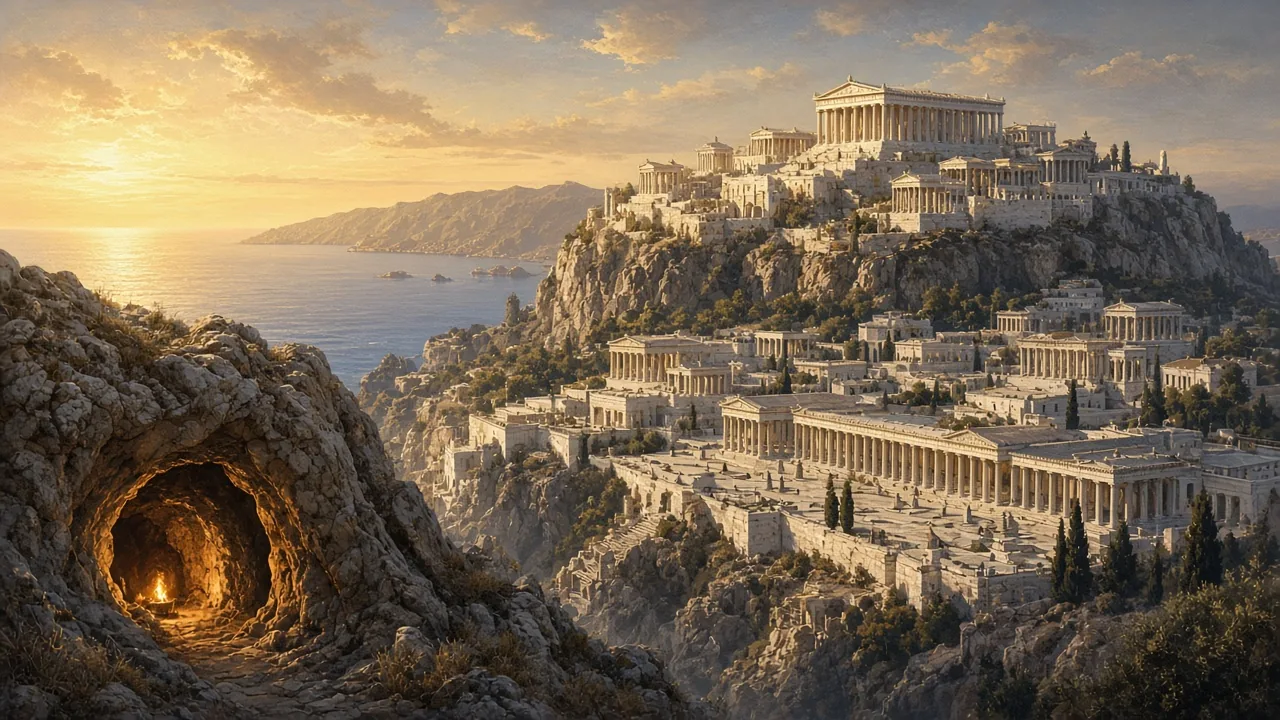
Plato did not invent modern socialism, but rather an earlier, hierarchical political model centered on governance by an elite claiming supreme knowledge of the Good.
In the Republic, Plato constructs an ideal city (Kallipolis) governed by philosopher-kings. Their authority rests on claims of philosophical insight rather than democratic consent, with the text asserting that human suffering will not cease until philosophers hold sovereign power or sovereigns become genuine philosophers ([473c]). To maintain their integrity, the ruling guardian class lives under a system of communal ownership. They are barred from private property, individual land ownership, and personal wealth, eating in shared messes and living in conditions likened to a military camp ([416d–417a]). In its most radical form, this arrangement extends to communal arrangements regarding spouses and children ([457c–d]). Plato explicitly warns that if guardians acquire private lands, homes, or money, they will inevitably transform from protective allies into self-interested tyrants ([417a–b]). Aristotle later critiqued this communal structure in the Politics, observing that property shared among the greatest number of people receives the least overall care ([1261b]).
To stabilize this political order, Plato introduces the "noble lie" (gennaion pseudos), also known as the myth of the metals ([414c–415d]). According to this state-sanctioned myth, citizens are instructed that they share a common earthly origin, yet God has mixed gold into the souls of the rulers, silver into the military auxiliaries, and bronze or iron into the farmers and artisans. The myth includes a warning that the state faces destruction should a bronze or iron individual assume the role of guardian. In The Open Society and Its Enemies (1945), philosopher Karl Popper identified the noble lie as an early precursor to modern ideological statecraft, arguing that Plato's closed society relies on manufactured myth to enforce a rigid social hierarchy.
This governance structure is reinforced by the Allegory of the Cave ([514a–517a]). In this framework, humanity resembles prisoners chained inside a cave, interpreting shadows on a wall as ultimate reality. The philosopher who escapes to the surface beholds true knowledge and must subsequently be compelled to return to the cave to govern ([520a–e]). Plato notes the paradox that the most stable state is governed by rulers least eager to hold power, whereas states led by those who actively seek office suffer from instability.
Plato attempted to apply these theoretical principles directly to politics through his interactions with the rulers of Syracuse. Travelling to Sicily on three occasions (around 388, 367, and 361 BCE), he sought to mentor Dionysius I and Dionysius II alongside his associate Dion, attempting to mold them into philosopher-kings. These efforts ultimately dissolved into political instability, imprisonment, and internal conflict, forcing Plato to flee Syracuse.
This historical intersection between political theory and authoritarian power illustrates the structural risks inherent in utopian governance models. When political frameworks require mandatory communal structures for leaders, state-directed mythmaking, and compulsory rule by an enlightened elite, they establish a structural pattern that has recurred throughout political history under various names.
Comments
Loading comments…