
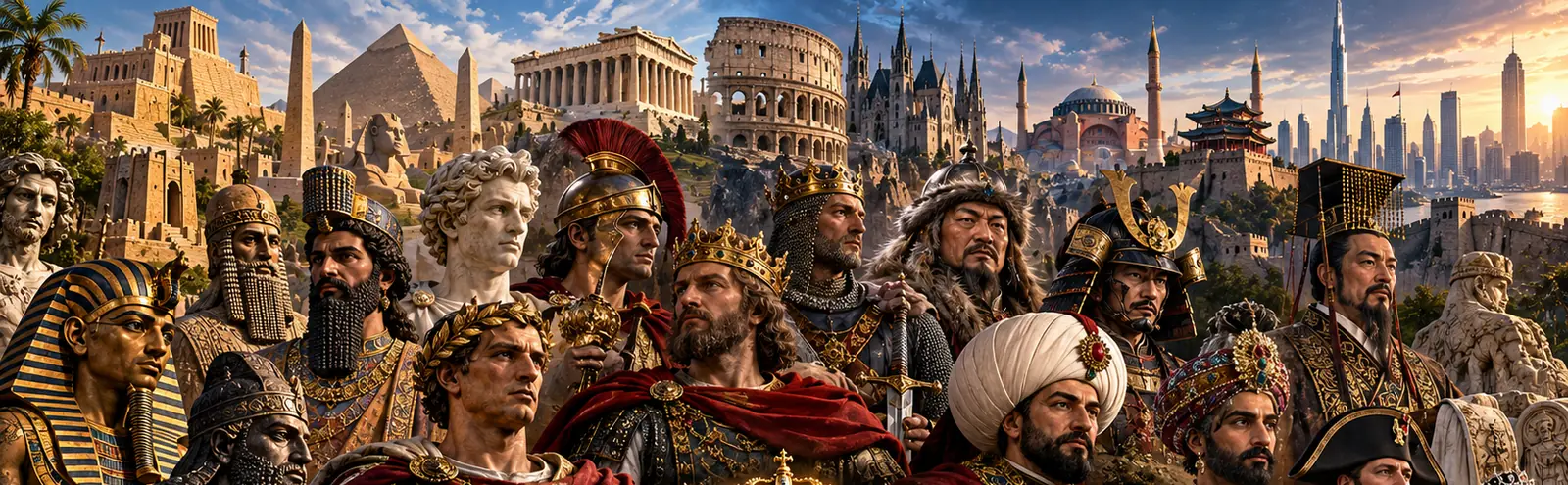
Ruler · High and Late Middle Ages · Mongol Empire · Mongolia
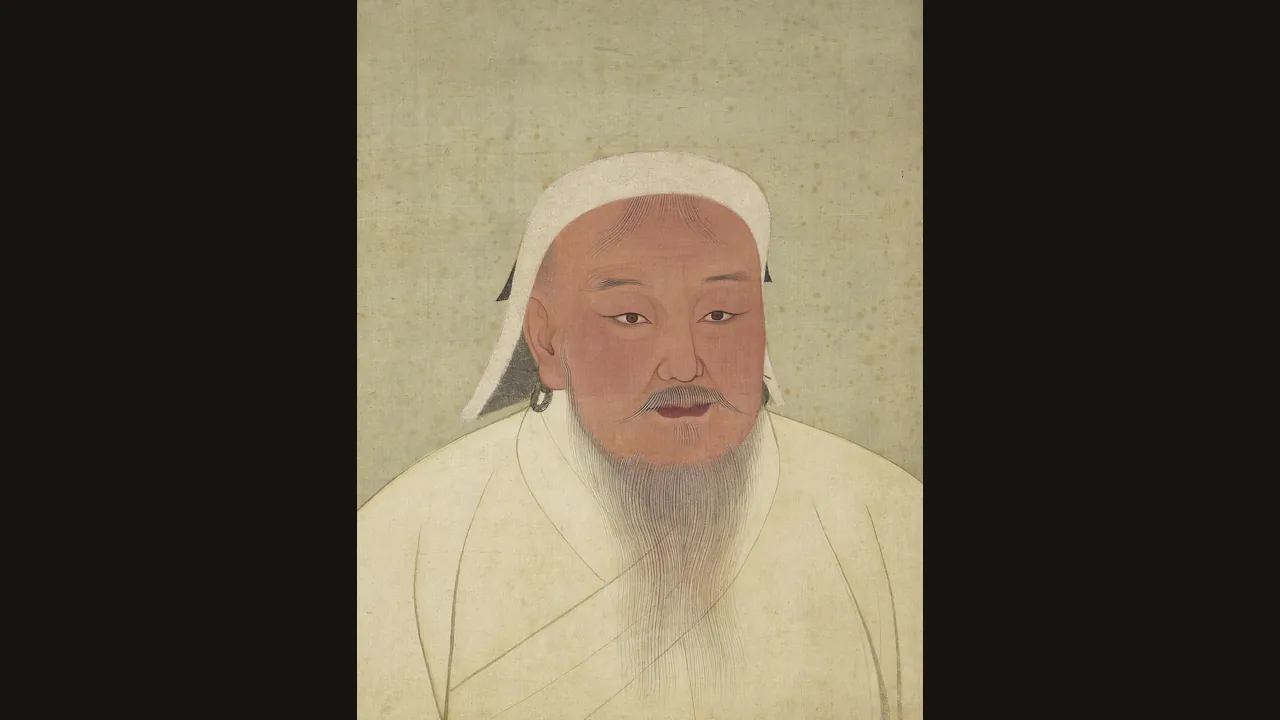
Genghis Khan
c. 1162–1227
Founder of the Mongol Empire, born Temujin about 1162 and dead in 1227, proclaimed Genghis Khan in 1206. He united the warring Mongol tribes and turned them into an army that conquered northern China, Central Asia and Persia. At his death his empire was already the largest contiguous land empire in history.
Temujin was born about 1162 in the steppe country near the Onon River, the son of Yesugei, a minor Mongol chief. When Temujin was about nine, a rival clan poisoned his father. The clan then abandoned the widow and her children, judging them too weak to follow. The family survived on roots, wild fruit, and small game. The Tayichiud, a stronger clan, captured the teenage Temujin and kept him in a wooden collar. He escaped, hid in a river, and won help from a common family that risked punishment to free him. The memory of abandonment shaped everything that followed. He built his following on personal loyalty and shared reward rather than on birth and clan rank.
Over the next two decades Temujin fought and negotiated his way to mastery of the steppe. He defeated the Merkits who had seized his wife Borte, broke the Tatars with Chinese backing, and destroyed his rivals the Keraits and the Naimans. In 1206 an assembly of the Mongol tribes proclaimed him Genghis Khan, ruler of all who lived in felt tents. He organized his army in decimal units, from squads of ten up to divisions of ten thousand called tumens. Officers rose by ability and loyalty, not by ancestry. Discipline was harsh and exact. Soldiers who fled battle faced death, and whole units paid for the failure of their members. His laws, known as the Yassa, governed the army and the camp. Historians dispute whether the Yassa was one written code or a body of decrees and customs written down later, since no copy survives.
His first foreign campaigns went against the states of northern China. The Tangut kingdom of Western Xia submitted after hard fighting. From 1211 he attacked the Jin dynasty, which ruled the north from Zhongdu, the city now called Beijing. Mongol horsemen could not at first take walled cities, so Genghis recruited Chinese engineers and learned siege craft. Zhongdu fell in 1215 after a long blockade, and its people suffered massacre and fire. By the end of the campaign the Mongols held the land north of the Yellow River, and thousands of skilled craftsmen had been carried off to serve the khan.
War with the Khwarazmian Empire began in 1219 after its governor at Otrar seized a Mongol caravan and killed the merchants, and the shah then killed or humiliated the envoys Genghis sent to demand satisfaction. The Mongol armies crossed Central Asia in coordinated columns and took the great cities one by one. Bukhara and Samarkand fell in 1220. Herat, Merv, and Nishapur were destroyed after resistance or revolt, and much of their populations were killed. Persian and Arab chroniclers wrote of deaths in the millions for single cities. Modern historians judge those figures too high, since medieval writers had no counts to work from, but they agree the killing was vast and that irrigation works and farmland in parts of Persia and Central Asia were ruined for generations.
Genghis returned east and in 1226 opened a final campaign against Western Xia, whose ruler had refused to send troops for the western war. He died in 1227 during that campaign. The cause is unknown. Accounts speak of wounds, fever, and the climate, and no source can be checked against another. His body was carried back to Mongolia and buried in secret. The soldiers of the escort were said to have killed everyone they met on the road, and the grave has never been found. His empire passed to his sons and grandsons under his third son Ogedei. They went on to take Persia, Russia, and in time the Song dynasty of the south, building the largest connected land empire in history. Trade routes across it were policed and protected, relay stations carried orders and merchants across Asia, and conquered peoples kept their religions as a matter of policy.
The cost of the conquests sits in the records of the conquered. Chinese census figures show the population of the north far lower after the wars than before, and Persian cities that had ranked among the largest in the world shrank to towns. Historians argue over how much of the drop was killing and how much was flight, disease, and broken tax registers. What is not argued is the method. Cities that surrendered at once usually lived and paid tribute. Cities that resisted were made examples, and the news of their fate marched ahead of the armies, opening gates that armies alone could not have forced.
Facts
- Born
- About 1162, on the Mongolian steppe.
- Source: Encyclopaedia Britannica, Genghis Khan
- Died
- 1227, on campaign against the Western Xia.
- Source: Encyclopaedia Britannica, Genghis Khan
- Reign
- Proclaimed khan 1206; ruled to 1227.
- Source: Encyclopaedia Britannica, Genghis Khan
- Realm
- The Mongol Empire from China to the Caspian Sea.
- Source: Encyclopaedia Britannica, Genghis Khan
- Known for
- Uniting the Mongols and the conquests of 1211 to 1227.
- Source: Encyclopaedia Britannica, Genghis Khan
Sources
- Encyclopaedia Britannica, Genghis Khan Source
Source links accessed 22 November 2026.
Images
Related
- Mongol EmpireSame civilization
- MaimonidesSame era
- SaladinSame era
- Zhu XiSame era
- AverroesSame era
- Frederick BarbarossaSame era
What happened elsewhere
Pairings are by recorded year, not exact simultaneity.
- PortugalWhile Genghis Khan (around 1139)
- MaimonidesWhile Genghis Khan (around 1138)
- SaladinWhile Genghis Khan (around 1137)
Meanwhile
Meanwhile, around the world — drag to spin, click a pulsing marker.
Keep reading
Test yourself
When was Genghis Khan born?
- About 1162, on the Mongolian steppe
- 1440, Moscow
- About 1137, Tikrit
- About 1028, Falaise, Normandy
Answer
About 1162, on the Mongolian steppe — Born: About 1162, on the Mongolian steppe.
When did Genghis Khan die?
- 1227, on campaign against the Western Xia
- 1193, Damascus
- Late 1476 or early 1477, in battle near Bucharest
- 1481, on campaign
Answer
1227, on campaign against the Western Xia — Died: 1227, on campaign against the Western Xia.
When did Genghis Khan reign?
- Proclaimed khan 1206; ruled to 1227
- 1368 to 1398
- King 1152 to 1190; emperor 1155 to 1190
- 1462 to 1505
Answer
Proclaimed khan 1206; ruled to 1227 — Reign: Proclaimed khan 1206; ruled to 1227.
What realm did Genghis Khan rule?
- The Mongol Empire from China to the Caspian Sea
- The Ottoman Empire
- The Mongol Empire's eastern half and Yuan China
- Ming dynasty China
Answer
The Mongol Empire from China to the Caspian Sea — Realm: The Mongol Empire from China to the Caspian Sea.
True or false: Founder of the Mongol Empire, born Temujin about 1162 and dead in 1227, proclaimed Genghis Khan in 1206.
- True
- False
Answer
True — True. Founder of the Mongol Empire, born Temujin about 1162 and dead in 1227, proclaimed Genghis Khan in 1206.
My notes
Highlights on this page
None yet.
Myth vs. evidence
The myth
The Mongol conquests killed forty million people, so many that emptied farmland turned back to forest and cooled the climate of the whole planet.
The evidence
The forty million figure is built by projecting census drops from records that are incomplete and disputed. It counts every missing person as a Mongol killing, though flight, famine, disease, and redrawn borders also emptied registers. The conquests were brutal and the toll very large, but the exact number and the cooling claim are estimates, not counts.
Sources: David Morgan, The Mongols; Morris Rossabi, The Mongols and Global History
Spotted an error on this page? Email [email protected] and it will be checked against the sources.