

Philosopher · High and Late Middle Ages · Italy
Thomas Aquinas
1225–1274
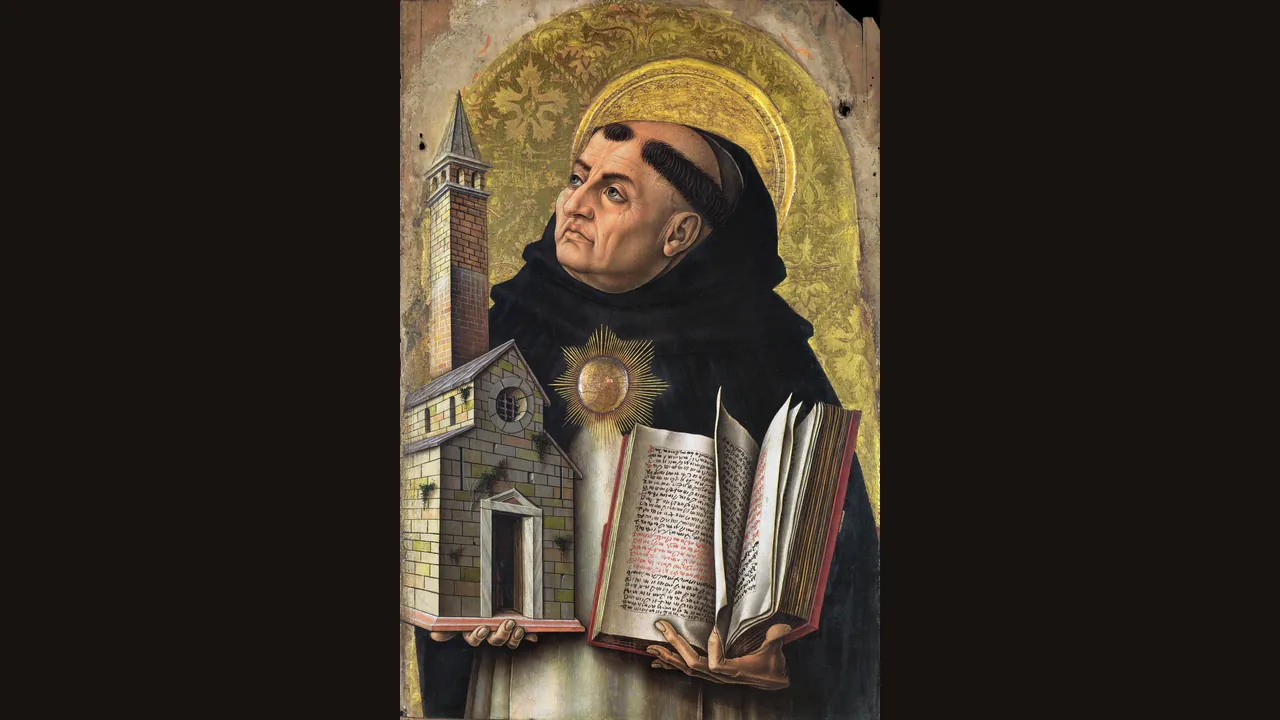
Italian Dominican friar whose Summa Theologiae joined Aristotle's philosophy to Christian doctrine in the most complete medieval system. He taught at Paris and Naples. He lived 1225 to 1274 and was canonized in 1323.
Thomas Aquinas was born in 1225 at the castle of Roccasecca near Aquino in southern Italy, the youngest son of a noble family. He was educated first at the Benedictine abbey of Monte Cassino, where his family placed him, and then at the new university at Naples. At Naples he joined the Dominicans, an order of preaching friars founded a generation earlier, receiving their habit in about 1244. His family expected a career that would advance its interests, and moved to take him back by force. His brothers seized him on the road, and the family held him at its castles for about a year. Whether he was released by a change of heart in the family or got away with the order's help, the early lives do not make clear.
Aquinas studied at Paris and then at Cologne under Albert the Great, the Dominican scholar who was bringing Aristotle's works, newly available in Latin translation, into the schools. The translations came in part from Greek and in part from Arabic, carrying the commentaries of Avicenna and Averroes with them, and they disturbed the universities: Aristotle's natural philosophy taught a world governed by necessary causes, and parts of it contradicted Christian doctrine as then stated. Aquinas returned to Paris as a master of theology and spent the rest of his short life teaching and disputing, at Paris twice, at the papal court, and at Naples, where he founded a school for his order.
His mature work has a fixed form, the disputed question. A question is posed. Objections against the answer he will give are stated in their strongest form. A short authority is set against them. Then Aquinas answers in his own voice and replies to each objection in turn. On the border between philosophy and theology he held a defined position. Some truths about God can be reached by reason: that God exists, and that God is one. Others, the Trinity and the Incarnation, exceed reason and are known only because God has revealed them. Faith and reason cannot finally contradict each other, since both come from God, but each governs its own ground. In the Summa Theologiae he sets out five ways of showing that God exists: arguments from motion, from causation, from contingency, from degrees of perfection, and from the ordered governance of the world. He also argued, against his older contemporary Bonaventure, that reason by itself cannot prove that the world had a beginning in time. He held that the beginning of the world is known by faith, and that an eternal world, had God willed it, would still have been a created world. The quarrel with the Franciscans was sharp and remains a standard case in the study of his thought.
His treatment of law in the Summa has had a long life of its own. Law, he argued, is an ordinance of reason directed to the common good. Eternal law is God's governance of the whole. Natural law is the share of that governance that rational creatures grasp by their own reason, and from it he derives the basic precepts of conduct. Human law applies natural law to a particular community, and it binds in conscience only when it is just. An unjust law, he wrote, is a corruption of law and does not bind in conscience. Building on Augustine, he set the conditions for a just war: sovereign authority, a just cause, and a right intention. For Pope Urban IV he composed the office for the new feast of Corpus Christi, including hymns still sung today. His output across less than twenty years of writing runs to millions of words, dictated to secretaries.
In December 1273, while celebrating Mass at Naples, Aquinas underwent an experience that his companions described as a rapture, and he wrote nothing after it. His confessor and secretary Reginald of Piperno urged him to resume. The answer recorded in the testimony for his canonization is that everything he had written seemed to him like straw beside what had been shown him. The Summa Theologiae stands unfinished, breaking off in the third part. He was summoned to the Council of Lyon and set out despite failing health. He died on the way, at the Cistercian abbey of Fossanova, in March 1274, at the age of forty nine. He was canonized in 1323. In 1879 Pope Leo XIII directed Catholic schools to teach his philosophy, and Thomism long served as the official intellectual frame of the Catholic Church. Scholars still dispute how to read him: how far his arguments for the existence of God were meant as strict demonstrations rather than as confirmations for men who already believed, and whether the tight system later Thomists built from his works matches the questioning method of the texts themselves.
Facts
- Born
- 1225, Roccasecca, near Aquino, Italy.
- Source: Encyclopaedia Britannica, Saint Thomas Aquinas
- Died
- 1274, Fossanova, Italy, on the way to the Council of Lyon.
- Source: Encyclopaedia Britannica, Saint Thomas Aquinas
- School
- Scholasticism; his own system is called Thomism.
- Source: Encyclopaedia Britannica, Saint Thomas Aquinas
- Known for
- The Summa Theologiae, the five ways of proving God's existence by reason, and the claim that grace perfects nature instead of destroying it.
- Source: Encyclopaedia Britannica, Saint Thomas Aquinas
Sources
- Encyclopaedia Britannica, Saint Thomas Aquinas Source
Source links accessed 22 November 2026.
Images
Related
- AristotleConnected
- Augustine of HippoConnected
- Anselm of CanterburyConnected
- AverroesConnected
- ItalyConnected
- William of OckhamConnected
What happened elsewhere
Pairings are by recorded year, not exact simultaneity.
- Kublai KhanWhile Thomas Aquinas (1215)
- Louis IXWhile Thomas Aquinas (1214)
- ThailandWhile Thomas Aquinas (1238)
- Mongol EmpireWhile Thomas Aquinas (1206)
- GuernseyWhile Thomas Aquinas (1204)
Meanwhile
Meanwhile, around the world — drag to spin, click a pulsing marker.
Keep reading
Test yourself
When was Thomas Aquinas born?
- 1225, Roccasecca, near Aquino, Italy
- 1033, Aosta, in what is now Italy
- About 1287, Ockham, Surrey, England
- 1058, Tus, in what is now Iran
Answer
1225, Roccasecca, near Aquino, Italy — Born: 1225, Roccasecca, near Aquino, Italy.
When did Thomas Aquinas die?
- 1274, Fossanova, Italy, on the way to the Council of Lyon
- 1111, Tus
- 1406, Cairo, Egypt
- 1200
Answer
1274, Fossanova, Italy, on the way to the Council of Lyon — Died: 1274, Fossanova, Italy, on the way to the Council of Lyon.
What is Thomas Aquinas known for?
- The Summa Theologiae, the five ways of proving God's existence by reason, and the claim that grace perfects nature instead of destroying it
- The great commentaries on Aristotle and The Incoherence of the Incoherence, his reply to Al Ghazali defending philosophy
- The Four Books with his commentaries, and the metaphysics of li, principle, and qi, material force
- The Muqaddimah and its theory of asabiyyah, group feeling, which binds tribes into states and loosens as luxury corrupts them
Answer
The Summa Theologiae, the five ways of proving God's existence by reason, and the claim that grace perfects nature instead of destroying it — Known for: The Summa Theologiae, the five ways of proving God's existence by reason, and the claim that grace perfects nature instead of destroying it.
Which school of thought was Thomas Aquinas part of?
- Scholasticism; his own system is called Thomism
- Islamic Aristotelianism, against the theologians
- Asharite theology, joined to Sufi mysticism
- Scholasticism; nominalism, the denial that universals exist outside the mind
Answer
Scholasticism; his own system is called Thomism — School: Scholasticism; his own system is called Thomism.
True or false: Italian Dominican friar whose Summa Theologiae joined Aristotle's philosophy to Christian doctrine in the most complete medieval system.
- True
- False
Answer
True — True. Italian Dominican friar whose Summa Theologiae joined Aristotle's philosophy to Christian doctrine in the most complete medieval system.
My notes
Highlights on this page
None yet.
Spotted an error on this page? Email [email protected] and it will be checked against the sources.