

Philosopher · High and Late Middle Ages · England
William of Ockham
c. 1287–1347
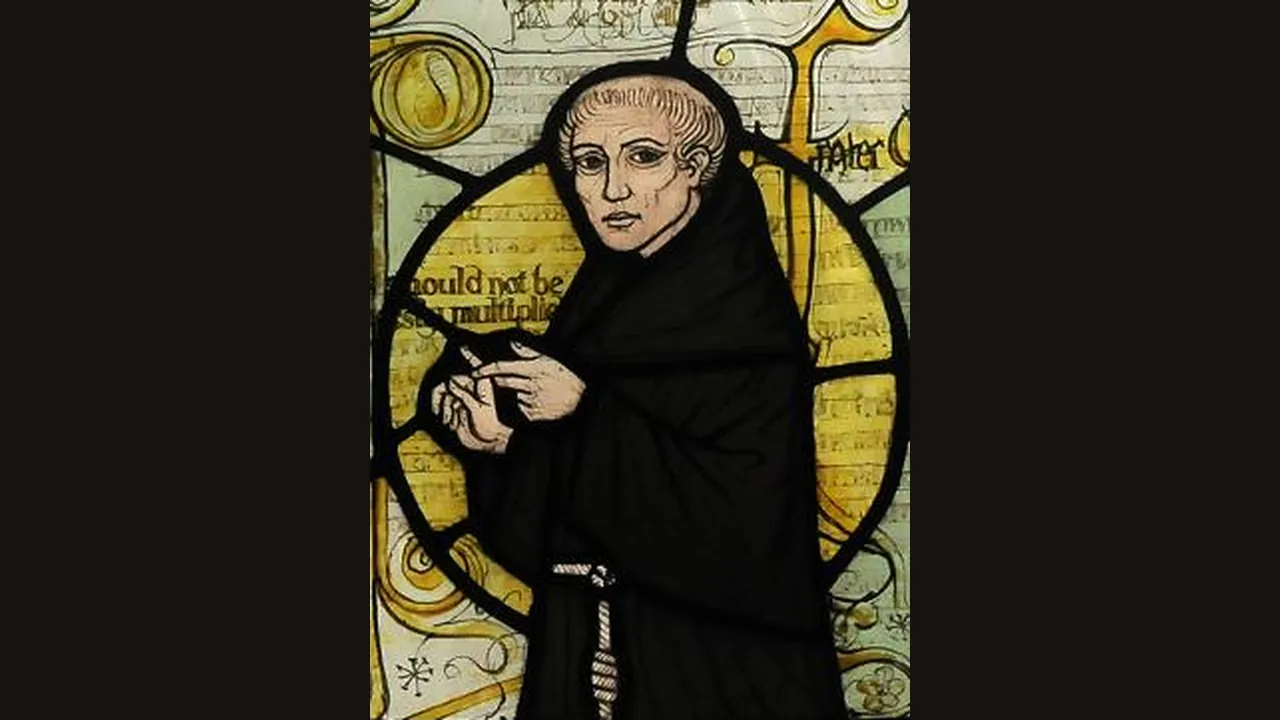
English Franciscan friar and logician whose razor, do not multiply entities beyond need, became a rule of science. He quarreled with Pope John XXII over poverty, fled Avignon, and died under excommunication. He lived about 1287 to 1347.
William of Ockham was born about 1287 at Ockham in Surrey and joined the Franciscan order. He studied and lectured on the Sentences at Oxford, and the commentary he wrote there drew charges from the chancellor John Lutterell. In 1324 the pope summoned him to Avignon, where a commission examined his teaching for four years without issuing a condemnation. In 1328 he fled Avignon with the Franciscan minister general Michael of Cesena, was excommunicated, and settled at Munich under the protection of the emperor Louis of Bavaria. He died there in 1347, probably of the plague.
Ockham held that only individual things exist. Universals, on his account, are signs: spoken words and the concepts behind them stand for many individuals and are not things shared among them. His Summa logicae works out this account through the theory of supposition, the ways a term stands for things in a sentence. The rule named Ockham's razor runs through the work: it is futile to do with more things what can be done with fewer, and a plurality is not to be posited without necessity. He distinguished intuitive cognition, awareness of a present thing, from abstractive cognition, which considers a thing apart from its presence. At Munich he wrote against the papal claim to fullness of power and argued from scripture and law that a pope can fall into heresy and be judged.
Facts
- Born
- About 1287, Ockham, Surrey, England.
- Source: Encyclopaedia Britannica, William of Ockham
- Died
- 1347, Munich, Germany, probably of the plague.
- Source: Encyclopaedia Britannica, William of Ockham
- School
- Scholasticism; nominalism, the denial that universals exist outside the mind.
- Source: Encyclopaedia Britannica, William of Ockham
- Known for
- Ockham's razor, the principle of parsimony, and writings against papal power in politics.
- Source: Encyclopaedia Britannica, William of Ockham
Sources
- Encyclopaedia Britannica, William of Ockham Source
Source links accessed 22 November 2026.
Images
Related
- Thomas AquinasConnected
- Mansa MusaSame era
- Hongwu EmperorSame era
- Ibn KhaldunSame era
- Kublai KhanSame era
- Louis IXSame era
What happened elsewhere
Pairings are by recorded year, not exact simultaneity.
- SwitzerlandWhile William of Ockham (around 1291)
- AndorraWhile William of Ockham (around 1278)
- MonacoWhile William of Ockham (around 1297)
- Ottoman EmpireWhile William of Ockham (around 1299)
- EthiopiaWhile William of Ockham (around 1270)
Meanwhile
Meanwhile, around the world — drag to spin, click a pulsing marker.
Keep reading
Test yourself
When was William of Ockham born?
- About 1287, Ockham, Surrey, England
- 1058, Tus, in what is now Iran
- 1126, Cordoba, Spain
- 1130, Youxi, Fujian, China
Answer
About 1287, Ockham, Surrey, England — Born: About 1287, Ockham, Surrey, England.
When did William of Ockham die?
- 1347, Munich, Germany, probably of the plague
- 1204, Fustat, Egypt
- 1111, Tus
- 1109, Canterbury, England
Answer
1347, Munich, Germany, probably of the plague — Died: 1347, Munich, Germany, probably of the plague.
What is William of Ockham known for?
- Ockham's razor, the principle of parsimony, and writings against papal power in politics
- The ontological argument: God, defined as that than which nothing greater can be thought, must exist even in reality. Also Cur Deus Homo, on why God became man
- The Guide for the Perplexed, the Mishneh Torah code of Jewish law, and the thirteen principles of faith
- The Summa Theologiae, the five ways of proving God's existence by reason, and the claim that grace perfects nature instead of destroying it
Answer
Ockham's razor, the principle of parsimony, and writings against papal power in politics — Known for: Ockham's razor, the principle of parsimony, and writings against papal power in politics.
Which school of thought was William of Ockham part of?
- Scholasticism; nominalism, the denial that universals exist outside the mind
- Jewish Aristotelianism
- Neo Confucianism, the school of principle
- Scholasticism, at its beginning
Answer
Scholasticism; nominalism, the denial that universals exist outside the mind — School: Scholasticism; nominalism, the denial that universals exist outside the mind.
True or false: English Franciscan friar and logician whose razor, do not multiply entities beyond need, became a rule of science.
- True
- False
Answer
True — True. English Franciscan friar and logician whose razor, do not multiply entities beyond need, became a rule of science.
My notes
Highlights on this page
None yet.
Spotted an error on this page? Email [email protected] and it will be checked against the sources.