

Philosopher · High and Late Middle Ages · Tunisia
Ibn Khaldun
1332–1406
Tunisian born historian and thinker whose Muqaddimah, the introduction to his world history, founded the study of how societies rise and fall. He served courts across North Africa and Spain, met Timur in 1401, and died at Cairo. He lived 1332 to 1406.
Ibn Khaldun was born at Tunis in 1332 into a family of scholars and officials from Seville in Muslim Spain. The plague that reached Tunis in 1348 killed his parents and many of his teachers. He spent twenty five years serving courts across North Africa and Spain, as secretary, diplomat, and judge, and spent two years in prison at Fez after a change of rulers. In 1377 he withdrew to the castle of Ibn Salama in Algeria and composed the Muqaddimah there. He then settled at Cairo, taught at al Azhar, and served as chief judge of the Maliki school.
The Muqaddimah, the introduction to his universal history, sets out a science of civilization. Its central term is asabiyyah, the group feeling that binds people together for conquest. He argued that group feeling is strongest among hard living nomads, that religion can strengthen it, and that a group carrying it to power founds a dynasty. He traced a decay across about four generations: the founders keep their virtues, their heirs grow up in luxury, cohesion loosens, and the dynasty sinks. He held that climate and livelihood shape the character of peoples, and that heavy taxation late in a dynasty shrinks revenue. He also laid down a rule for historians: reports are to be tested against the workings of society, and stories that contradict those workings are to be rejected.
Facts
- Born
- 1332, Tunis, Tunisia.
- Source: Encyclopaedia Britannica, Ibn Khaldun
- Died
- 1406, Cairo, Egypt.
- Source: Encyclopaedia Britannica, Ibn Khaldun
- School
- No school; the founder of historiography and early sociology.
- Source: Encyclopaedia Britannica, Ibn Khaldun
- Known for
- The Muqaddimah and its theory of asabiyyah, group feeling, which binds tribes into states and loosens as luxury corrupts them.
- Source: Encyclopaedia Britannica, Ibn Khaldun
Sources
- Encyclopaedia Britannica, Ibn Khaldun Source
Source links accessed 22 November 2026.
Images
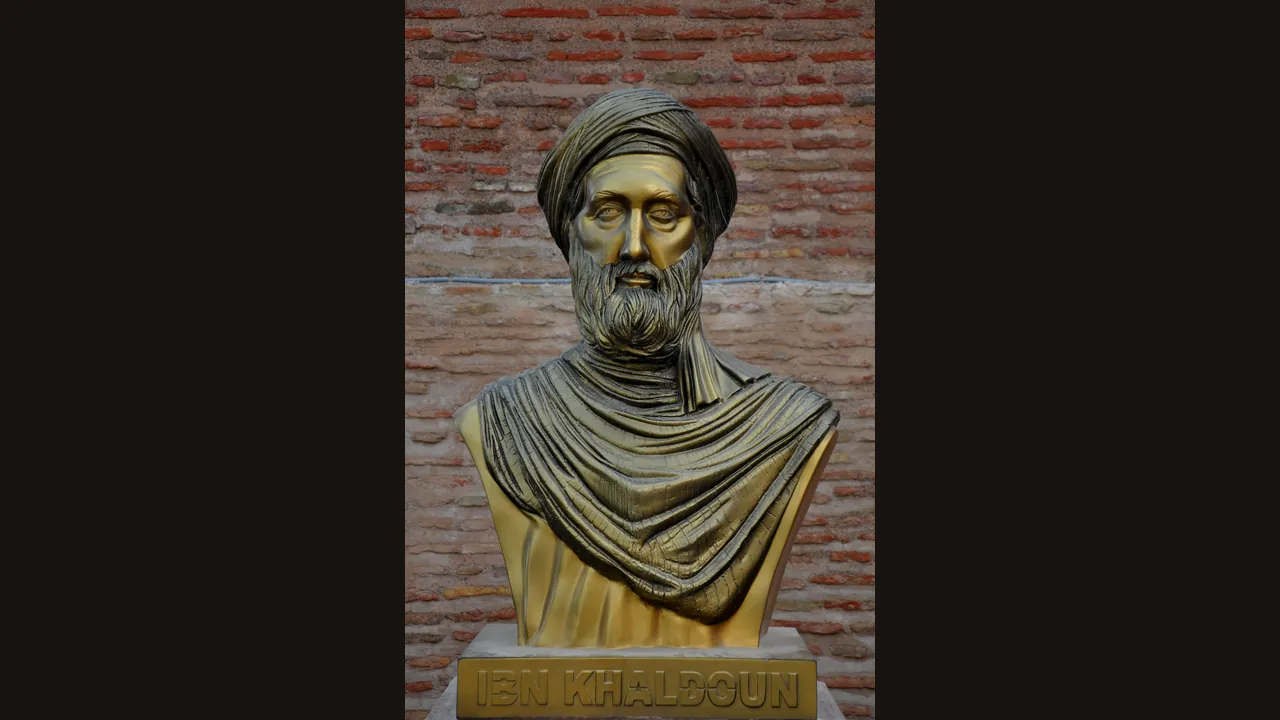
Related
- EgyptConnected
- Hongwu EmperorSame era
- Mansa MusaSame era
- William of OckhamSame era
- Inca EmpireSame era
- Aztec EmpireSame era
What happened elsewhere
Pairings are by recorded year, not exact simultaneity.
- Hongwu EmperorWhile Ibn Khaldun (1328)
- Mansa MusaWhile Ibn Khaldun (around 1312)
Meanwhile
Meanwhile, around the world — drag to spin, click a pulsing marker.
Keep reading
Test yourself
When was Ibn Khaldun born?
- 1332, Tunis, Tunisia
- 1130, Youxi, Fujian, China
- About 1287, Ockham, Surrey, England
- 1058, Tus, in what is now Iran
Answer
1332, Tunis, Tunisia — Born: 1332, Tunis, Tunisia.
When did Ibn Khaldun die?
- 1406, Cairo, Egypt
- 1198, Marrakesh, Morocco
- 1109, Canterbury, England
- 1204, Fustat, Egypt
Answer
1406, Cairo, Egypt — Died: 1406, Cairo, Egypt.
What is Ibn Khaldun known for?
- The Muqaddimah and its theory of asabiyyah, group feeling, which binds tribes into states and loosens as luxury corrupts them
- The Summa Theologiae, the five ways of proving God's existence by reason, and the claim that grace perfects nature instead of destroying it
- The ontological argument: God, defined as that than which nothing greater can be thought, must exist even in reality. Also Cur Deus Homo, on why God became man
- The Incoherence of the Philosophers, which denied that reason can prove metaphysical truths, and the Revival of the Religious Sciences
Answer
The Muqaddimah and its theory of asabiyyah, group feeling, which binds tribes into states and loosens as luxury corrupts them — Known for: The Muqaddimah and its theory of asabiyyah, group feeling, which binds tribes into states and loosens as luxury corrupts them.
Which school of thought was Ibn Khaldun part of?
- No school; the founder of historiography and early sociology
- Jewish Aristotelianism
- Scholasticism; nominalism, the denial that universals exist outside the mind
- Scholasticism; his own system is called Thomism
Answer
No school; the founder of historiography and early sociology — School: No school; the founder of historiography and early sociology.
True or false: Tunisian born historian and thinker whose Muqaddimah, the introduction to his world history, founded the study of how societies rise and fall.
- True
- False
Answer
True — True. Tunisian born historian and thinker whose Muqaddimah, the introduction to his world history, founded the study of how societies rise and fall.
My notes
Highlights on this page
None yet.
Myth vs. evidence
The myth
Ibn Khaldun's Muqaddimah vanished after his death and stayed unknown until European scholars rediscovered it in the nineteenth century.
The evidence
Copies of the Muqaddimah circulated in the Islamic world for centuries, and Ottoman historians and statesmen read and used it. European scholars came late to a book that learned readers in Cairo and Istanbul had never entirely lost.
Sources: Robert Irwin, Ibn Khaldun, An Intellectual Biography
Spotted an error on this page? Email [email protected] and it will be checked against the sources.