

Civilization · Twentieth century · China
People's Republic of China
1949–
The state proclaimed in Beijing on 1 October 1949 after the communist victory in the civil war. A container for that state, not a history of it.
The People's Republic of China was proclaimed in Beijing on 1 October 1949, after the Chinese Communist Party won the civil war against the Nationalist government, which withdrew to Taiwan. The new state held mainland China and its population of more than 500 million, most of them farmers speaking Chinese languages. The Communist Party took the only legal political power, and it has held that power since.
The government redistributed farmland in the early 1950s and then merged farms into communes during the Great Leap Forward, launched in 1958 to raise farm and steel output at once. Output fell, and a famine followed from 1959 to 1961. Historians' estimates of the deaths run from about 15 million to about 45 million. In 1966 Mao Zedong launched the Cultural Revolution, and Red Guard groups attacked officials, teachers, and others classed as enemies; schools closed, and millions of people were persecuted, imprisoned, or sent to the countryside before the campaign ended with Mao's death in 1976.
From 1978 the government under Deng Xiaoping dismantled the communes, allowed private farming and business, and opened special economic zones to foreign investment. Output and trade grew for decades, and the population passed 1.4 billion. The state remains a one party state ruled by the Communist Party, with its capital at Beijing.
Watch
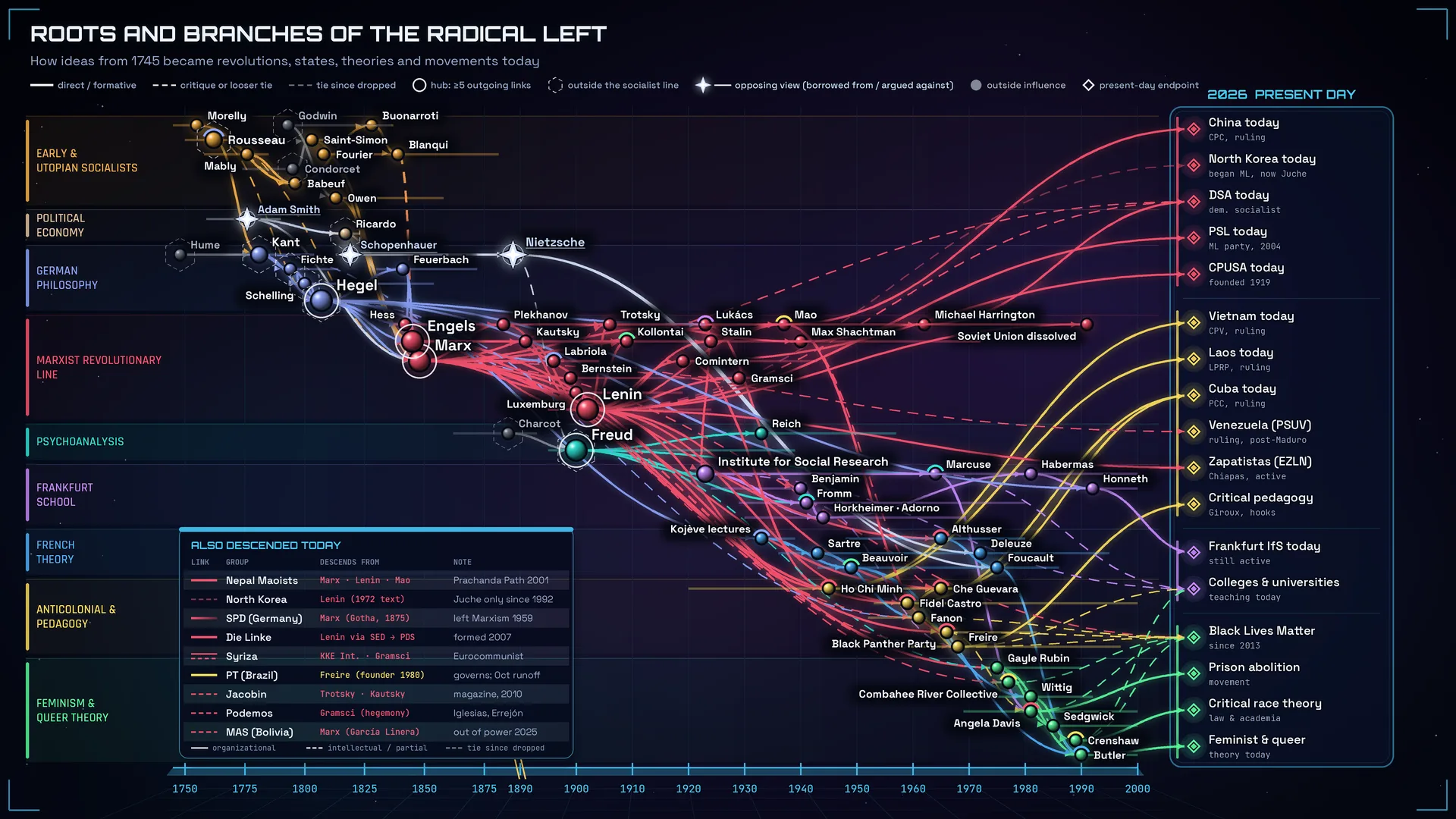
Roots and Branches of the Radical Left
Events · 2026-10-15
Socialism is presented as an economic theory. In reality, woven through every part of the theory are two things that must be adopted before socialism can "work properly": a pseudo-history of mankind, and a massive shift of worldview. Both rest on a fundamental lie about human nature: they blame man's conditions for what belongs to the man himself.
That ideology did not appear from nowhere. It grew out of long-standing ideas, taken up across a chain of events and twisted over time into a promise of a better way for human beings to live, which is why the whole runs far deeper and is far more complex than the economic label suggests. Along the way it was woven in and out of great thinkers, at different points and for different reasons. Some were used for it and some against it, and through all of it the idea kept building.
This map lays that out where it can be seen: the evolution of the ideas, the effects they had, and the chain of cause and effect that followed from thinker to thinker.
Facts
- Proclaimed
- 1 October 1949, Beijing.
- Source: Encyclopaedia Britannica, Chinese Civil War
- Other claim
- The Nationalist government retreated to Taiwan in December 1949 and did not treat the proclamation as the end of its own claim.
- Source: Encyclopaedia Britannica, Chinese Civil War
Sources
- Encyclopaedia Britannica, Chinese Civil War Source
Source links accessed 22 November 2026.
Related
- Mao ZedongConnected
- Great Leap ForwardConnected
- Cultural RevolutionConnected
- Chinese Civil WarConnected
- ChinaConnected
- Twentieth centuryConnected
What happened elsewhere
Pairings are by recorded year, not exact simultaneity.
Meanwhile
Meanwhile, around the world — drag to spin, click a pulsing marker.
Keep reading
Articles
My notes
Highlights on this page
None yet.
Spotted an error on this page? Email [email protected] and it will be checked against the sources.