

Civilization · Middle and Late Bronze Age · Mycenaean Greece
Mycenaean Greece
c. 1750–1050 BCE
Mycenaean Greece was the civilization of the Iliad: warrior kings in walled citadels who sailed against Troy. Its palaces at Mycenae and Pylos kept the first Greek writing. It collapsed about 1050 BCE in the Bronze Age catastrophe.
Mycenaean Greece covered the mainland of southern and central Greece, the Aegean islands, and Crete in its later centuries. Its people spoke Greek, the earliest attested form of the language, and wrote it in the Linear B script on clay tablets. The civilization is named for Mycenae, its citadel in the northeast Peloponnese, where shaft graves of about 1650 to 1500 BCE held gold masks, weapons, and jewelry.
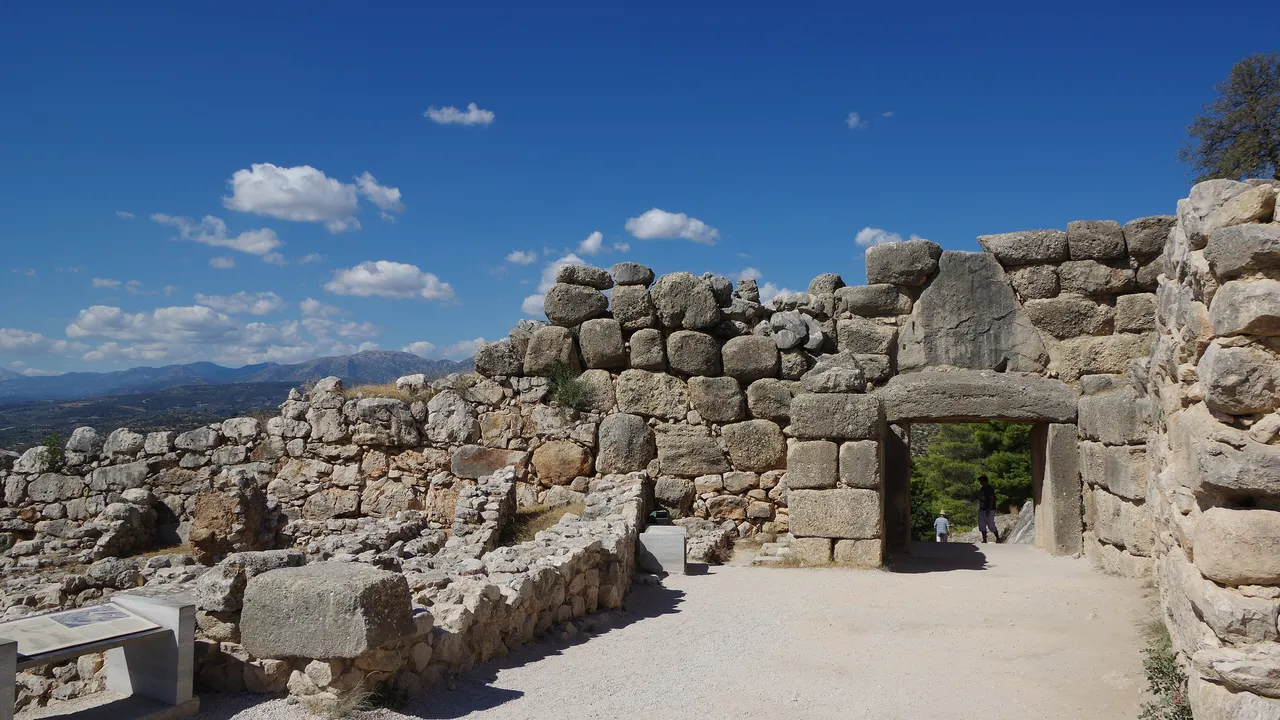
Each center was a small kingdom. A king called the wanax ruled from a fortified palace at Mycenae, Tiryns, Pylos, and Thebes, and palace scribes recorded land, livestock, rations, and workers on tablets. Their builders raised walls of huge stones and domed tombs cut into hillsides. Mycenaean goods reached Italy, Cyprus, Egypt, and the Levant through trade, and Mycenaean soldiers served abroad as mercenaries.
The poems of Homer, composed centuries later, tell of a Greek expedition against Troy. Excavations at Troy show a city destroyed by fire in this period, and no surviving text settles whether that destruction matches the war of the poems. The palaces burned about 1200 BCE, in the same wave of destruction that struck the eastern Mediterranean. Writing disappeared from Greece, settlements shrank, and the palace kingdoms had ended by about 1050 BCE.
Facts
- Founded
- c. 1750 BCE, the shaft grave kings at Mycenae.
- Source: Encyclopaedia Britannica, Mycenaean civilization
- Ended
- c. 1050 BCE, the palaces destroyed.
- Source: Encyclopaedia Britannica, Mycenaean civilization
- Heartland
- The Greek mainland and the Aegean, center at Mycenae.
- Source: Encyclopaedia Britannica, Mycenaean civilization
- Major rulers
- Agamemnon, the legendary king of the Iliad.
- Source: Encyclopaedia Britannica, Mycenaean civilization
Sources
- Encyclopaedia Britannica, Mycenaean civilization Source
Source links accessed 22 November 2026.
Images
Related
- HammurabiSame era
- Hittite EmpireSame era
- BabyloniaSame era
- Thutmose IIISame era
- Ramesses IISame era
- Minoan civilizationSame era
What happened elsewhere
Pairings are by recorded year, not exact simultaneity.
- HammurabiWhile Mycenaean Greece (around 1810 BC)
Meanwhile
Meanwhile, around the world — drag to spin, click a pulsing marker.
Keep reading
Test yourself
When was Mycenaean Greece founded?
- c. 1750 BCE, the shaft grave kings at Mycenae
- c. 1894 BCE, as an Amorite kingdom at Babylon
- c. 1650 BCE, the Old Kingdom at Hattusa
- c. 3000 BCE, the first palaces on Crete
Answer
c. 1750 BCE, the shaft grave kings at Mycenae — Founded: c. 1750 BCE, the shaft grave kings at Mycenae.
When did Mycenaean Greece end?
- c. 1050 BCE, the palaces destroyed
- 539 BCE, conquered by Cyrus the Great of Persia
- c. 1190 BCE, in the Bronze Age collapse
- c. 1100 BCE, the palaces abandoned
Answer
c. 1050 BCE, the palaces destroyed — Ended: c. 1050 BCE, the palaces destroyed.
Where was the heartland of Mycenaean Greece?
- The Greek mainland and the Aegean, center at Mycenae
- Central Anatolia, capital Hattusa, in present day Turkey
- Southern Mesopotamia, capital Babylon
- The island of Crete, center at Knossos
Answer
The Greek mainland and the Aegean, center at Mycenae — Heartland: The Greek mainland and the Aegean, center at Mycenae.
True or false: Mycenaean Greece was the civilization of the Iliad: warrior kings in walled citadels who sailed against Troy.
- True
- False
Answer
True — True. Mycenaean Greece was the civilization of the Iliad: warrior kings in walled citadels who sailed against Troy.
My notes
Highlights on this page
None yet.
Spotted an error on this page? Email [email protected] and it will be checked against the sources.