

Civilization · Middle and Late Bronze Age · Minoan civilization
Minoan civilization
c. 3000–1100 BCE
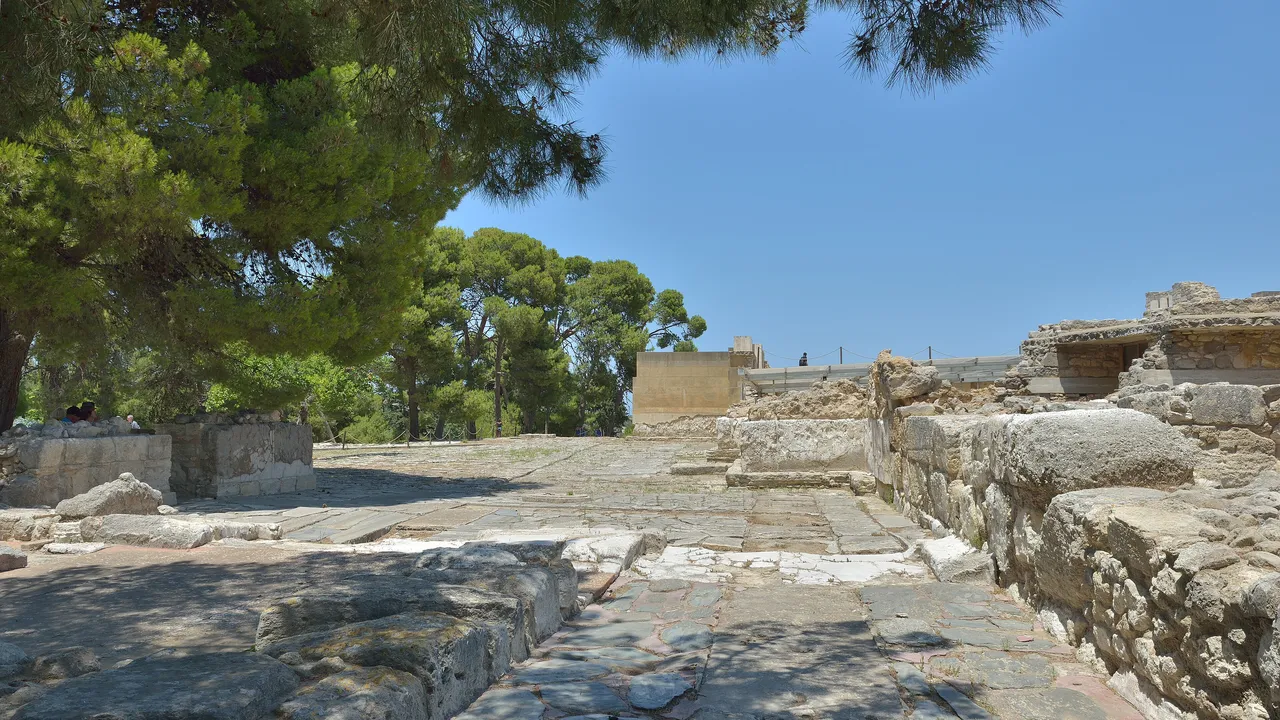
The Minoans built Europe's first advanced civilization on the island of Crete. Their palace at Knossos was a maze of courtyards and frescoes. The civilization faded about 1100 BCE, leaving the legend of the Minotaur.
The Minoan civilization developed on the island of Crete in the Aegean Sea. Its name is modern, taken from Minos, a king of Crete in Greek legend, and the name its people used for themselves is unknown. Farming villages stood on Crete from about 7000 BCE, and the first large palaces rose about 2000 BCE at Knossos, Phaistos, Malia, and Zakros.
No king of the Minoans is named in any surviving text. The palaces stored grain, oil, and wine in large magazines, kept records on clay tablets, and housed workshops, and their remains point to rulers who administered the collection and distribution of goods. Minoan scribes wrote in a picture script and in a second script, Linear A, and neither has been deciphered. Their ships traded with Egypt, the Levant, and the Greek mainland, carrying oil, wine, and crafted goods in exchange for metals and ivory.
A volcanic eruption on the island of Thera, dated to about 1600 BCE, scattered ash over the eastern Aegean and damaged Cretan settlements, and scholars disagree on how much it weakened the palaces. About 1450 BCE most of the palaces burned. Greek-speaking Mycenaeans then held Knossos, and the last palace centers were abandoned in the centuries that followed, the civilization ending by about 1100 BCE.
Facts
- Founded
- c. 3000 BCE, the first palaces on Crete.
- Source: Encyclopaedia Britannica, Minoan civilization
- Ended
- c. 1100 BCE, the palaces abandoned.
- Source: Encyclopaedia Britannica, Minoan civilization
- Heartland
- The island of Crete, center at Knossos.
- Source: Encyclopaedia Britannica, Minoan civilization
- Major rulers
- Minos, the legendary king who gave the civilization its name.
- Source: Encyclopaedia Britannica, Minoan civilization
Sources
- Encyclopaedia Britannica, Minoan civilization Source
Source links accessed 22 November 2026.
Images
Related
- BabyloniaSame era
- HammurabiSame era
- Mycenaean GreeceSame era
- Hittite EmpireSame era
- Thutmose IIISame era
- Ramesses IISame era
Meanwhile
Meanwhile, around the world — drag to spin, click a pulsing marker.
Keep reading
Test yourself
When was Minoan civilization founded?
- c. 3000 BCE, the first palaces on Crete
- c. 1894 BCE, as an Amorite kingdom at Babylon
- c. 1650 BCE, the Old Kingdom at Hattusa
- c. 1750 BCE, the shaft grave kings at Mycenae
Answer
c. 3000 BCE, the first palaces on Crete — Founded: c. 3000 BCE, the first palaces on Crete.
When did Minoan civilization end?
- c. 1100 BCE, the palaces abandoned
- c. 1190 BCE, in the Bronze Age collapse
- 539 BCE, conquered by Cyrus the Great of Persia
- c. 1050 BCE, the palaces destroyed
Answer
c. 1100 BCE, the palaces abandoned — Ended: c. 1100 BCE, the palaces abandoned.
Where was the heartland of Minoan civilization?
- The island of Crete, center at Knossos
- The Greek mainland and the Aegean, center at Mycenae
- Central Anatolia, capital Hattusa, in present day Turkey
- Southern Mesopotamia, capital Babylon
Answer
The island of Crete, center at Knossos — Heartland: The island of Crete, center at Knossos.
True or false: The Minoans built Europe's first advanced civilization on the island of Crete.
- True
- False
Answer
True — True. The Minoans built Europe's first advanced civilization on the island of Crete.
My notes
Highlights on this page
None yet.
Spotted an error on this page? Email [email protected] and it will be checked against the sources.