
Event · Twenty-first century · Iran
Islamic Revolutionary Guard Corps
1979–
Parallel military and security force of the Islamic Republic of Iran, founded 1979 to protect the revolution. Controls large economic and external operations alongside the regular army.
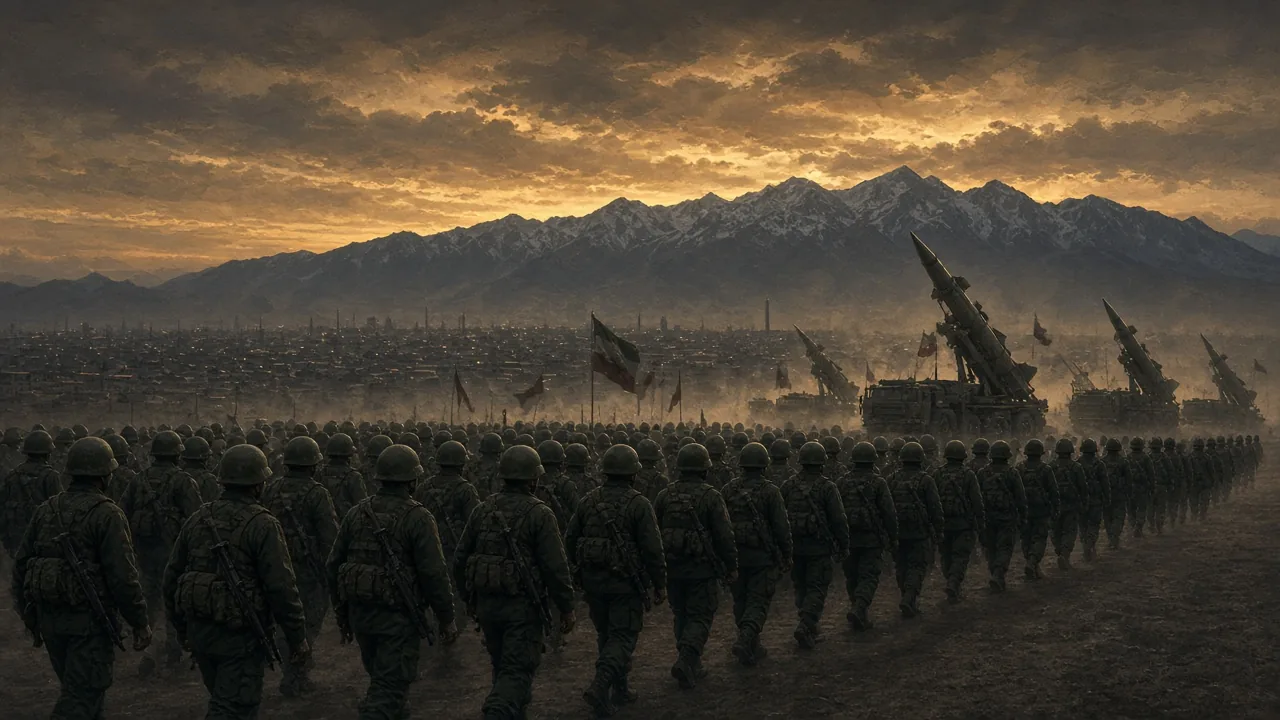
A modernizing monarchy fell, and a theocracy rose in its place. The Iranian population, the governance of the Islamic Republic, and the Islamic Revolutionary Guard Corps (IRGC) are three distinct political and social entities operating under a single flag.
The monarchy that collapsed in 1979 had been aggressively re-engineering Iranian society from above since January 1963, when Mohammad Reza Shah Pahlavi submitted his "White Revolution" to a national referendum that officially reported a 99 percent approval rate. The initiative encompassed six primary structural reforms: land redistribution that broke up traditional landowning estates, profit-sharing programs for industrial workers, the nationalization of forests and pastures, the sale of state-owned factories to finance development, and the establishment of the Literacy Corps, which sent conscripted graduates into rural villages to combat widespread illiteracy. A month later, the Shah extended voting rights to women. On paper, it was presented as a bloodless revolution; in practice, it executed rapid socioeconomic modernization without public representation, funded by oil revenues and policed by SAVAK, the state's secret police whose torture chambers became the regime's most feared institution. Following the 1973 oil boom, soaring state revenues multiplied both domestic development and socioeconomic inequality, forging a broad opposition coalition that spanned clergy, traditional bazaar merchants, leftist organizations, and secular liberals, factions that agreed solely on the necessity of removing the Shah.
Ayatollah Ruhollah Khomeini, exiled since November 1964, first in Turkey, then Najaf, and from October 1978 in Neauphle-le-Château outside Paris, served as the focal point for this opposition. Operating from Paris, Khomeini conducted extensive media interviews and distributed message tapes throughout Iran while maintaining a carefully calculated stance on clerical power. He stated to the Iranian publication Ettelaat that the ulema would not hold administrative government positions, and informed European correspondents that the clergy's role would be limited to moral guidance rather than direct governance, statements recorded in Sahifeh-ye Imam. Following the Shah's departure on January 16, 1979, Khomeini returned to Tehran on February 1 aboard a chartered Air France Boeing 747 (Flight AF 4721), carrying approximately 120 international journalists as insurance against an attack on the aircraft. When asked by journalist Peter Jennings what he felt upon returning after fifteen years in exile, Khomeini replied, "Hichi," meaning nothing.
The transition of power unfolded over ten days during which Iran maintained two competing authorities: Shapour Bakhtiar's imperial government and Khomeini's provisional administration under Mehdi Bazargan, appointed on February 4. On February 11 (22 Bahman), the Supreme Military Council declared the armed forces neutral, precipitating the final collapse of the monarchy. The broad anti-monarchical coalition quickly narrowed. A national referendum held on March 30 and 31 offered a binary choice, Islamic Republic, yes or no, printed on green and red ballots without a secret vote, reporting over 98 percent approval and leading to the formal proclamation of the Islamic Republic on April 1. The Assembly of Experts drafted a constitution that codified Khomeini's doctrine of velayat-e faqih (the guardianship of the jurist) into law. The draft had originally been structured around a Gaullist-style presidency; the constitution turned it into a framework for clerical rule. It was ratified on December 2 and 3 with an official 99.5 percent affirmative vote.
The IRGC was created during this period of consolidation by decree in the spring of 1979. Iranian officialdom marks its anniversary on April 22 (2 Ordibehesht), whereas Western records cite Khomeini's formal decree on May 5. Between February and December 1979, the Guard evolved from a loose collection of militias into an organized armed force built deliberately parallel to the regular army (Artesh). While the Artesh defends national sovereignty, the IRGC's constitutional mandate is safeguarding the Islamic Republic and the revolution's claim to power. Its initial charter was drafted by Mohsen Sazegara, a mechanical engineer who had studied volunteer military models, ranging from the Swiss and Israeli systems to the Viet Cong and the U.S. National Guard, during his time in Paris, before later fleeing west and repudiating the organization. The Basij paramilitary was established later, following Khomeini's November 1979 call for a "twenty million man army" (decreed November 26, founded April 30, 1980), and was placed under IRGC command in 1981 to serve as an instrument for domestic enforcement, military deployment during the Iran-Iraq War, and protest suppression.
On November 4, 1979, Iranian students stormed the U.S. Embassy in Tehran, seizing 66 Americans and holding 52 of them for 444 days. In response, President Jimmy Carter froze Iranian government assets in American banks on November 14. That freeze began the modern U.S. sanctions framework. These events unfolded against the backdrop of 1953's Operation Ajax (TPAJAX / Operation Boot), the joint CIA and MI6 covert operation that overthrew Prime Minister Mohammad Mossadegh and restored the Shah, an action formally acknowledged by the CIA in 2013. While Operation Ajax remains an established foundational element of Iranian historical memory, it serves as context rather than a blanket justification for subsequent international conflict. After 1963 the sequence runs in the open: a top-down modernizing state sustained by oil revenues and enforced by secret police, a broad opposition coalition united strictly by its anti-monarchical stance, the legal codification of jurist guardianship, and the creation of a parallel armed force that expanded into the country's dominant political institution.
Sources
Primary sources
- The CIA's role in the 1953 coup against Mossadegh (Operation Ajax/TPAJAX), formally confirmed in declassified records released in 2013 National Security Archive, George Washington University, CIA Confirms Role in 1953 Iran Coup, Electronic Briefing Book No. 435 (2013).
Secondary sources
- The IRGC's creation in 1979, its constitutional mandate to guard the revolution, and its growth into a political and economic power Afshon Ostovar, Vanguard of the Imam: Religion, Politics, and Iran's Revolutionary Guards (2016).
- The White Revolution, SAVAK, and the broad coalition that overthrew the Shah in 1979 Ervand Abrahamian, A History of Modern Iran (2008).
Facts
- Founded
- 1979, after the Islamic Revolution.
- Source: Encyclopaedia Britannica, Islamic Revolutionary Guard Corps
- Role
- Internal security, expeditionary and proxy operations, and extensive economic holdings; distinct from the regular Artesh.
- Source: Encyclopaedia Britannica, Islamic Revolutionary Guard Corps
Sources
- Encyclopaedia Britannica, Islamic Revolutionary Guard Corps Source
Source links accessed 22 November 2026.
Images
Related
- IranConnected
- September 11 attacksSame era
- Abbas ISame country
- Al GhazaliSame country
- Darius ISame country
- Cyrus the GreatSame country
What happened elsewhere
Pairings are by recorded year, not exact simultaneity.
- Saint LuciaWhile Islamic Revolutionary Guard Corps (1979)
- Saint Vincent and the GrenadinesWhile Islamic Revolutionary Guard Corps (1979)
- KiribatiWhile Islamic Revolutionary Guard Corps (1979)
- ZimbabweWhile Islamic Revolutionary Guard Corps (1980)
- DominicaWhile Islamic Revolutionary Guard Corps (1978)
Meanwhile
Meanwhile, around the world — drag to spin, click a pulsing marker.
Keep reading
My notes
Highlights on this page
None yet.
Spotted an error on this page? Email [email protected] and it will be checked against the sources.