

Civilization · Classical antiquity · Qin dynasty
Qin dynasty
221–206 BCE
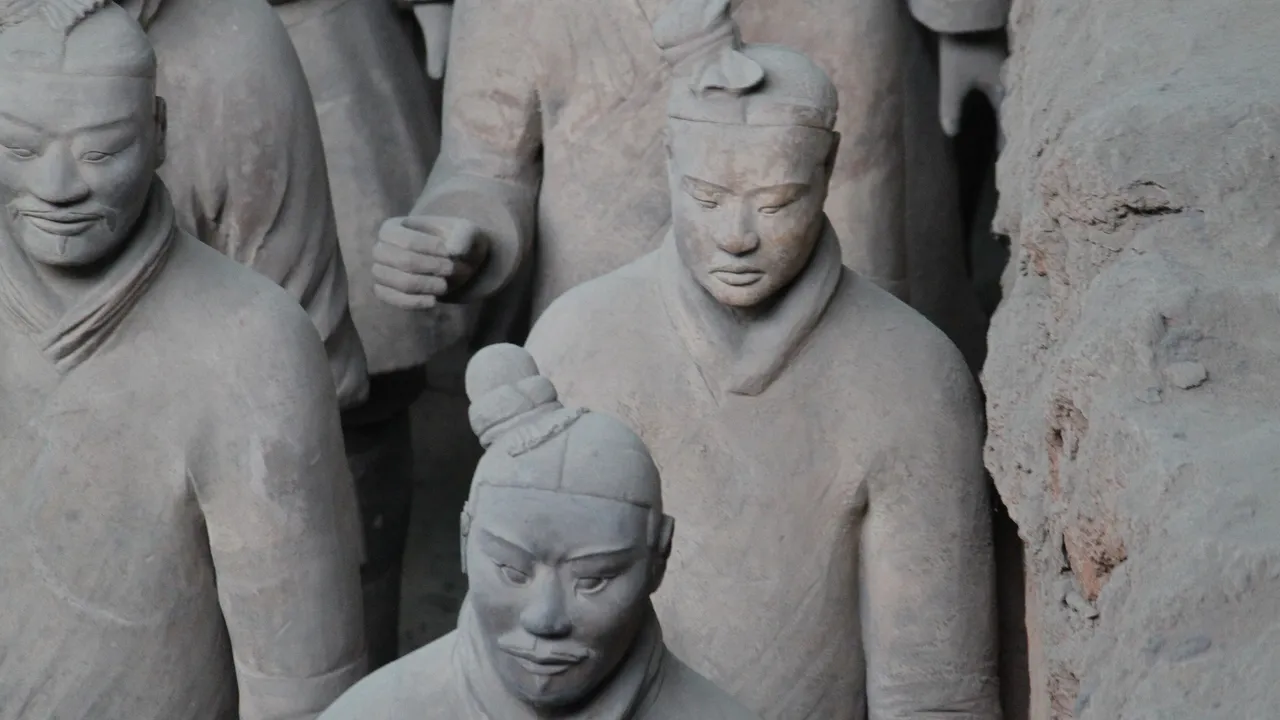
The Qin dynasty was the first to unite China, ending centuries of warring states. Qin Shi Huang standardized writing, money, and roads, built the Great Wall's first version, and was buried with the terracotta army. It lasted only fifteen years.
The Qin dynasty began in 221 BCE, when the western state of Qin finished conquering the six other Chinese states after more than a century of war. Its king, Ying Zheng, took the new title Shi Huangdi, First Emperor. Qin governed all of China from Xianyang, near modern Xi'an, for fifteen years.
The government replaced the old feudal kingdoms with commanderies and counties staffed by appointed officials. It imposed one script, the small seal script, on all official writing, and standard coinage, weights, and measures on the whole country. Officials registered households, collected taxes in grain and cloth, and called men up for labor service and military service. Armies built roads and canals and joined the northern frontier walls against the Xiongnu nomads. The chancellor Li Si directed the administration on Legalist principles. Sima Qian, the Han historian who wrote a century later, reports that in 213 BCE the court ordered most private copies of historical records and the classics burned.
The First Emperor died in 210 BCE on a tour of the east. His younger son took the throne under the control of the eunuch Zhao Gao, and revolts broke out across the country in 209 BCE. In 206 BCE the last Qin ruler surrendered to Liu Bang, and the dynasty ended in the civil war that followed.
Facts
- Founded
- 221 BCE, Qin Shi Huang proclaimed the first emperor.
- Source: Encyclopaedia Britannica, Qin dynasty
- Ended
- 206 BCE, collapsed in rebellion after the emperor's death.
- Source: Encyclopaedia Britannica, Qin dynasty
- Heartland
- Northern China, capital Xianyang.
- Source: Encyclopaedia Britannica, Qin dynasty
- Major rulers
- Qin Shi Huang, the first emperor of China.
- Source: Encyclopaedia Britannica, Qin dynasty
Sources
- Encyclopaedia Britannica, Qin dynasty Source
Source links accessed 22 November 2026.
Images
Related
- Qin Shi HuangSame civilization
- Han FeiziSame civilization
- Han dynastySame era
- Parthian EmpireSame era
- AshokaSame era
- Han WudiSame era
What happened elsewhere
Pairings are by recorded year, not exact simultaneity.
- Han dynastyWhile Qin dynasty (206 BC)
- Parthian EmpireWhile Qin dynasty (247 BC)
- AshokaWhile Qin dynasty (around 268 BC)
- Han WudiWhile Qin dynasty (156 BC)
Meanwhile
Meanwhile, around the world — drag to spin, click a pulsing marker.
Keep reading
Test yourself
When was Qin dynasty founded?
- 221 BCE, Qin Shi Huang proclaimed the first emperor
- 27 BCE, Augustus became the first emperor
- 206 BCE, Liu Bang founded the dynasty after Qin's fall
- 247 BCE, Arsaces I founded the dynasty
Answer
221 BCE, Qin Shi Huang proclaimed the first emperor — Founded: 221 BCE, Qin Shi Huang proclaimed the first emperor.
When did Qin dynasty end?
- 206 BCE, collapsed in rebellion after the emperor's death
- 651 CE, the last king killed; Persia became Muslim
- 27 BCE, Augustus established the empire
- 185 BCE, the last Mauryan assassinated
Answer
206 BCE, collapsed in rebellion after the emperor's death — Ended: 206 BCE, collapsed in rebellion after the emperor's death.
Where was the heartland of Qin dynasty?
- Northern China, capital Xianyang
- Northern India, capital Pataliputra
- Italy, capital Rome
- Persia and Mesopotamia, capital Ctesiphon
Answer
Northern China, capital Xianyang — Heartland: Northern China, capital Xianyang.
True or false: The Qin dynasty was the first to unite China, ending centuries of warring states.
- True
- False
Answer
True — True. The Qin dynasty was the first to unite China, ending centuries of warring states.
My notes
Highlights on this page
None yet.
Myth vs. evidence
The myth
The First Emperor of Qin buried 460 scholars alive because they criticized his rule.
The evidence
The story comes from Sima Qian, writing a century later under the dynasty that defined itself against Qin. His account ties the killings to a fraud case over the emperor's immortality drugs and puts scholars and magicians together among the victims. The scale, and whether Confucian scholars as such were the target, remain disputed.
Sources: Sima Qian, Records of the Grand Historian, chapter 6
Spotted an error on this page? Email [email protected] and it will be checked against the sources.