
Artifacts · No. 33
Imperial Crown of the Holy Roman Empire
Eight hinged gold plates of gems and biblical kings under a single arch and cross: the crown of the Holy Roman Emperors for eight centuries, and the model for every crown drawn since.
c. 960-980Zoomable photographFamily viewing: YesCatalogue: WS XIII 1
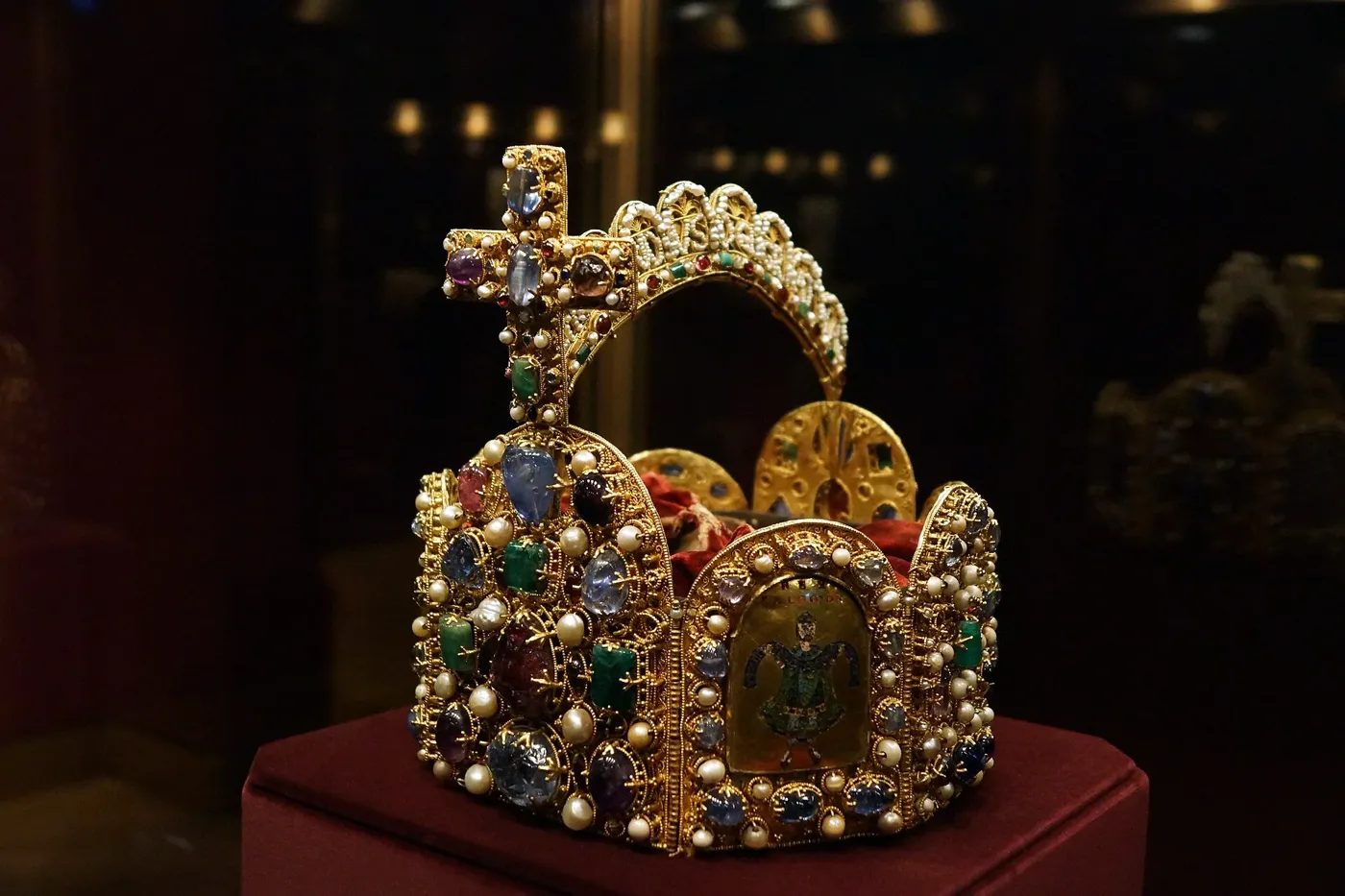
Photograph: Bede735c · CC BY-SA 3.0 · Source
Held by: Imperial Treasury, Hofburg, Vienna · Catalogue WS XIII 1
The story
The Imperial Crown is not a band but an octagon of eight hinged gold plates, made probably in the 960s or 970s for an Ottonian emperor, Otto I or Otto II. Four plates carry cloisonné enamel images of Christ, David, Solomon and Hezekiah with the prophet Isaiah; the other four are crusted with pearls and great stones. A single arch, added a generation later, rises from front to back under a cross, turning the whole into a piece of architecture the emperor wore.
It crowned emperors from the Ottonians to Francis II, who dissolved the empire in 1806, and it survived everything the regalia survived: the moves between Nuremberg and Vienna, the Nazi seizure, and the return in 1946. The Imperial Treasury's research scanning of the crown is not published as a public model, so this page carries a photograph.
The record, not the myth
Which emperor first wore it is argued from the enamel plates' inscriptions and style; the honest answer is an Ottonian of the later tenth century. The crown was never a daily object: emperors wore it rarely, and it ruled mostly from its shrine.
Sources
Image and model credits
- PhotographBede735c · CC BY-SA 3.0 · Source
Continue on
Holy Lance (Vienna Lance)Gold Crown from Hwangnamdaechong Tomb