
Artifacts · No. 32
Holy Lance (Vienna Lance)
The lancehead carried as the spear that pierced Christ's side, set with a nail of the Crucifixion: for a thousand years the palladium of emperors, and the centre of the Holy Roman Empire's regalia.
8th-9th century ADZoomable photographFamily viewing: YesCatalogue: WS XIII 19
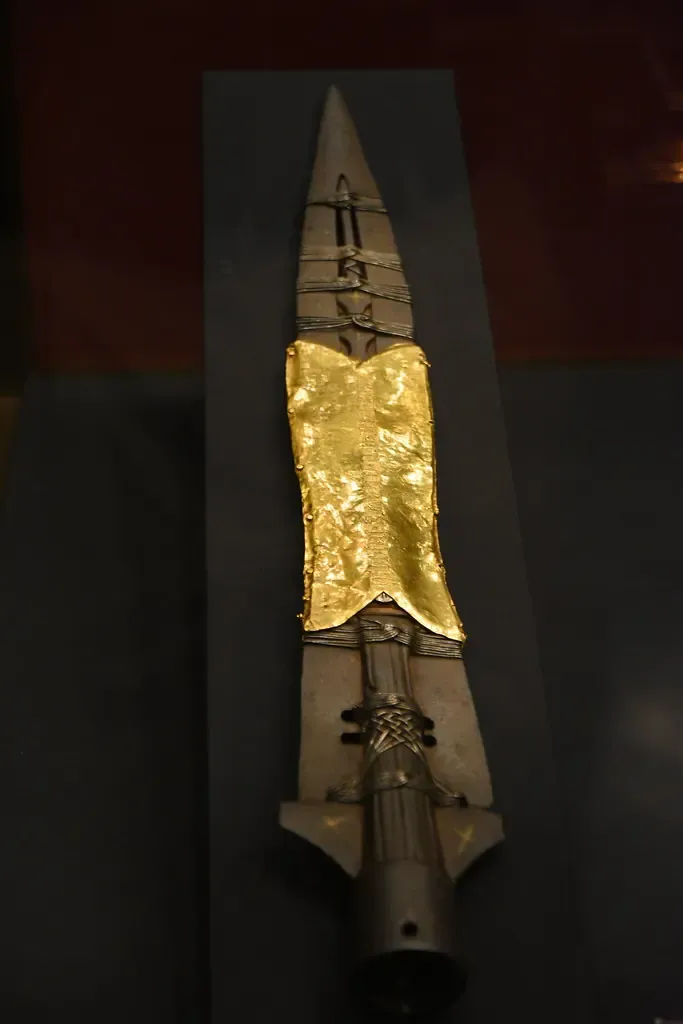
Photograph: Amaury Laporte · CC BY 2.0 · Source
Held by: Imperial Treasury, Hofburg, Vienna · Catalogue WS XIII 19
The story
The Vienna lance is a Carolingian winged lancehead of the eighth or ninth century, its blade split and bound around an iron pin said to be a nail of the Crucifixion, held by sleeves of silver and gold added by later emperors. From the tenth century it travelled with the imperial regalia: carried before the emperor, pledged, captured, ransomed, and kept at Nuremberg for five centuries before the regalia settled in Vienna.
Other lances claim the same honour, in Rome, in Krakow, and the Armenian lance at Etchmiadzin, and the Vienna blade's own metal is early medieval, not Roman. What is not in doubt is the work the object did: possession of the lance was a claim to rule, argued by Ottonians, Salians and Habsburgs in turn, and Hitler had the regalia moved to Nuremberg in 1938 for the same reason. The Americans returned them to Vienna after the war.
The record, not the myth
The blade is Carolingian work; its claim rests on the nail and on tradition. The popular story that American officers hunted it as an occult weapon is a postwar publishing legend, not in the records of the Monuments Men who actually handled the regalia.
Sources
Image and model credits
- PhotographAmaury Laporte · CC BY 2.0 · Source