
Artifacts · No. 42
Bust of Charlemagne
A reliquary bust of gold and silver holding a piece of Charlemagne's skull: the emperor remade as a saint by the city that kept his bones.
c. 1349Zoomable photographFamily viewing: Yes
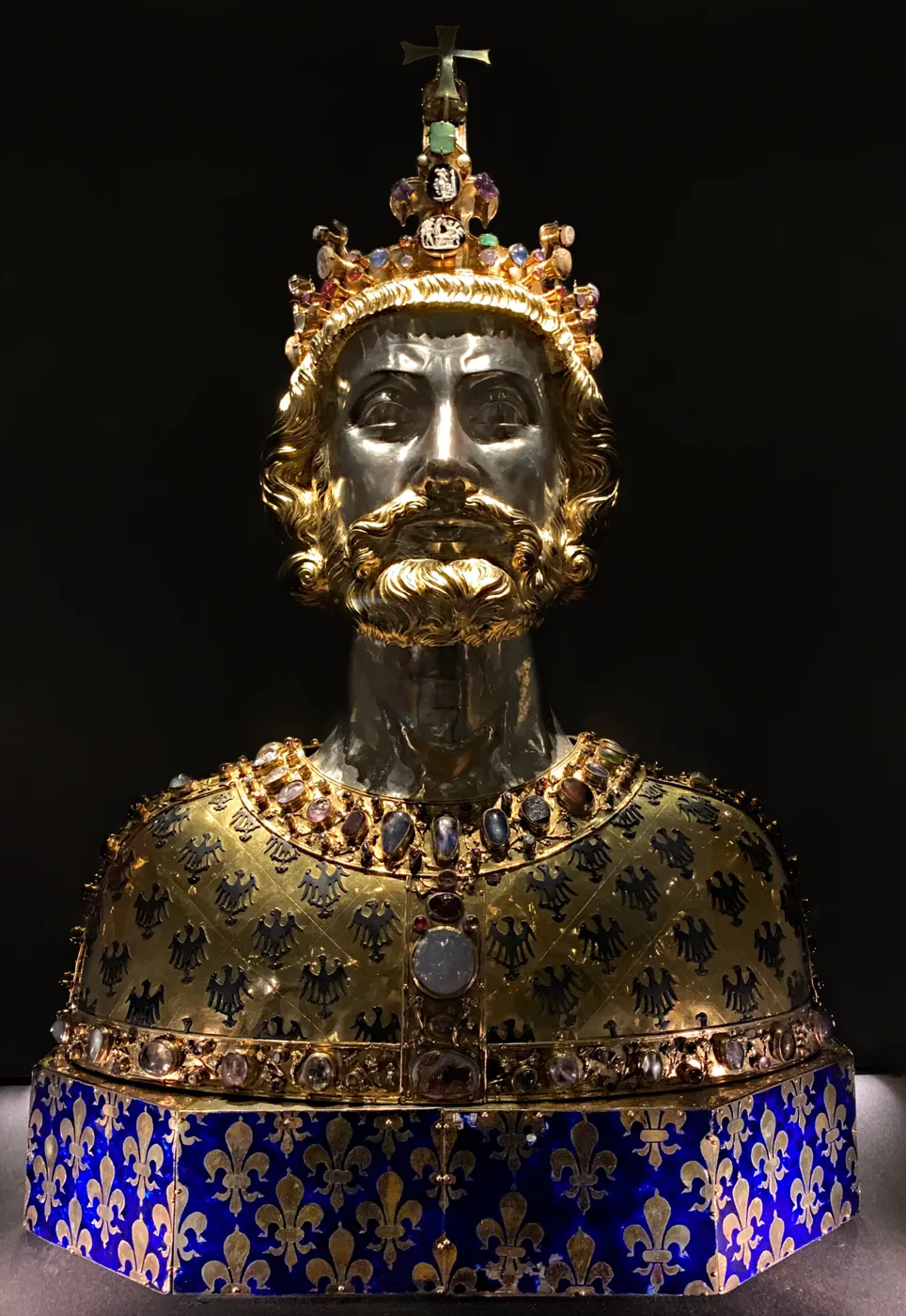
Photograph: Florian B. Gutsch · CC BY-SA 4.0 · Source
Held by: Aachen Cathedral Treasury
The story
Charles IV had this bust made around 1349, in the years of his own imperial coronation journey, and gave it to Aachen. Inside the head is a fragment of Charlemagne's skull, taken from the shrine where Barbarossa had laid the emperor's bones in 1165, when Charlemagne was canonised by an antipope and Aachen became a pilgrimage city. The bust shows him as the goldsmiths of Charles IV's Prague and Aachen imagined him: bearded, crowned with a French crown of lilies, calm and young for a man dead five centuries.
It is the most famous portrait of an emperor who left no contemporary portrait at all. Every image of Charlemagne descends from inventions like this one, and Aachen's treasury, gathered around his shrine and his throne, is where the invention was kept.
The record, not the myth
The skull relic's authenticity is a matter of the shrine's tradition, not testing. The bust's Charlemagne is a fourteenth century ideal; the real man's one contemporary description, Einhard's, gives a tall, thick necked, cheerful king who wore Frankish linen, not this gold saint.
Sources
Image and model credits
- PhotographFlorian B. Gutsch · CC BY-SA 4.0 · Source