
Artifacts · No. 41
Apollo 11 Command Module Columbia
The only part of Apollo 11 that came back: the cone that carried Armstrong, Aldrin and Collins to the Moon and home, its heat shield burned by its return through the atmosphere.
1969Zoomable photographFamily viewing: YesCatalogue: A19700102000
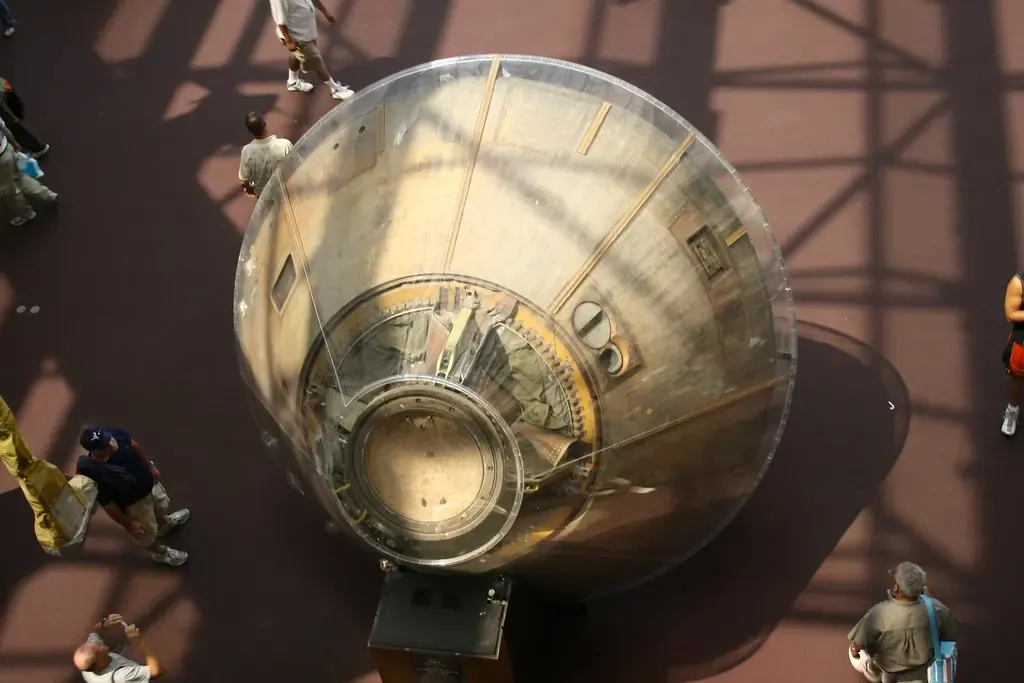
Photograph: Gary Lee Todd, Ph.D. · CC0 1.0 · Source · The Smithsonian's 3D study of Columbia, inside and out, is linked under Sources; its viewer does not offer an embed this page could verify.
Held by: Smithsonian National Air and Space Museum, Washington, DC · Catalogue A19700102000
The journey
- LaunchedKennedy Space Center, Florida, 16 July 1969
- Lunar orbitCarried the crew around the Moon, 19-24 July 1969
- Splashed downPacific Ocean, 24 July 1969
- Held nowNational Air and Space Museum, Washington, DC
The story
Columbia is a cone 3.9 metres across at the base, built by North American Rockwell: three couches, 243 switches' worth of panels, and a heat shield of ablative resin in a steel honeycomb. In July 1969 it carried the crew to lunar orbit, waited with Michael Collins aboard while Eagle went down to the Sea of Tranquility, and brought all three men home through a reentry that heated its shield to some 2,800 degrees Celsius, charring the surface the visitor sees today.
It toured all fifty state capitals in 1970-71, then settled at the National Air and Space Museum, where for its fiftieth anniversary the Smithsonian scanned it inside and out and rebuilt its tour as a travelling exhibition. The scorch marks are not damage to be restored away; the museum keeps them as the record of the return.
The record, not the myth
Columbia never landed on the Moon: the lunar module Eagle did, and its descent stage still stands at Tranquility Base. Columbia's fame is the return, the part of the mission with no margin at all.
Sources
Image and model credits
- PhotographGary Lee Todd, Ph.D. · CC0 1.0 · Source