
October 6, 2026
Tiananmen Square
In contemporary China, a calendar date continues to be treated with the severity of contraband.
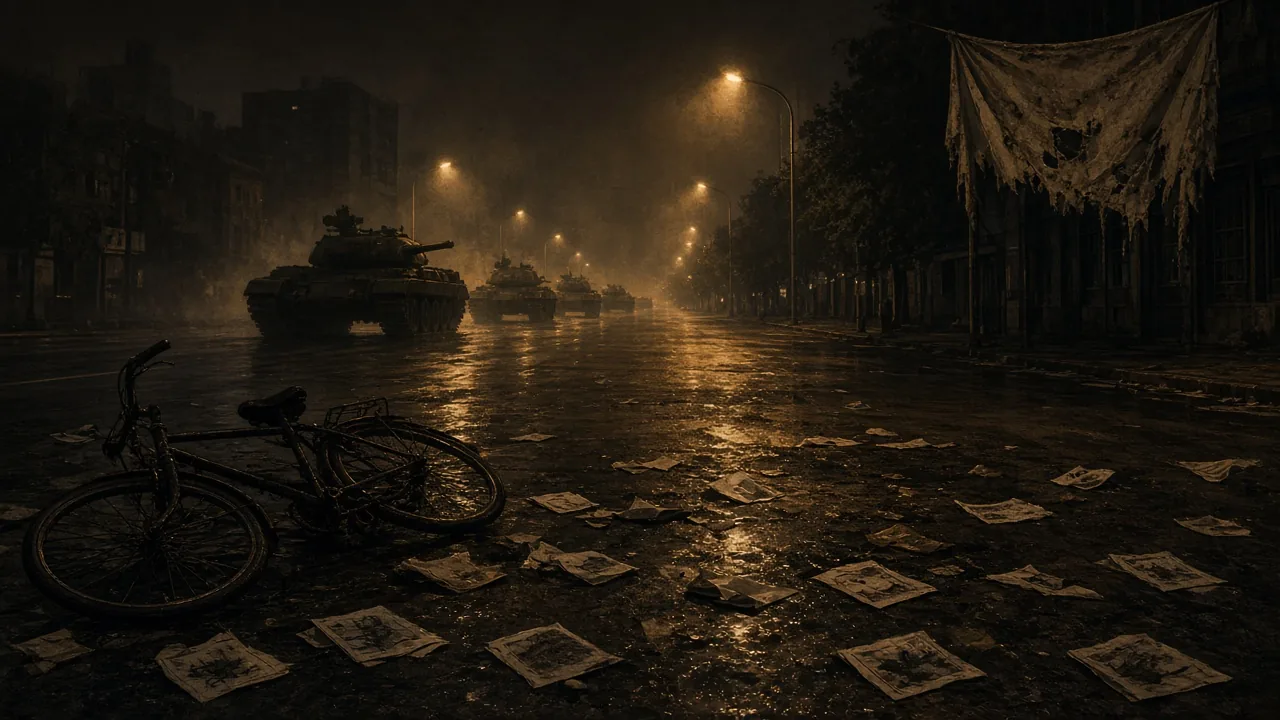
In contemporary China, a calendar date continues to be treated with the severity of contraband.
The political crisis of 1989 opened with the death of Hu Yaobang on April 15. A reformist Communist Party leader previously purged for tolerating earlier student demonstrations, his passing prompted students to gather in Tiananmen Square initially to mourn, then to issue broader political demands: anti-corruption measures, freedom of speech and the press, and democratic reform. Within weeks, the movement expanded beyond university campuses. Workers established an autonomous federation, citizens joined the demonstrations, and by mid-May over one million people occupied the streets of Beijing. Following the initiation of a student hunger strike on May 13, the state declared martial law in parts of Beijing on May 20. However, initial military convoys were blocked at major intersections by crowds of citizens engaging with soldiers, forcing an initial army withdrawal.
Internal resistance also surfaced within the military leadership. General Xu Qinxian, commander of the 38th Group Army—the largest mechanized unit tasked with defending the capital—refused a verbal order to mobilize. When informed that it was wartime and written orders would follow, Xu responded that no war existed, demanded written authorization, and was subsequently arrested in his hospital bed. He was court-martialed, imprisoned for five years, and expelled from the Party.
Late in May, demonstrators erected a symbolic monument. Students from Beijing's Central Academy of Fine Arts constructed the Goddess of Democracy—a ten-meter statue composed of foam, papier-mâché, and a steel frame—placing it in the square on May 30 directly facing the portrait of Mao Zedong on the Tiananmen Gate. The statue remained standing for five days.
On the evening of June 3, elements of the 38th Army under a replacement commander advanced from the western suburbs along Chang'an Avenue toward the square. Demonstrators attempted to block the advance at Gongzhufen, leading to escalating clashes involving rubber bullets, tear gas, rocks, and petrol bombs. At approximately 10:30 PM, troops opened fire with live ammunition. The primary loss of civilian life occurred near Muxidi Bridge, approximately five kilometers west of the square, where regular troops fired into barricades and crowds. An investigation by Amnesty International published in its 1990 report documented that the majority of civilian casualties were inflicted along the primary west-east thoroughfare, with hundreds killed or wounded in the Muxidi area alone, including bystanders shot in surrounding streets and homes. Troops reportedly utilized expanding ammunition. Casualties mounted along a two-mile stretch toward Xidan, where protesters destroyed military vehicles and attacked isolated soldiers, hanging the corpse of a young soldier from a bus west of the square.
The clearing of Tiananmen Square itself involved comparatively few direct fatalities. Journalist Jay Mathews, writing in the Columbia Journalism Review, noted that available evidence indicates no individuals were killed inside the physical bounds of Tiananmen Square during its evacuation; remaining students were allowed to depart, while the vast majority of victims—primarily workers and residents—were killed in the surrounding avenues and access routes. Around 5:23 AM on June 4, an armored vehicle toppled the Goddess of Democracy, and its remains were cleared by military helicopters. Shortly after 6:00 AM, as evacuated students marched west along a bicycle lane, advancing tanks deployed tear gas and drove into the crowd, killing eleven individuals.
Casualty figures remain unverified due to state concealment. Official government tallies provided varying numbers: State Council spokesman Yuan Mu reported approximately 300 total dead (including military personnel), while an internal report by the Beijing Party secretary listed 241 confirmed deaths, including 218 civilians, 10 PLA soldiers, and 13 armed police. Partial Beijing hospital records compiled shortly after the event recorded at least 478 dead, leading historian Timothy Brook to estimate approximately 2,800 total fatalities. A figure of 2,600 to 2,700 attributed to the Chinese Red Cross was circulated and subsequently denied by the organization. Amnesty International estimated the death toll in the hundreds to low thousands, whereas journalist Nicholas Kristof estimated 400 to 800 civilian casualties. Diplomatic communications provided higher, albeit disputed, estimates: a declassified 1989 cable from British Ambassador Alan Donald cited a source claiming at least 10,000 civilian deaths—a figure Donald revised three weeks later to between 2,700 and 3,400—while a 2014-released U.S. file quoted a Chinese military source citing an internal regime count of 10,454.
On the morning of June 5, a lone man carrying shopping bags stepped in front of a column of Type 59 tanks on Chang'an Avenue. As the lead tank attempted to steer around him, he repeatedly repositioned himself to block its path before climbing onto the hull to speak with the crew. He was subsequently pulled into the crowd by two unidentified individuals and disappeared. His identity and ultimate fate remain unconfirmed. Five press photographers—Jeff Widener, Charlie Cole, Stuart Franklin, Arthur Tsang, and Terril Jones—along with a CNN camera crew, captured the standoff from the balconies of the Beijing Hotel. Photojournalists faced immediate state suppression; Cole's room was raided by public security agents who confiscated his passport and forced a signed confession, though hidden film was successfully smuggled out of the country.
Domestically, the events of June 4 remain heavily censored. Search engines and social media platforms, including Baidu, Sina, and Tencent, systematically block terms such as "June 4," "Tiananmen Mothers," and indirect evasions like "May 35th" or homohyphenated phrases. The Tiananmen Mothers, an organization formed by victims' families that documented 202 fatalities, remain under state surveillance and are prohibited from holding public commemorations. In Hong Kong, the annual Victoria Park candlelight vigil, which drew up to 180,000 attendees in 2019, was banned in 2020, and the organizing alliance dissolved in 2021 following the prosecution and imprisonment of its leaders under the National Security Law. Through comprehensive educational omission and digital censorship, the state maintains a systemic policy of enforced forgetting surrounding the 1989 crackdown.
Comments
Loading comments…