
October 6, 2026
Stalin's Terror
The Great Terror was not merely a series of high-profile show trials targeting Old Bolsheviks and political elites. It was quota politics enforced with a gun.
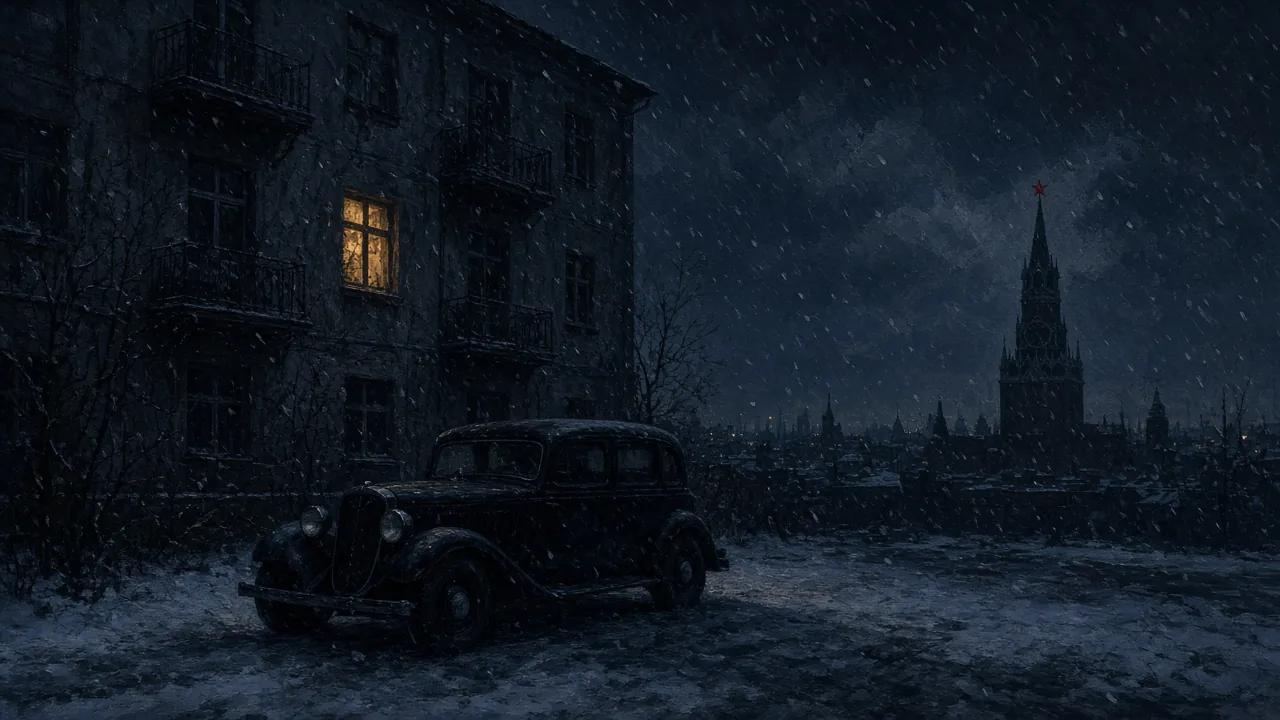
The Great Terror was not merely a series of high-profile show trials targeting Old Bolsheviks and political elites. It was quota politics enforced with a gun. The violence was systematically organized, planned, and executed using the same bureaucratic mechanisms the Soviet state applied to industrial production. The directives for mass executions and detentions did not originate from lower-level secret police units, but from the highest levels of the Soviet leadership.
The process began at the very top on July 2, 1937, when the Politburo issued a secret resolution—Resolution P51/94, titled "About Anti-Soviet Elements"—composed and signed directly by Joseph Stalin. This document ordered regional party secretaries and local leaders of the NKVD (the People's Commissariat for Internal Affairs) to submit precise counts of "kulaks" and "criminals" within five days. The directive mandated that these individuals be categorized into two groups: those to be shot immediately, and those to be sentenced to long terms in labor camps. Local officials responded rapidly, providing estimates based on existing secret police registries, and the central leadership used these self-reported figures to establish the baseline quotas for the operation. Targets were established before specific formal charges were brought against individuals.
This directive culminated in NKVD Order No. 00447, signed by NKVD chief Nikolai Yezhov on July 30, 1937, and formally approved by the Politburo the following day. Order No. 00447 outlined the systematic repression of "former kulaks, criminals, and other anti-Soviet elements," a category defined broadly to include former tsarist officials, White Army officers, clergy, members of non-Bolshevik political parties, returned emigres, petty criminals, and individuals already residing in special settlements across Siberia, the Urals, and Kazakhstan.
The order divided suspects into two specific categories: Category I comprised individuals deemed the "most active" anti-Soviet elements, who were to be arrested and executed by shooting after their cases were reviewed by local administrative bodies. Category II included individuals classified as "less active" but hostile, who were to be sentenced to terms of eight to ten years in corrective-labor camps or prisons. To process these cases outside the standard judicial system, the order established NKVD troikas—three-person extrajudicial panels composed of the local NKVD chief, the regional party secretary, and the regional prosecutor. These panels reviewed cases without the presence of defense counsel, without hearing witness testimony, and without allowing right of appeal.
Order No. 00447 listed explicit numerical limits for every republic, krai, and oblast. For example, the initial quota for the Moscow region was set at 5,000 executions under Category I and 30,000 camp imprisonments under Category II, while Leningrad was assigned 4,000 for execution and 10,000 for imprisonment. Although these targets were initially presented as maximum limits requiring central approval to exceed, in practice local officials routinely requested higher limits, treating the original quotas as minimum targets to be met or surpassed. Archival records illustrate how regional officials requested increases in their execution limits. In a telegram addressed to Stalin on February 4, 1938, a regional party secretary reported that the local troika had fully processed its original quota, sentencing 9,600 former kulaks, Socialist-Revolutionaries, and anti-Soviet elements. Stating that the original plan was fulfilled, the official formally requested an additional limit of 3,000 executions under Category I and 2,000 camp sentences under Category II, alongside an extension of the operational deadline to March 20. Requests for quota increases were routinely submitted, processed, and approved through standard administrative channels.
Originally intended to run for four months starting August 5, 1937, the mass operation under Order No. 00447 was repeatedly extended and lasted for more than a year. By the time the operation concluded, troikas had sentenced approximately 767,000 individuals under Order No. 00447 alone, resulting in roughly 387,000 executions.
Historical records differentiate between several distinct statistical ledgers measuring the scale of repression during this era. Official secret police records document that 681,692 individuals were executed in NKVD cases across all operations during 1937 and 1938 alone, while total political and non-political arrests during this period are estimated between 1.5 million and 2.5 million. Meanwhile, official records for the corrective-labor camps of the Gulag system record 1,053,829 deaths between 1934 and 1953. Historians note this figure specifically measures deaths within primary labor camps and excludes penal colonies, as well as prisoners who were released shortly before dying to avoid recording deaths on official camp registries.
Parallel to Order No. 00447, the regime instituted a series of "national operations" targeting specific ethnic groups along Soviet border regions. The primary template for these operations was NKVD Order No. 00485, issued by Yezhov on August 11, 1937, which directed the liquidation of alleged espionage networks associated with the Polish Military Organization. Sentencing for national operations utilized the "album procedure". Instead of troikas, local NKVD officials and regional prosecutors formed two-person panels known as "dvoikas". These panels compiled brief summaries of individual cases into bound books or "albums," listing the personal details of suspects in one column and recommending either execution ("shoot") or labor camp sentences in the other. These albums were sent to Moscow, where Yezhov and Chief Prosecutor Andrei Vyshinsky signed off on thousands of sentences in single sessions. The Polish Operation resulted in the sentencing of 139,835 people, of whom 111,091 were executed. Across all national operations combined, 335,513 people were sentenced and 247,157 were shot.
While the public was presented with the Moscow Show Trials of 1936, 1937, and 1938—featuring elaborate public confessions from prominent Old Bolsheviks—the vast majority of executions occurred quietly through the extrajudicial troika and dvoika systems. To manage the social impact of these mass executions, the regime informed relatives that the condemned had been sentenced to "ten years without the right of correspondence". In 1937 and 1938, this phrasing served as a standardized euphemism for immediate execution. When relatives inquired after the ten-year period elapsed in the late 1940s, authorities were instructed to report that the missing individuals had died while serving sentences in labor camps.
The institutional framework of the Great Terror expanded under Nikolai Yezhov, who assumed control of the NKVD from Genrikh Yagoda on September 26, 1936. The operations were formally terminated from the top. On November 17, 1938, a joint decree issued by the Council of People's Commissars and the Central Committee of the Communist Party prohibited further mass arrests, abolished the extrajudicial troikas, and mandated that all future arrests obtain standard judicial or prosecutorial authorization. Lavrentiy Beria replaced Yezhov as head of the NKVD on November 25, 1938. The historical record confirms that the mass repressions of 1937 and 1938 operated through bureaucratic planning. Quotas for detentions and executions were formally assigned, fulfilled, exceeded, and renewed through administrative channels, leaving a documented paper trail across the Soviet state archives.
Comments
Loading comments…