
October 6, 2026
Mao's Great Leap Forward
In 1958, Mao Zedong decided that China would outproduce Great Britain in steel within fifteen years, and he intended to accomplish it through the force of sheer political will.
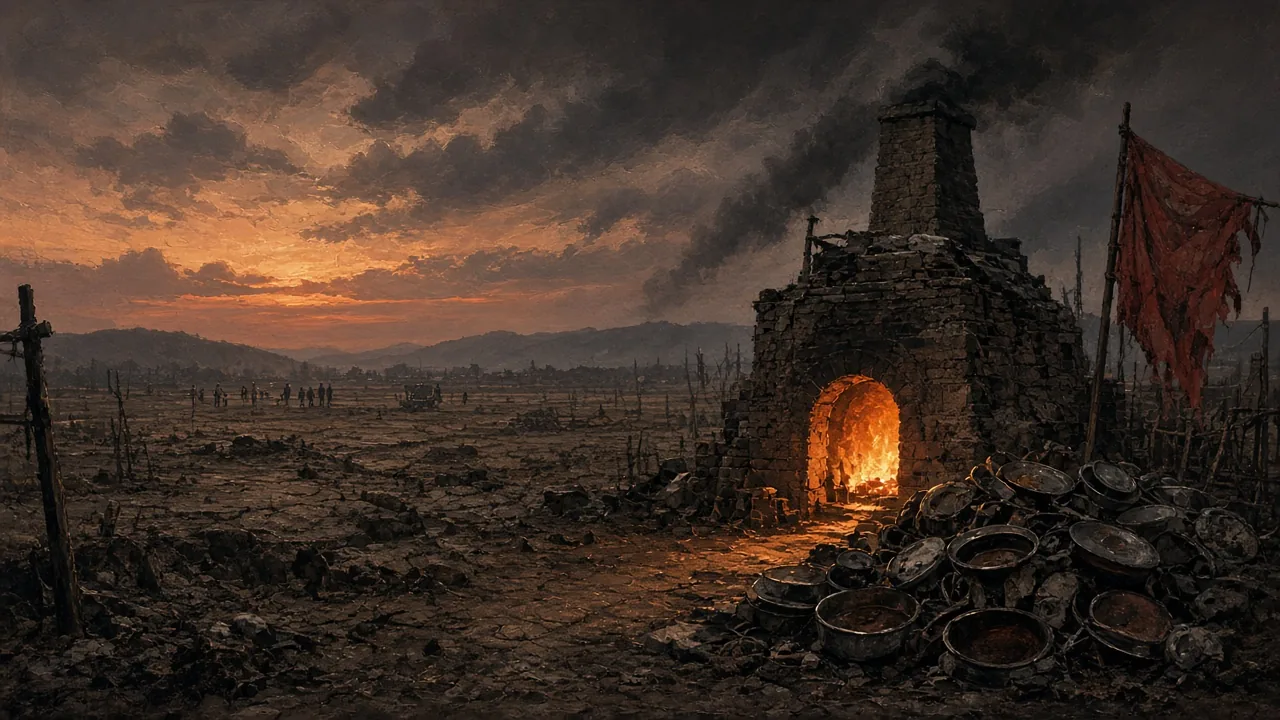
In 1958, Mao Zedong decided that China would outproduce Great Britain in steel within fifteen years, and he intended to accomplish it through the force of sheer political will. At an enlarged Politburo conference held in the coastal resort of Beidaihe that August, the national targets were established in an atmosphere of ideological fervor. The annual steel output goal for 1958 was set to double the previous year’s total of 5.35 million tons, raising the target to an ambitious 10.7 million tons. To mobilize the human resources required for this economic push, China’s peasantry was systematically reorganized into roughly 26,500 people’s communes, encapsulating virtually the entire rural population. Private kitchens and domestic dining were abolished in favor of centralized communal canteens, civilian life was subjected to quasi-military discipline, and private agricultural plots were confiscated by the state. The regime sought to eliminate any intermediate institutional structures between the central economic plan and the citizens tasked with executing it.
The national steel production target was pursued through literal, decentralized methods. Approximately 600,000 backyard furnaces were constructed across fields, courtyards, and urban neighborhoods. Kept burning day and night, these small-scale clay structures were staffed by agricultural workers who were pulled away from farming responsibilities at the precise moment crops required harvesting. Observers noted that whole towns and rural landscapes glowed red into the night as peasants fed the fires. To supply raw material for the furnaces, domestic iron goods of every description were collected and melted down, including farm plows, cooking pots, woks, door hinges, and iron gates. In some regions, historical currency was destroyed as well, including quantities of Shengbao iron cash coins minted a century earlier by the Taiping Heavenly Kingdom.
The industrial yield from this effort proved largely unusable. Of the 10.7 million tons of steel declared to have been produced in 1958, more than 3 million tons consisted of brittle pig iron that could not be converted into structural steel due to the technical limitations of simple clay furnaces, which lacked the ability to decarbonize the metal. Contemporary economic estimates indicated that producing a ton of backyard iron cost approximately double the expenditure required by a modern industrial blast furnace, and vast quantities of the resulting slag were quietly discarded in rural dumps. The effort also caused severe environmental damage, as whole forests were clear-cut to provide fuel, and wooden furniture, doors, and building materials were burned after timber supplies were exhausted. This resulted in a massive conversion of tangible tools, natural resources, and labor into low-grade metal.
Simultaneously, the agricultural sector fell victim to systemic misreporting and ideological pseudo-science. Local party cadres, competing to outdo neighboring districts in reported yields, introduced the concept of "launching a sputnik" to describe record-breaking agricultural production. On August 13, 1958, the People's Daily published a front-page article featuring the Macheng Jianguo commune in Hubei province, which claimed an early-rice yield of 36,900 jin per mu—a physical impossibility for any arable land. On the basis of such exaggerated provincial reports, the national grain forecast for 1958 was officially inflated to 525 million tons, compared to the actual 1957 harvest of 195 million tons. Decades later, historical revisions established that the real 1958 harvest was roughly 200 million tons.
Relying on these fabricated figures, state authorities calculated grain procurement quotas that stripped rural villages of their actual harvests. At the same time, official agricultural guidelines mandated radical, unproven farming techniques based on the theories of Soviet agronomist Trofim Lysenko, including close planting and deep plowing, which damaged soil structure and reduced crop yields wherever they were enforced. Furthermore, between 1957 and 1958, an estimated 38 million agricultural laborers were diverted from farming to work on industrial projects, dam construction, and backyard furnaces, while millions of others migrated to urban centers. Communal canteens, which had replaced private meal preparation, rapidly exhausted their food supplies. Having surrendered their cooking utensils to the steel drives, rural residents found that by early 1959, food rations in the canteens were drastically reduced, eventually ceasing entirely in many areas. Peasants who attempted to leave their assigned villages to seek food elsewhere were regularly intercepted and punished by local militias. Despite the plummeting domestic food supply, state grain exports continued, with China shipping 4.2 million tons of grain abroad in 1959 and 2.7 million tons in 1960, primarily to fulfill foreign debt obligations to the Soviet Union for industrial equipment. Economists have calculated that the volume of grain exported between 1958 and 1961 was sufficient to supply 16 million people with a basic survival diet for nearly two years.
A critical opportunity to alter these policies arose in the summer of 1959 during the Lushan Conference. Minister of Defense Peng Dehuai, a senior military commander and veteran of the Chinese Communist Revolution, openly raised concerns regarding the economic disruption caused by the Great Leap Forward. During group discussions, Peng argued that responsibility for the errors rested with the party leadership, explicitly including Mao Zedong. Unable to secure a private audience, Peng summarized his observations in a personal letter delivered to Mao on July 14, 1959. Although Mao had previously encouraged open feedback, he responded by distributing Peng's letter to the conference participants on July 16. By the conclusion of the plenum in mid-August, Peng was denounced as the leader of an "anti-Party clique," removed from his post as Minister of Defense, and replaced by Lin Biao. The party then launched a nationwide campaign against "right opportunism," which effectively suppressed internal criticism and intensified the aggressive collection policies of the Great Leap Forward, accelerating the onset of widespread famine over the subsequent three years.
The structural mechanism that exacerbated the famine's geographic impact had been established shortly before the Great Leap Forward. On January 9, 1958, the Standing Committee of the National People's Congress enacted the Regulations on Household Registration, formalizing the hukou system. This legislation classified every Chinese citizen as holding either agricultural or non-agricultural status, effectively binding rural populations to their local communes and prohibiting unauthorized migration to urban centers. As a result, the mortality rate in the countryside doubled between 1959 and 1960, rising from roughly 14.6 to 28.6 per thousand, whereas the urban mortality rate remained comparatively stable. The system ensured that urban populations were prioritized for food distribution, while rural areas bore the brunt of the shortages.
The severity of the conditions in the countryside was recorded in official state documentation. In Xinyang prefecture, Henan province, one of the most severely affected regions, fatalities from starvation and violence reached 1.05 million out of a population of roughly 8.5 million. Official party reports indicated that approximately 67,000 individuals in Xinyang were beaten to death by local militias for attempting to hide grain or flee the region. A reporter for the state news agency Xinhua traveling through Xinyang in late 1959 documented unburied corpses along roadsides and noted that passing buses did not stop. To prevent news of the disaster from leaking, the Xinyang post office intercepted and confiscated over 1,200 outgoing letters requesting assistance. When Mao received an official report regarding Xinyang in October 1960, he attributed the disaster to ideological deviance among lower-level cadres and local class enemies rather than the central government's procurement targets. Government archives from the period also document several thousand cases of desperate cannibalism across various provinces while state granaries in regional centers remained locked and guarded.
The total death toll of the Great Leap Forward remains a subject of detailed historical and demographic analysis. Official statistical gaps published by the Chinese government imply approximately 15 to 16.5 million excess deaths, a figure generally viewed by demographers as an absolute floor. American demographer Ansley Coale estimated between 16.5 and 27 million excess deaths, accounting for regional underreporting. Independent demographic research by Basil Ashton, Judith Banister, and Cao Shuji produced estimates ranging between 30 and 32.5 million excess deaths. Former Xinhua journalist Yang Jisheng, following extensive research in provincial party archives, concluded in his study Tombstone that 36 million people died of starvation, accompanied by an estimated 40 million lost or postponed births. An unpublished internal government investigation conducted in the 1980s under Premier Zhao Ziyang estimated total excess deaths between 43 and 46 million. Historian Frank Dikötter, reviewing provincial archives, estimated a minimum of 45 million excess deaths, though demographers such as Cormac Ó Gráda and Andrew Walder have challenged this upper figure, citing baseline mortality assumptions. Declassified intelligence documents record that during an autumn 1961 meeting with British Field Marshal Bernard Montgomery, Mao himself acknowledged that unnatural deaths in 1960 and 1961 had exceeded 5 million.
The scholarly consensus holds that the Great Leap Forward resulted in a man-made famine driven by government policy and economic mismanagement. While adverse weather conditions affected certain regions during this period, historical evidence indicates that natural factors played a secondary role compared to state grain requisitions, labor diversions, and political coercion. In January 1962, at the "Seven Thousand Cadres Conference" in Beijing, Vice Chairman Liu Shaoqi publicly summarized popular sentiment in rural Hunan, stating that the economic disaster was thirty percent natural calamity and seventy percent human error. Liu warned the party leadership that history would hold them accountable for the millions who had perished under the economic experiment.
Comments
Loading comments…