
October 6, 2026
Mao's Cultural Revolution
In August 1966, Mao Zedong stood atop Tiananmen Gate wearing a military uniform and a bright red armband bestowed upon him by a teenage schoolgirl, Song Binbin.
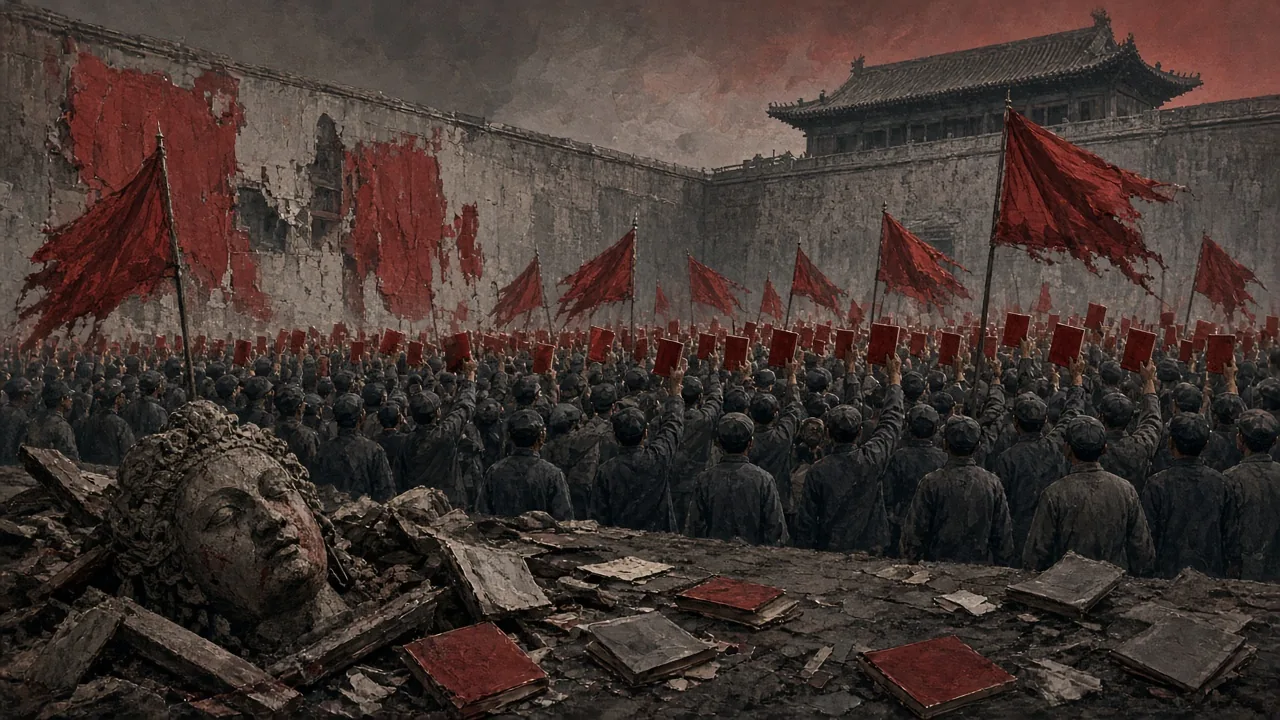
In August 1966, Mao Zedong stood atop Tiananmen Gate wearing a military uniform and a bright red armband bestowed upon him by a teenage schoolgirl, Song Binbin. Looking out over a vast sea of hundreds of thousands of shouting youths waving copies of his Little Red Book, the Chairman provided his implicit authorization to the gathered masses. When told that Song’s name meant "gentle" or "polite," Mao remarked that it would be better if she were "violent". That exchange served as a green light for an unprecedented wave of state-sanctioned youth violence across the People's Republic of China.
The institutional framework for the Cultural Revolution had been established earlier that year. On May 16, 1966, the Politburo issued a secret circular drafted under Mao’s direction. The May 16 Notice warned that representatives of the bourgeoisie had infiltrated the Communist Party, the government, the military, and the educational system. These hidden counter-revolutionaries, the document declared, were waiting for an opportunity to seize power and replace the dictatorship of the proletariat with a capitalist regime. Within days of the notice, classes were suspended across Beijing’s primary and secondary schools, a shutdown extended nationwide by June 13. Millions of students were transformed into an ideological paramilitary force: the Red Guards.
Armed with Mao’s declaration that "to rebel is justified," the Red Guards launched a systematic assault against what they termed the "Four Olds"—old ideas, old culture, old customs, and old habits. The opening victim of this campaign in Beijing was Bian Zhongyun, the deputy principal of the girls' middle school attached to Beijing Normal University. On August 5, 1966, Bian was set upon by her own students. Over several hours, teenagers beat her with wooden clubs studded with nails, struck her with copper-buckled leather belts, poured black ink over her head, and forced her to perform hard labor while shouting self-accusations. She collapsed and died from her injuries in the school courtyard. Following her death, state security cadres visited her widower, ordering him to remain silent and maintain a proper revolutionary attitude toward the student masses.
Bian’s death marked the beginning of "Red August" in Beijing. Released from legal restraints by Minister of Public Security Xie Fuzhi—who explicitly instructed police officers not to detain Red Guards for assault or murder—the student groups operated with total immunity. Over six weeks, official post-facto state statistics recorded 1,772 individuals beaten to death or driven to suicide in the capital alone, with later internal surveys placing the metropolitan death toll above 10,000. Scholars documenting the victims noted that these deaths rarely involved firearms or quick executions; instead, victims were subjected to prolonged, hours-long torture sessions using wooden posts, iron bars, and brass belt buckles. The cost of cremating the victims—28 yuan—was regularly billed directly to their surviving family members, who were forbidden from mourning or protesting.
The terror quickly expanded from school administrators to writers, artists, intellectuals, and individuals labeled as belonging to bad class backgrounds. On August 23, 1966, the novelist Lao She was dragged from his office by Red Guards, brought to the Beijing Temple of Confucius, and forced to kneel for hours beside a pyre of burning books. His head was partially shaved, his face smeared with ink, and a heavy wooden placard listing his alleged crimes was hung around his neck. He was beaten continuously with leather belts until he lost consciousness. The following morning, his body was recovered from Beijing’s Taiping Lake. Between August and September 1966, Red Guards in Beijing ransacked 33,695 homes, burned 2.3 million books and over 3 million paintings and historical artifacts, destroyed 4,922 of the capital’s 6,843 designated historical sites, and forcibly expelled 77,000 residents from the city into rural exile.
The primary mechanism for public humilation was the "struggle session". Victims were forced to wear tall, paper dunce caps bearing their names and alleged political crimes, with heavy wooden slates suspended from their necks by thin wire. Positioned on elevated stages before chanting crowds, they were forced into the "airplane position"—standing with their knees bent, heads forced down, and arms pulled back rigidly behind them. These sessions often lasted for hours in the summer heat, with victims subjected to physical blows, spitting, and verbal denunciations led by their own colleagues, neighbors, or children.
As the movement progressed into 1967, the Red Guards fractured into competing political factions, each claiming to represent Mao's genuine ideology. Armed conflict broke out across major Chinese cities. In industrial centers like Chongqing, rival Red Guard factions raided state armories and seized heavy weaponry, including automatic rifles, artillery pieces, armored cars, and river gunboats. Street battles reduced urban neighborhoods to ruins, resulting in thousands of combat casualties.
The scale of violence escalated further when the People’s Liberation Army (PLA) was ordered to intervene in early 1967 to restore public order and establish "Revolutionary Committees" to replace collapsed municipal governments. Historical demographic analyses indicate that the vast majority of casualties during the Cultural Revolution occurred between 1968 and 1971 during these state-directed suppression campaigns, rather than during the initial student rebellions of 1966. Nationwide statistical research based on official county annals estimates that between 1.1 million and 1.6 million people were killed across China, with up to 36 million individuals subjected to political persecution, imprisonment, or property confiscation.
In certain rural regions, the collapse of administrative oversight led to systematic mass executions. In Guangxi province, factional warfare and state-sponsored purges resulted in the killing of an estimated 100,000 to 150,000 people. Official post-Cultural Revolution government investigation teams sent to Guangxi in the early 1980s documented widespread instances of ritual execution and political cannibalism. In districts such as Wuxuan County, local militia members, party cadres, and Red Guards executed targeted individuals—including former landlords, rich peasants, and suspected counter-revolutionaries—and subsequently consumed their hearts, livers, and flesh. These acts were conducted publicly as deliberate demonstrations of political zeal, often accompanied by communal banquets organized by local revolutionary committees. The official investigations corroborated hundreds of individual cases of cannibalism across Guangxi, confirming that the practice was motivated by ideological zealotry rather than economic food shortages or famine.
By late 1968, facing urban chaos and factional warfare, Mao moved to dismantle the Red Guard movement. Under the "Down to the Countryside Movement," the regime ordered the closure of universities and mandated the forced relocation of approximately 16 million urban youths to remote rural villages to undergo re-education by the peasantry. Through this massive forced migration, the student groups that had served as the initial enforcers of the movement were dispersed across the country.
The formal period of the Cultural Revolution ended following Mao’s death in September 1976 and the subsequent arrest of the Gang of Four. However, the institutional mechanisms established during this era left an indelible mark on Chinese society. Through a combination of state directives, student violence, extrajudicial trials, and ideological campaigns, the movement systematically dismantled existing social structures, religious institutions, historical sites, and personal relationships, replacing them with absolute devotion to central authority.
Comments
Loading comments…