
October 6, 2026
Niccolò Machiavelli
Niccolò Machiavelli confronts a fundamental political problem that theorists and idealists still attempt to avoid: what happens when the world refuses to behave according to our highest moral ideals?
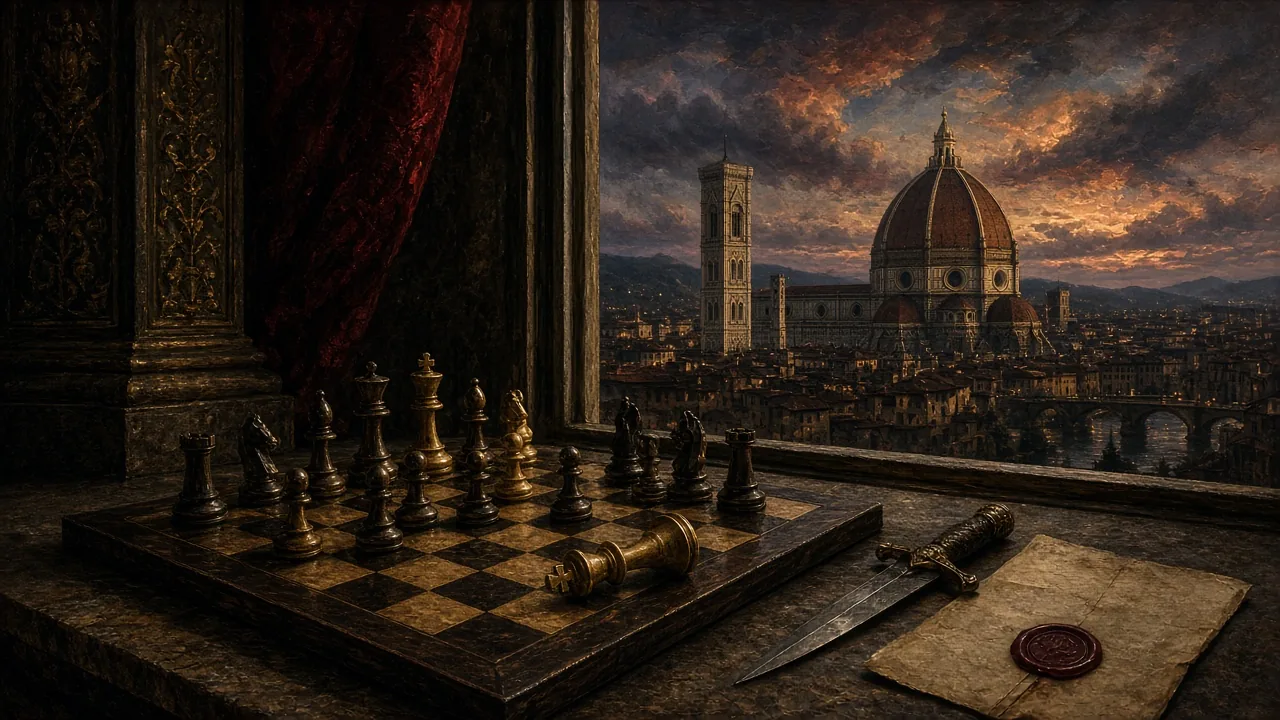
Niccolò Machiavelli confronts a fundamental political problem that theorists and idealists still attempt to avoid: what happens when the world refuses to behave according to our highest moral ideals?
He wrote The Prince in 1513, and the desperate circumstances of its composition are essential to understanding its contents. Following the return of the Medici to Florence, Machiavelli was stripped of his diplomatic post, falsely accused of conspiracy, and imprisoned. He was subjected to torture by the strappado—a painful procedure where the victim's wrists were bound behind their back and their body weight suspended until their shoulders dislocated. Denying all charges, he was released after three weeks and exiled to his small farm at Sant'Andrea in Percussina. Deprived of office, income, and political influence, Machiavelli spent his evenings in his study. In a famous December 1513 letter to his friend Francesco Vettori, he described shedding his muddy work clothes each night to put on courtly garments, figuratively entering the ancient courts of dead statesmen to converse with them about history and power. His method was not born from dry academic speculation, but from the reflections of a disgraced diplomat attempting to make sense of political survival.
The Prince grew directly from this experience. Published posthumously in 1532 with the permission of Pope Clement VII, it was later placed on the Catholic Church's Index of Prohibited Books in 1559. In Chapter 15, Machiavelli explicitly defines his political philosophy: he deemed it more practical to go directly to the verità effettuale—the effectual truth of the matter—rather than indulge in imaginative ideals. Scholars Bowd and Lee note that the term verità effettuale was unprecedented in Italian literature. Machiavelli argued that "many have imagined republics and principalities that have never been seen or known to exist in reality," warning that anyone who abandons how people actually live in favor of how they ought to live guarantees their own ruin rather than their preservation.
This empirical approach explains the uncompromising nature of his political advice. Machiavelli asserts that a ruler must learn how not to be good when necessity requires it. If a prince cannot be both loved and feared, choosing to be feared is the safer path, provided he avoids provoking hatred. While fortune may govern half of human affairs, he contends that the other half remains subject to human judgment, adaptability, courage, and virtù—the strategic capacity to master circumstances rather than surrender to them.
Sixteenth-century Italy provided the turbulent framework for these conclusions. Fragmented into competing powers—Milan, Venice, Florence, Naples, and the Papal States—the peninsula became a primary battleground for French and Habsburg-Spanish armies during the Italian Wars following Charles VIII's invasion in 1494. Observing these conflicts firsthand, Machiavelli concluded that clean intentions do not eliminate political enemies or military threats.
Popular culture frequently attributes the phrase "the ends justify the means" to Machiavelli, though he never wrote those words. The passage typically misquoted appears at the conclusion of Chapter 18, where he observes that in the actions of men—and particularly princes who acknowledge no higher court of appeal—results are what ultimately get judged. This observation describes how political actions are evaluated in an international arena devoid of an overarching tribunal, rather than offering an unconditional moral license.
The Prince represents only one dimension of Machiavelli's political thought. In his Discourses on Livy, he argues in favor of republican governance, civic participation, liberty, constitutional institutions, and civic virtue. Yet even within his republican framework, realistic assessments of necessity prevail. In Book III, Chapter 41 of the Discourses, he writes that when the survival of the state is at stake, considerations of justice, cruelty, praise, or ignominy must be set aside in favor of whatever action preserves the nation's existence and liberty.
Machiavelli insists that stable institutions cannot be constructed on ideal assumptions about human nature. In Discourses I.3, he states that anyone founding a republic and drafting its laws must presuppose that all men are naturally inclined toward self-interest and will exercise their malice whenever given the opportunity. This realistic premise influenced later political thought. David Hume subsequently formulated the constitutional rule that every man ought to be supposed a knave, driven primarily by self-interest. James Madison embedded this concept into the framework of the United States Constitution in Federalist No. 51, arguing that ambition must be made to counteract ambition because "if men were angels, no government would be necessary".
Whereas classical theorists like Plato sought to engineer ideal societies by reshaping human desires through education, class structures, and civic myths, Machiavelli analyzed political power among self-interested, ambitious, and armed actors as they actually exist. By founding political analysis on the verità effettuale, he established a realist framework for institutional design that continues to influence modern statecraft.
Comments
Loading comments…