
Ruler · High and Late Middle Ages · Muscovy · Russia
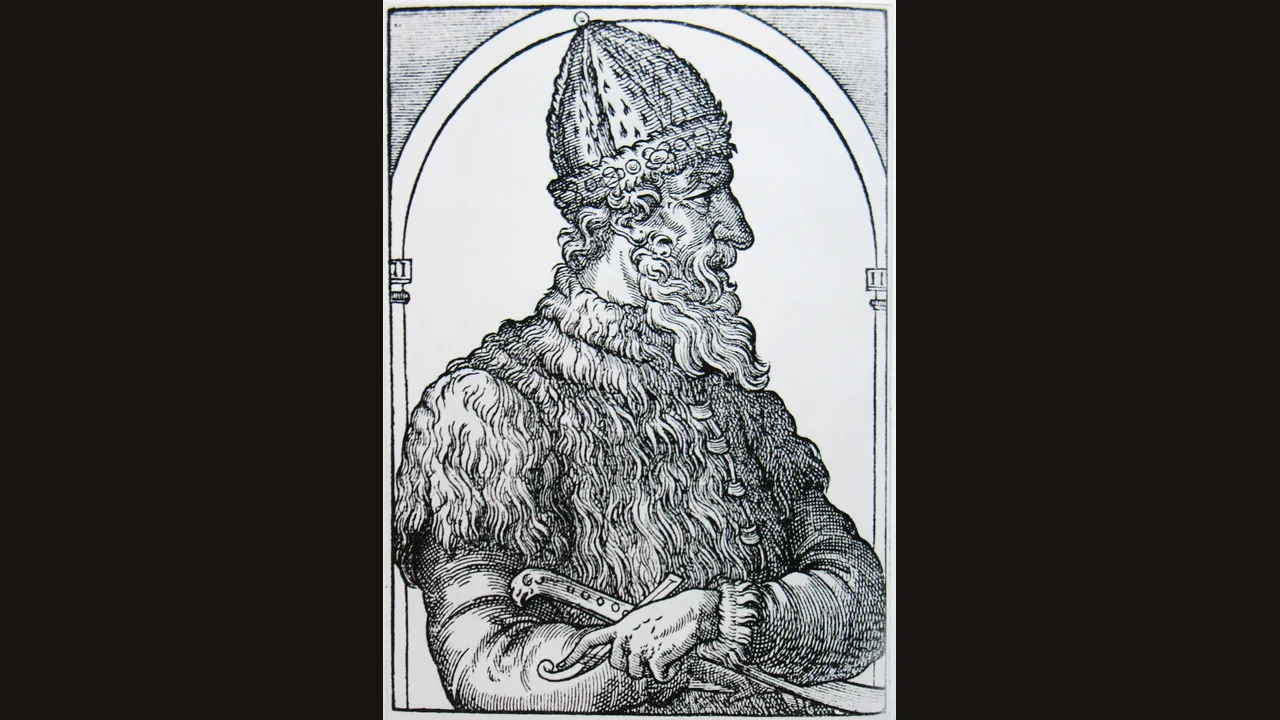
Ivan III
1440–1505
Grand prince of Moscow from 1462 to 1505, born in 1440, who made Russia an independent power. He ended two centuries of Mongol overlordship by refusing tribute in 1480, annexed Novgorod and other principalities, and took the title sovereign of all Russia. The double headed eagle became Russia's emblem under him.
Ivan became grand prince of Moscow in 1462 on the death of his father, Vasily II. Over four decades he absorbed the other Russian principalities. He defeated Novgorod at the river Shelon in 1471 and annexed the republic outright in 1478, removing its assembly bell to Moscow and deporting leading boyar families, whose lands he gave to Moscow servitors. Tver fell to him in 1485, and wars with Lithuania brought the upper Oka and Desna lands, including Chernigov, under Moscow by the treaty of 1503.
In 1480 Ivan refused the tribute his predecessors had paid to the khans. He faced Khan Ahmed of the Great Horde across the Ugra river through the autumn, and in November Ahmed withdrew without a battle. Moscow paid no tribute after that year. In 1472 Ivan married Sophia Palaiologina, a niece of the last Byzantine emperor. The double headed eagle appeared on his seal, and he used the title sovereign of all Russia.
At home he issued the Sudebnik, a law code, in 1497, and rebuilt the Moscow Kremlin in brick with Italian architects, raising the Dormition Cathedral and the Kremlin walls that still stand. Ivan died in 1505. His son Vasily III succeeded him, after a succession struggle in which Ivan had first crowned his grandson Dmitry as co ruler and then imprisoned him.
Facts
- Born
- 1440, Moscow.
- Source: Encyclopaedia Britannica, Ivan III
- Died
- 1505, Moscow.
- Source: Encyclopaedia Britannica, Ivan III
- Reign
- 1462 to 1505.
- Source: Encyclopaedia Britannica, Ivan III
- Realm
- Muscovy, grown into a united Russian state.
- Source: Encyclopaedia Britannica, Ivan III
- Known for
- The end of the Mongol yoke (1480) and the annexation of Novgorod (1478).
- Source: Encyclopaedia Britannica, Ivan III
Sources
- Encyclopaedia Britannica, Ivan III Source
Source links accessed 22 November 2026.
Images
Related
- RussiaConnected
- PachacutiSame era
- Mehmed IISame era
- Vlad the ImpalerSame era
- Aztec EmpireSame era
- Inca EmpireSame era
What happened elsewhere
Pairings are by recorded year, not exact simultaneity.
- PachacutiWhile Ivan III (around 1438)
- Mehmed IIWhile Ivan III (1432)
- Vlad the ImpalerWhile Ivan III (around 1431)
- Aztec EmpireWhile Ivan III (1428)
Meanwhile
Meanwhile, around the world — drag to spin, click a pulsing marker.
Keep reading
Test yourself
When was Ivan III born?
- 1440, Moscow
- 1214, Poissy
- About 1137, Tikrit
- About 1162, on the Mongolian steppe
Answer
1440, Moscow — Born: 1440, Moscow.
When did Ivan III die?
- 1505, Moscow
- 1270, Tunis, on crusade
- 1227, on campaign against the Western Xia
- Late 1476 or early 1477, in battle near Bucharest
Answer
1505, Moscow — Died: 1505, Moscow.
When did Ivan III reign?
- 1462 to 1505
- 1368 to 1398
- Khagan from 1260; emperor of China 1271 to 1294
- King 1152 to 1190; emperor 1155 to 1190
Answer
1462 to 1505 — Reign: 1462 to 1505.
What realm did Ivan III rule?
- Muscovy, grown into a united Russian state
- The Mongol Empire from China to the Caspian Sea
- The Mongol Empire's eastern half and Yuan China
- Normandy and England
Answer
Muscovy, grown into a united Russian state — Realm: Muscovy, grown into a united Russian state.
True or false: Grand prince of Moscow from 1462 to 1505, born in 1440, who made Russia an independent power.
- True
- False
Answer
True — True. Grand prince of Moscow from 1462 to 1505, born in 1440, who made Russia an independent power.
My notes
Highlights on this page
None yet.
Spotted an error on this page? Email [email protected] and it will be checked against the sources.