
Sunday 8 November 2026
Europe says it will show up for the Abu Dhabi Ukraine talks, after the Kremlin said the format had no room for it
France's foreign minister, Jean-Noël Barrot, said on Sunday that European officials will take part in this week's American mediated talks between Russia and Ukraine in Abu Dhabi, telling RTL radio, "France will be there and will ensure that Europe's voice is heard," NPR reported. Kremlin spokesman Dmitry Peskov had ruled out a European role, saying the trilateral format was already agreed. Barrot did not say who would represent Europe or whether its officials would negotiate directly or observe. The talks, on Tuesday and Wednesday, are the fourth round brokered by the Trump administration and the first since Geneva in February.
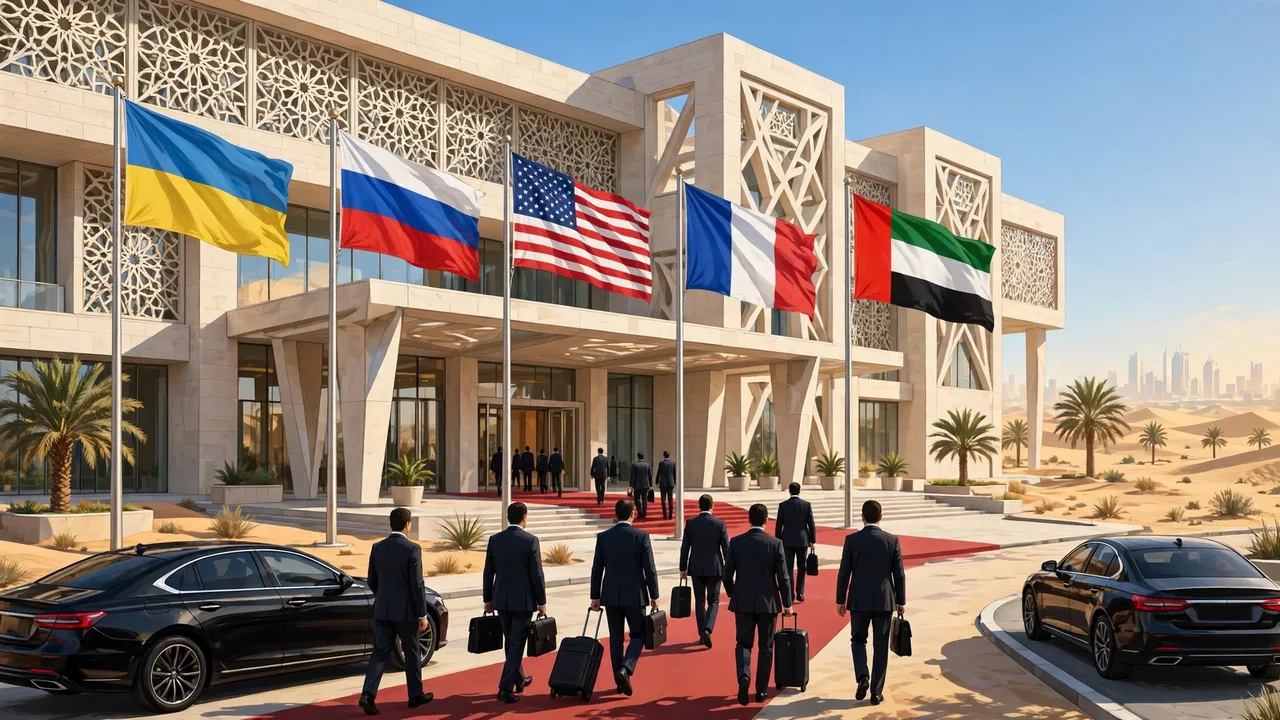
The guest list for Abu Dhabi changed on Sunday, on French radio. Foreign Minister Jean-Noël Barrot told RTL that European representatives will be present at the American mediated talks between Russia and Ukraine on Tuesday and Wednesday, and that France will take part. "France will be there and will ensure that Europe's voice is heard," he said. He did not say who would go, and he did not say whether European officials would sit at the negotiating table or work at the edges of it.
Moscow had already answered the question the other way. Kremlin spokesman Dmitry Peskov ruled out a European role and said the trilateral format, Washington, Moscow and Kyiv, had already been agreed. Talking to a Russian news channel on Friday, Peskov accused European governments of failing to decide who speaks for them, while allowing that security talks would at some point require Europe's involvement. Italy's prime minister, Giorgia Meloni, made the same point from the other side last week when she asked the European Union to name a single envoy for the talks, warning that the bloc looks in disarray over who speaks for it.
The American president blurred the format himself on Thursday. Trump met Kremlin envoy Kirill Dmitriev and said a coming agreement was "going to involve more than Ukraine," adding that he could even say it "might involve all of Europe." President Volodymyr Zelenskyy told CNN on Friday that he had not been given details of the agreement Trump described, and warned, "For me, it's not simple, and it can be dangerous." He reached for the precedent Ukrainians reach for: Yalta in 1945, where the Allied leaders settled Europe's division without several of the countries being divided.
Whoever sits where, the delegations are heavier than the last round. Russia is again led by Vladimir Medinsky, with Deputy Foreign Ministers Sergei Ryabkov and Mikhail Galuzin added for the first time, alongside military intelligence chief Igor Kostyukov and General Staff operations deputy Yury Zhigarlovsky. Ukraine is led by Rustem Umerov. Steve Witkoff has set the agenda as postwar security arrangements, de-escalation and humanitarian issues. The Institute for the Study of War has cautioned that some of the added Russian officials have previously worked to slow talks or harden Moscow's demands, so a senior table does not settle which way the round leans.
The politics around the table have moved since Geneva. The talks are the fourth round the Trump administration has brokered and the first since February. They land a week after Democrats took both chambers of Congress in the midterms, which Zelenskyy has said could improve Ukraine's chances of more American aid, and two months before that Congress is seated, which gives Moscow its own reason to test the administration's outline now. A possible meeting of Trump, China's Xi Jinping and Vladimir Putin at the APEC summit in Shenzhen on November 18 and 19 hangs over the week, with all sides confirming discussions and none confirming the meeting.
And the war did not pause for the announcement. The second night of Russian strikes left about 850,000 people without power in the Dnipropetrovsk and Kharkiv regions on Sunday morning, as of November 8, and Zelenskyy said only four of 36 ballistic missiles aimed at the Kyiv area on Friday night were intercepted, accusing Moscow of treating diplomacy "as a form of aggression." Europe's argument for a seat is that it will live with whatever is signed. On Sunday it said it is coming whether the Kremlin seats it or not.
Spotted an error in this story? Email [email protected] and it will be checked against the sources.