
Artifacts · No. 55
Warka Vase
A metre tall alabaster vase carved in registers with the whole order of the world, water, plants, animals, men, and the goddess at the top: Sumerian art's first great statement.
c. 3200-3000 BCZoomable photographFamily viewing: NoCatalogue: IM19606
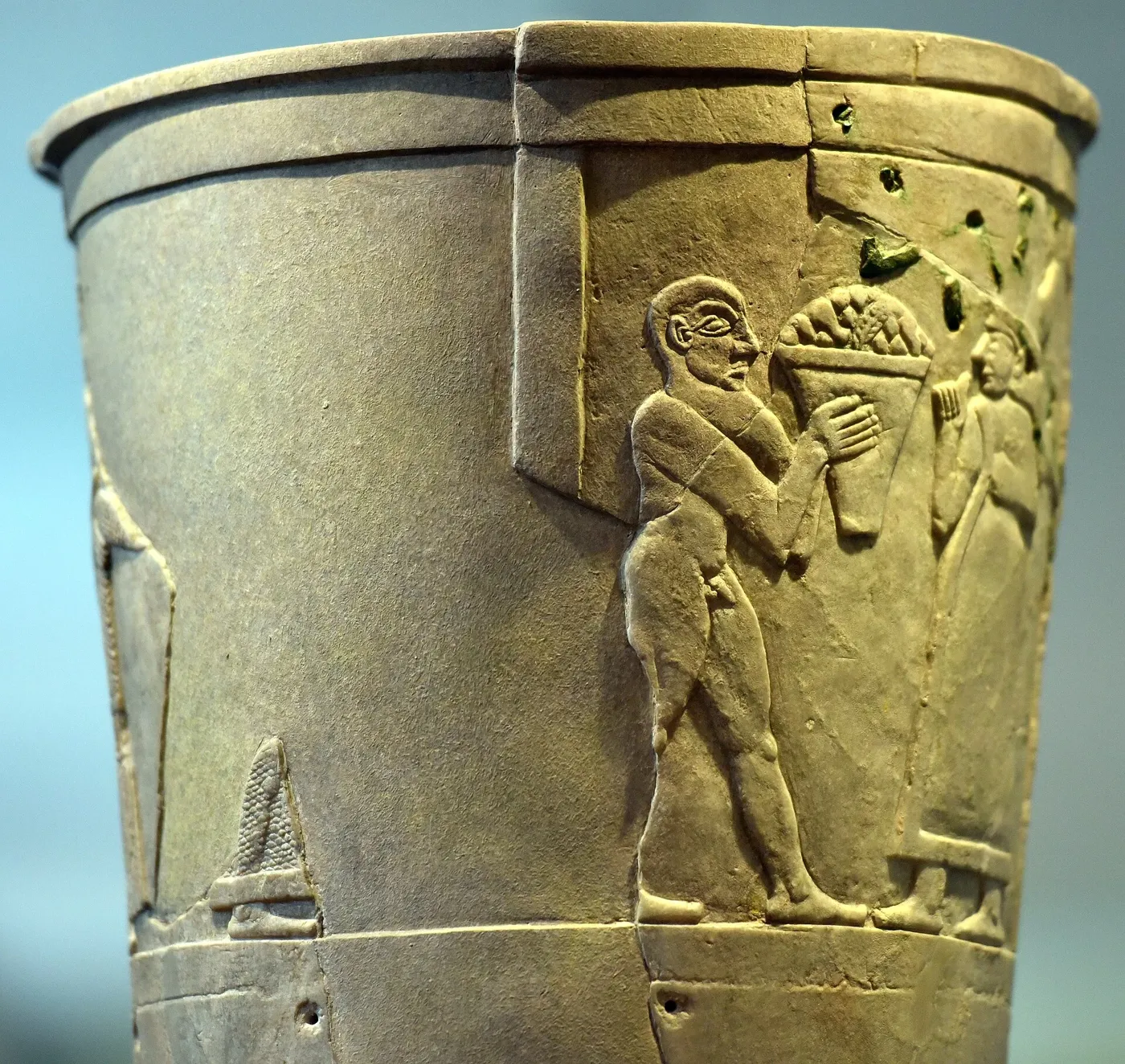
Photograph: Osama Shukir Muhammed Amin FRCP(Glasg) · CC BY-SA 4.0 · Source
Held by: Iraq Museum, Baghdad · Catalogue IM19606
The journey
- MadeUruk (Warka), Sumer
- Looted and returnedIraq Museum, Baghdad, 2003
- Held nowIraq Museum, Baghdad
The story
The vase was found in pieces in the Eanna temple precinct at Uruk, Warka in Arabic, in the 1930s, and rebuilt from its fragments. Its carving reads from the bottom up: water, then crops, then rams and ewes, then naked men carrying baskets of produce, and at the top a ruler figure presenting the harvest to the goddess Inanna at her shrine. It is a diagram of how the Sumerians said the world worked, the temple at the centre and every level feeding the next.
In April 2003, in the looting of the Iraq Museum after the fall of Baghdad, the vase was taken from its case and smashed. It was returned months later, in pieces, in the amnesty for looted objects, and Iraqi conservators rebuilt it. It stands again in Baghdad, cracks and all, which is now part of what it is.
The record, not the myth
The top register's scene is reconstructed from fragments and early drawings; the figure of the ruler is partly restored. No scan of the original is published, and copies in Western museums are casts, a fact their labels do not always stress.
Sources
Image and model credits
- PhotographOsama Shukir Muhammed Amin FRCP(Glasg) · CC BY-SA 4.0 · Source