
Artifacts · No. 29
Sutton Hoo Helmet
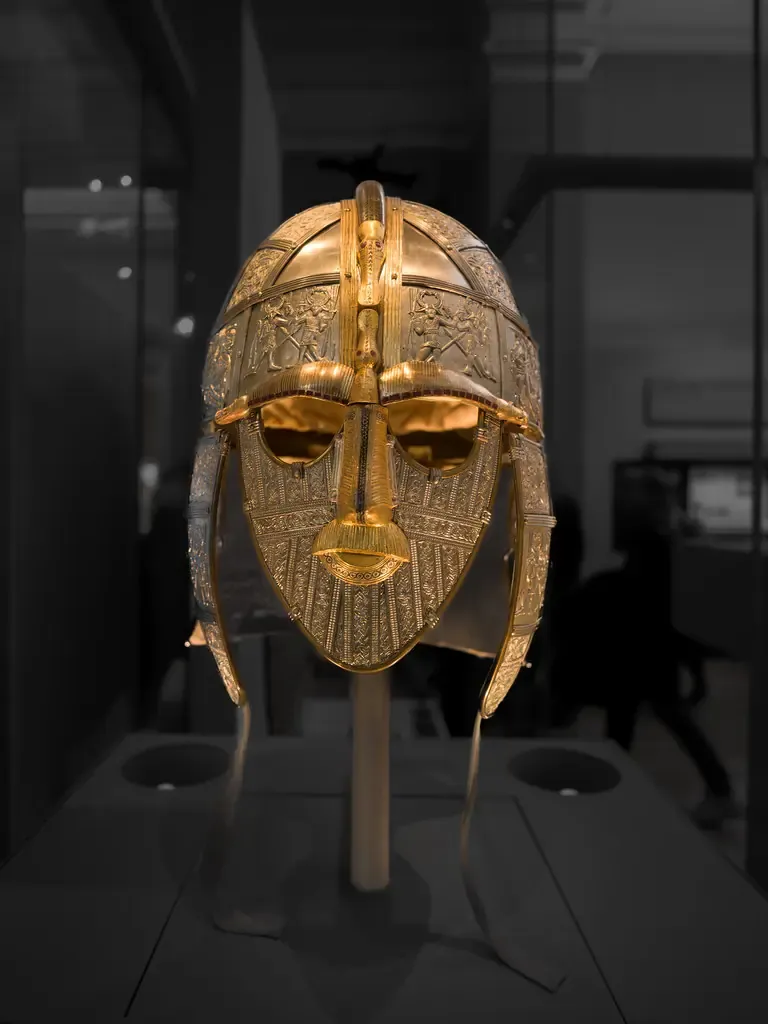
The face of the Anglo Saxon age: an iron helmet crushed into some 500 fragments in a ship burial and rebuilt twice, its eyebrows ending in boars' heads.
early 7th century ADZoomable photographFamily viewing: YesCatalogue: 1939,1010.93
Photograph: dalecruse · CC BY 2.0 · Source
Held by: British Museum, London · Catalogue 1939,1010.93
The story
In the summer of 1939, on the eve of war, excavators at Sutton Hoo in Suffolk opened a buried ship 27 metres long and found the richest grave ever dug in Britain: gold buckles, garnet jewellery, coins, a great shield, and, in hundreds of corroded pieces, a helmet. The first reconstruction, finished in 1947, stood for a generation; in the 1960s the museum took it apart again and rebuilt it over six years into the face known today, a mask of iron and bronze with a flying creature formed by its nose and eyebrows, whose wings are the brows and whose tail is the moustache.
The burial is usually read as that of Rædwald, king of East Anglia, who died about 624, though the grave has no name on it. The helmet is the image of the age between Rome and the Vikings, Germanic, Roman and Scandinavian work all in one object.
The record, not the myth
No inscription names the buried man; Rædwald is the scholarly favourite, not a certainty. What visitors see is a reconstruction twice over: the fragments are original, their arrangement is expert judgement.
Sources
Image and model credits
- Photographdalecruse · CC BY 2.0 · Source