
Artifacts · No. 2
Narmer Palette
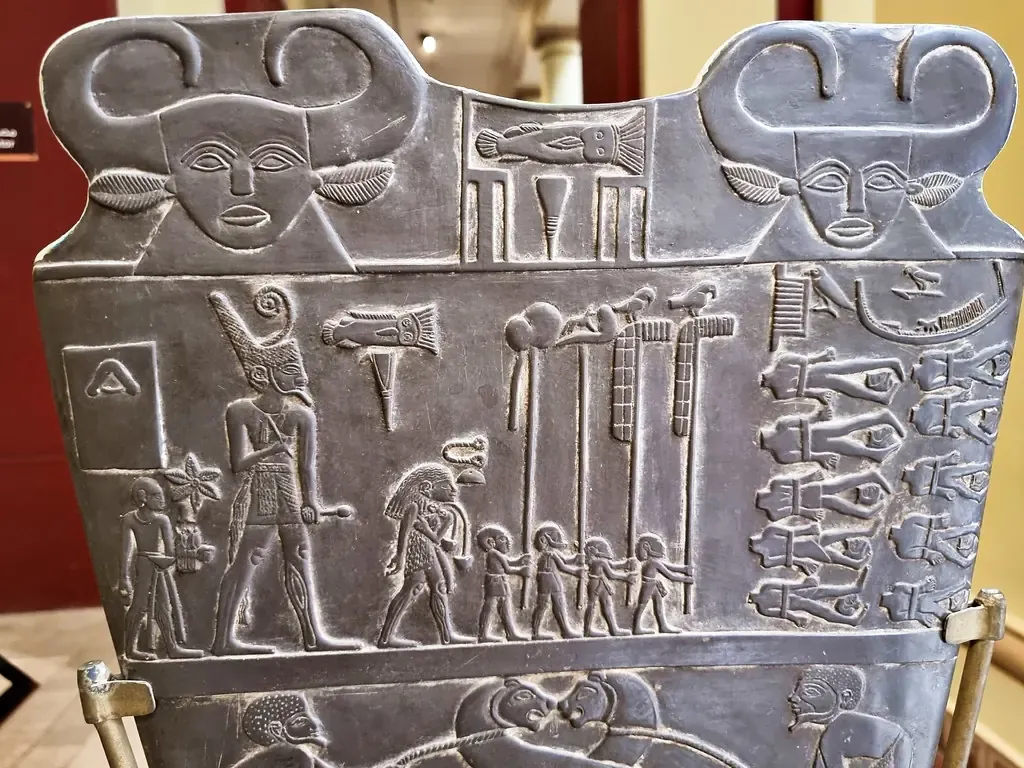
The key visual document for the unification of Egypt: King Narmer wears the White Crown of Upper Egypt on one face and the Red Crown of Lower Egypt on the other.
c. 3100 BCZoomable photographFamily viewing: NoCatalogue: JE 32169
Photograph: Prof. Mortel · CC BY 2.0 · Source
Held by: Egyptian Museum, Cairo · Catalogue JE 32169
The story
This shield shaped slab of siltstone, about 64 centimetres tall, was found at Hierakonpolis in the 1897-98 season and dates to the very start of pharaonic Egypt. On one face Narmer, wearing the tall White Crown of the south, raises his mace over a kneeling enemy while the falcon god Horus holds a captive by a rope through his nose. On the other face the same king wears the Red Crown of the north and walks in procession past rows of beheaded prisoners, while two long necked beasts below have their necks knotted together by attendants.
Palettes of this shape were grinding slabs for eye paint, but this one was made for a temple, not a dressing table. It is the earliest Egyptian royal monument of its scale, and it sets the grammar of Egyptian royal art for the next three thousand years: the king smiting his enemies, the gods watching, order imposed on chaos in registers of carved stone.
The record, not the myth
Whether it records a real campaign or a symbolic claim is debated. Narmer's place in the king lists, as Menes or as a predecessor, is still argued; the palette itself does not call him the first king of a united Egypt.
Sources
Image and model credits
- PhotographProf. Mortel · CC BY 2.0 · Source