
Artifacts · No. 3
Standard of Ur
The finest surviving picture of a Sumerian city at war and at feast: one face shows battle, the other a banquet, both in shell, lapis and red limestone mosaic.
c. 2600 BCZoomable photographFamily viewing: NoCatalogue: 1928,1010.3
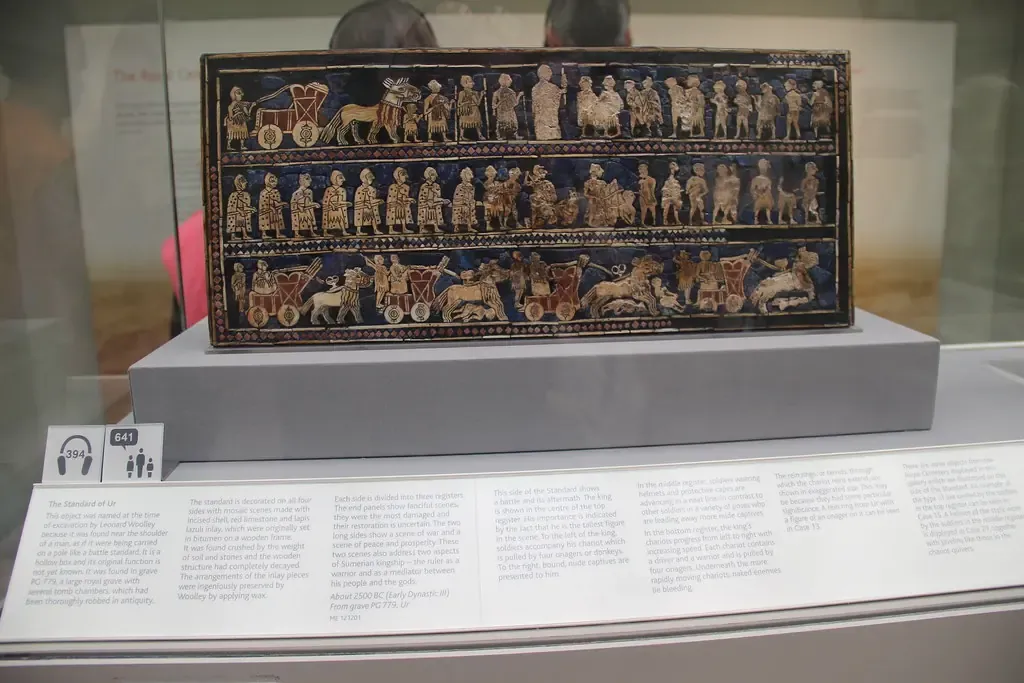
Photograph: Gary Lee Todd, Ph.D. · CC0 1.0 · Source
Held by: British Museum, London · Catalogue 1928,1010.3
The story
Leonard Woolley found this hollow wooden box in the Royal Cemetery at Ur in the 1920s, crushed flat, its mosaic of shell, lapis lazuli and red limestone scattered in the soil. His team lifted the pieces in wax and rebuilt the two great faces. One side is war: chariots with solid wheels trample the fallen, infantry in cloaks march prisoners forward, and the king, larger than any other figure, reviews the captives. The other side is peace: a banquet with lyre players and singers, and below it the city's wealth carried in, sheep, goats, fish, grain and jars.
The king sits at the centre of both faces, at war and at table, and that is the point of the object: kingship shown as victory abroad and provision at home. Woolley called it a battle standard carried on a pole. Nothing on it proves that use, and the name has stuck anyway.
The record, not the myth
Its function is unknown: battle standard, soundbox of a lyre, and games box have all been argued. The crushed state of the find also means the panel order was reconstructed, not observed.
Sources
Image and model credits
- PhotographGary Lee Todd, Ph.D. · CC0 1.0 · Source