
Artifacts · No. 27
Lycurgus Cup
A Roman cage cup of glass that changes colour with the light: green in daylight, blood red when lit from behind, thanks to gold and silver particles in the glass.
4th century ADZoomable photographFamily viewing: MildCatalogue: 1958,1202.1
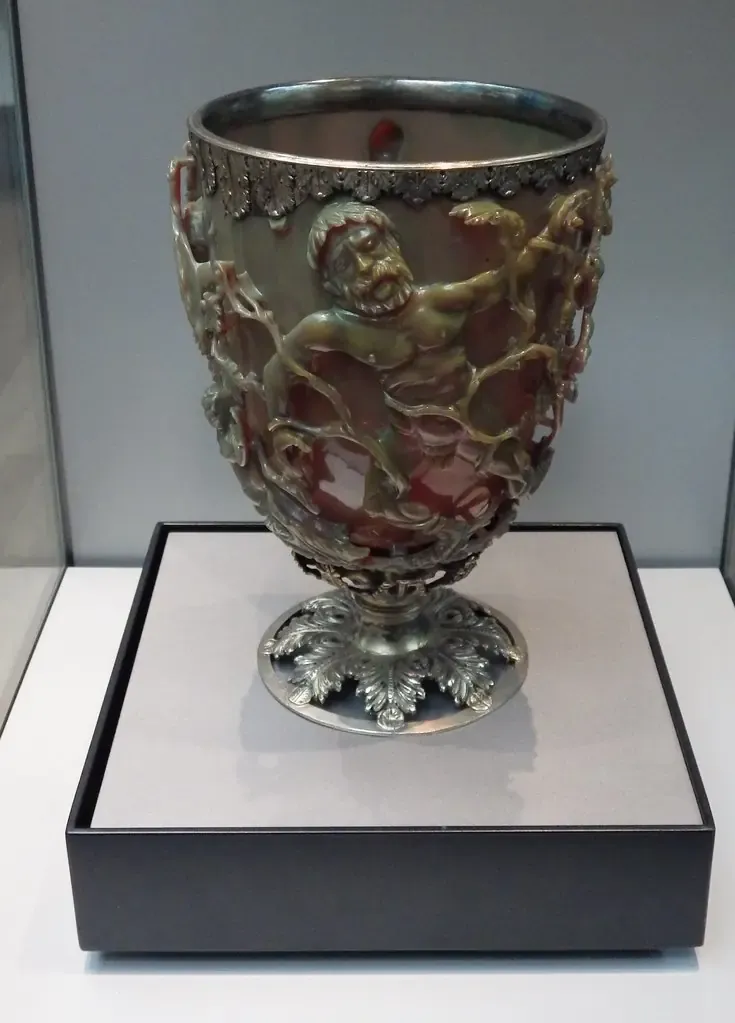
Photograph: puffin11uk · CC0 1.0 · Source
Held by: British Museum, London · Catalogue 1958,1202.1
The story
The cup is a diatretum, a cage cup, cut from a single thick blank of glass until the decoration stands free of the vessel, joined only by thin bridges. Its scene is the death of King Lycurgus, tangled in the vines of Dionysus. But the glass is the wonder: viewed in ordinary light it is jade green; put a light behind it and it turns red. Analysis in the 1990s found the cause, a dispersion of gold and silver nanoparticles in the glass, a few hundred atoms across, the same effect modern nanotechnology uses on purpose.
Whether the Roman glassworkers understood the recipe or hit it by a contaminated batch of glass is unknown; no other cup does it as strongly. It surfaced in the nineteenth century in the Rothschild collections and came to the British Museum in 1958, first on loan and then by purchase.
The record, not the myth
The colour change is real physics, measured and published, not a legend. The cup's ancient history before the Rothschilds is undocumented, and its foot and rim mounts are later additions.
Sources
Image and model credits
- Photographpuffin11uk · CC0 1.0 · Source