
Artifacts · No. 26
Gemma Augustea
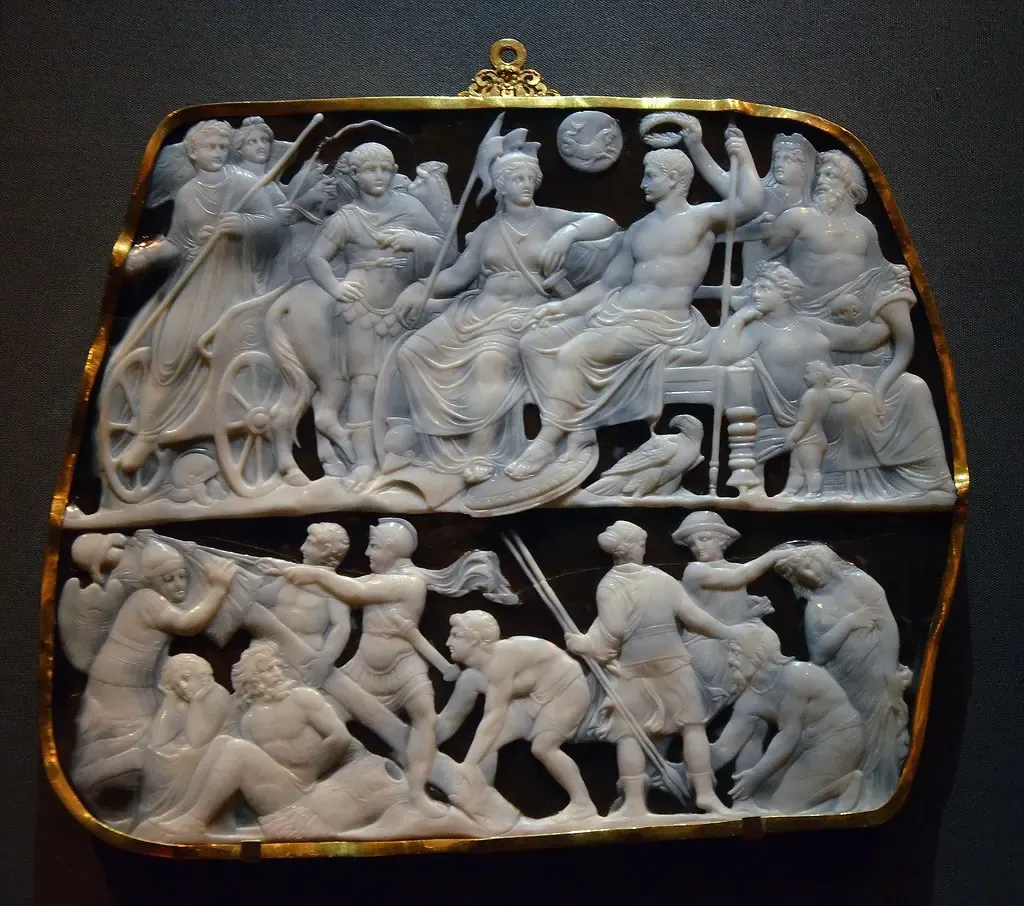
The largest cameo of the ancient world: Augustus enthroned as a god on earth in the upper register, his soldiers raising a trophy over barbarians below.
AD 9-12Zoomable photographFamily viewing: NoCatalogue: ANSA IXa 79
Photograph: Following Hadrian · CC BY-SA 2.0 · Source · The 3D model in circulation shows a plaster cast, not the stone, so this page carries a photograph of the original.
Held by: Kunsthistorisches Museum, Vienna · Catalogue ANSA IXa 79
The story
The Gemma Augustea is a dish sized cameo, about 19 by 23 centimetres, cut from a double layered Arabian onyx so the figures stand white against a dark ground. In the upper register Augustus sits enthroned in the pose of Jupiter, crowned by the personified World, with Roma beside him and the earth, ocean and plenty in attendance, while Tiberius steps down from his victory chariot. Below, Roman soldiers haul up a trophy as captives, a barbarian man and woman, wait under it.
It was cut at Augustus's court, probably by the gem carver Dioscurides or his circle, as a gift object for the imperial house itself: state theology small enough to hold in two hands. It passed through treasuries for two thousand years, was stolen from Vienna in the seventeenth century's wars and ransomed back, and is now the prize of the Kunsthistorisches Museum's coin and cameo cabinet.
The record, not the myth
The identifications of some figures are still argued, and the exact occasion, Tiberius's Pannonian or German triumph, is a judgement call. The stone is sardonyx, not the agate it is sometimes called.
Sources
Image and model credits
- PhotographFollowing Hadrian · CC BY-SA 2.0 · Source