
Artifacts · No. 18
Kleroterion (Allotment Machine)
The machine Athens used to choose its jurors by lot: a stone slab of token slots and a tube of black and white dice that made rigging a jury as hard as the city could manage.
2nd century BC (type in use from the 4th century BC)Zoomable photographFamily viewing: YesCatalogue: Agora I 3967
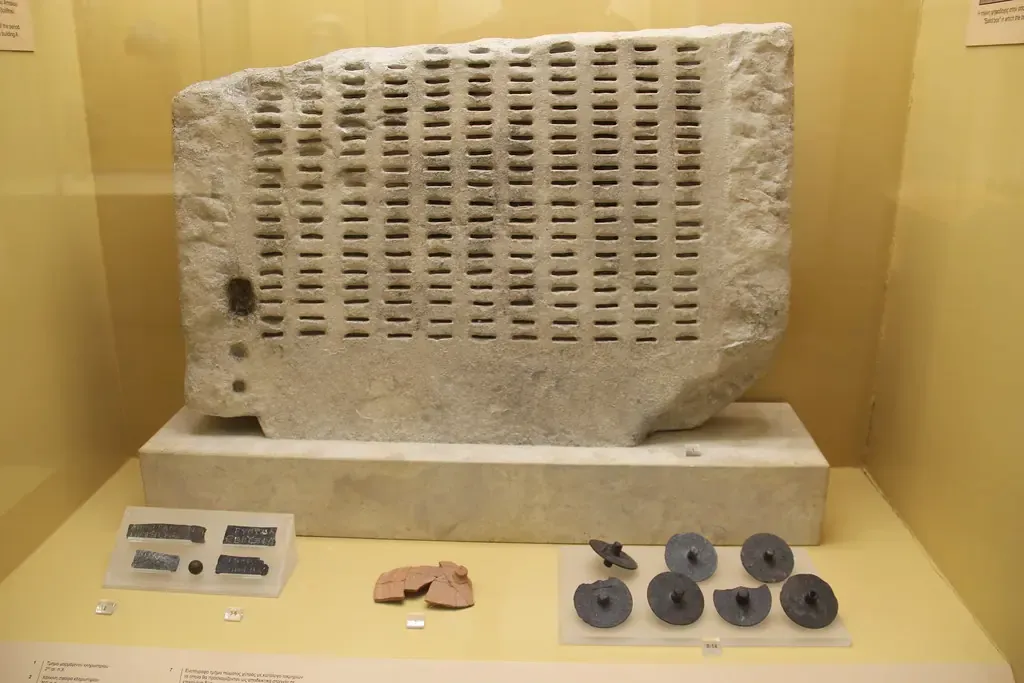
Photograph: Gary Lee Todd, Ph.D. · CC0 1.0 · Source
Held by: Agora Museum, Athens · Catalogue Agora I 3967
The story
Athens did not elect its jurors; it raffled them, every court day, in public. Citizens who wanted jury service carried bronze name plates, pinakia, and at dawn they fed them into the slots of a kleroterion, a tall stone slab in rows and columns. Down a tube at its side the operator dropped a mix of black and white bronze dice: a white die took the whole row whose plate sat in it, a black die rejected the row. No man chose who judged, and no litigant could know in the morning who would hear his case by noon.
Several kleroteria survive in fragments; the Agora Museum's, Agora I 3967, is the one on display in the Stoa of Attalos. The machine is the physical form of the Athenian claim that sortition, not election, was the truly democratic way to fill an office.
The record, not the myth
Aristotle's Constitution of the Athenians describes the procedure in detail, but the surviving stones are later than the classical democracy's peak, and details changed over the machine's long life. It chose jurors and some officials, never generals: Athens elected the men who could get it killed.
Sources
Image and model credits
- PhotographGary Lee Todd, Ph.D. · CC0 1.0 · Source