
Artifacts · No. 64
Jade Burial Suit of Prince Liu Sheng
A suit of 2,498 jade plaques sewn with gold wire, made to clothe a Han prince's body for eternity: the first complete jade suit ever found, from a tomb cut into a mountain.
113 BC (burial)Zoomable photographFamily viewing: Yes
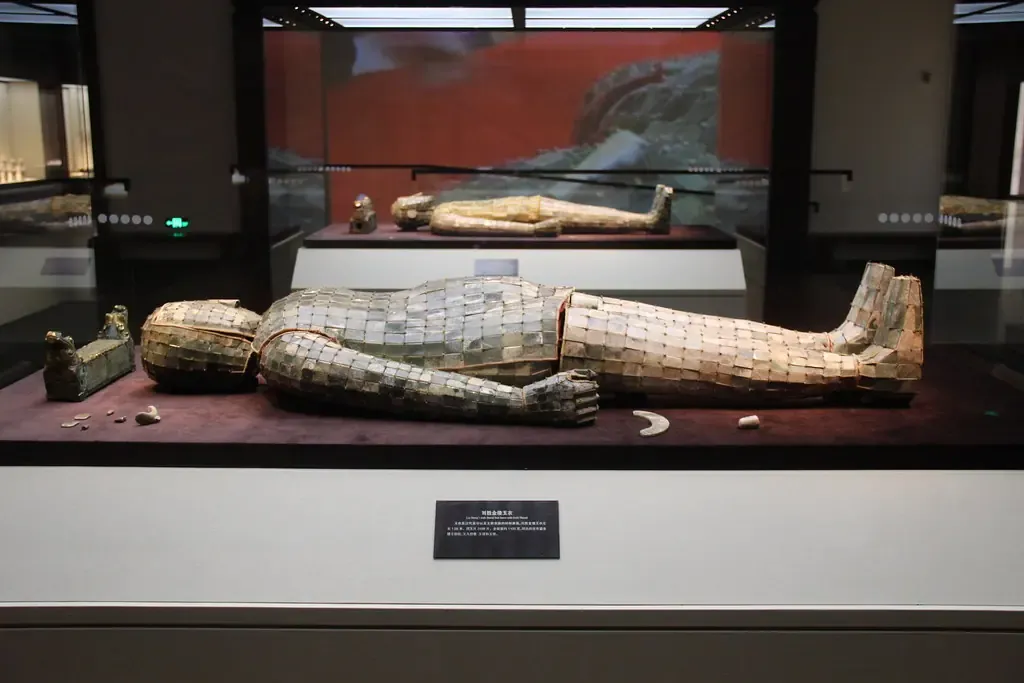
Photograph: Gary Lee Todd, Ph.D. · CC0 1.0 · Source
Held by: Hebei Museum, Shijiazhuang
The story
Liu Sheng, Prince Jing of Zhongshan, was a son of the Emperor Jing and half brother of the Emperor Wu, and when he died in 113 BC he was buried inside a hollowed mountain at Mancheng, in a palace of chambers with his wife Dou Wan beside him in her own tomb. Soldiers blasting in 1968 found the tombs untouched. On the prince's body lay the suit: 2,498 plaques of nephrite jade, each drilled at the corners and sewn to the next with gold wire, shaped to head, torso, arms, hands, legs and feet, a second skin of the stone the Han believed preserved the body from decay.
Texts said such suits existed, graded by thread: gold for princes, silver and copper below. Mancheng proved the texts plain fact. The suit took a decade's skilled work by the estimate of the museum that rebuilt it, plaque by plaque, in the years after the excavation.
The record, not the myth
The suits did not preserve the bodies, which had decayed inside them; the belief is documented, the result is archaeology. Liu Sheng's own reputation in the histories is of a prince who preferred wine and women to governing, which the tomb's luxury does nothing to contradict.
Sources
Image and model credits
- PhotographGary Lee Todd, Ph.D. · CC0 1.0 · Source
Continue on
Sword of GoujianFlying Horse of Gansu (Bronze Running Horse)