
Artifacts · No. 65
Flying Horse of Gansu (Bronze Running Horse)
A bronze horse at full gallop balanced on one hoof, and that hoof on a bird: the most famous Chinese bronze, and the emblem of China's tourism.
c. AD 186-219Zoomable photographFamily viewing: Yes
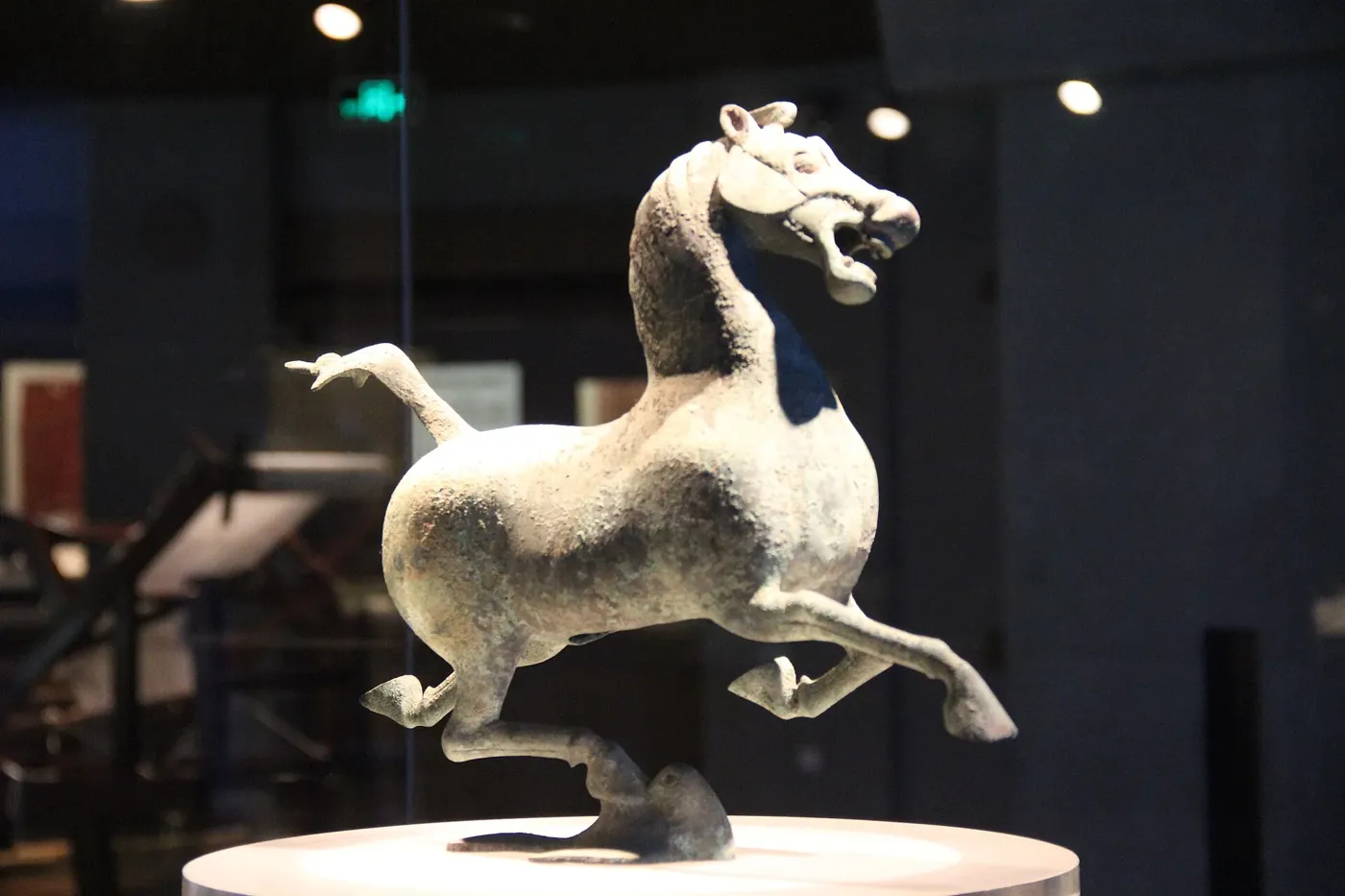
Photograph: Gary Todd from Xinzheng, China · CC0 · Source
Held by: Gansu Provincial Museum, Lanzhou
The story
The horse came out of a Han dynasty general's tomb at Leitai in Wuwei in 1969, at the head of a procession of bronze chariots and horsemen. It is caught at the flying gallop, three legs in the air, the fourth resting on the back of a small bird in flight, which is both the joke and the engineering: the bird spreads the weight so the whole bronze balances on a point. The horse's head is up, ears back, mouth open, a heavenly horse of the kind the Han emperors sent armies to Ferghana to obtain.
In 1983 China's tourism authority took the horse for its symbol, and it now stands at the head of every account of Han art. The bird under the hoof is usually called a swallow; on a close look it is more likely a falcon or a mythic swift bird, and the museum's own name for the piece, the Bronze Running Horse, avoids the question.
The record, not the myth
The swallow is probably not a swallow; the name Flying Horse Treading on a Swallow is a later romantic label. The horse's tomb owner is read as a general surnamed Zhang from the tomb's finds, not from an inscription on the horse.
Sources
Image and model credits
- PhotographGary Todd from Xinzheng, China · CC0 · Source